3 months ago
28
3 months ago
28
If you didn’t know otherwise, you might think Box Hill was abandoned. Not a single person was sighted in the north-west Sydney suburb on Saturday afternoon, the faces of real estate agents on billboards the only sign of human life.
The decision of residents to stay indoors was entirely reasonable. It felt like 55.2 degrees.
The air temperature at 3.37pm was 42.8 degrees, according to our measurements. But that metric doesn’t account for the wind, sun, humidity and other factors that affect how the human body processes heat. The more representative metric, the globe temperature, or “feels like”, painted a picture of a new suburb halfway to boiling point.
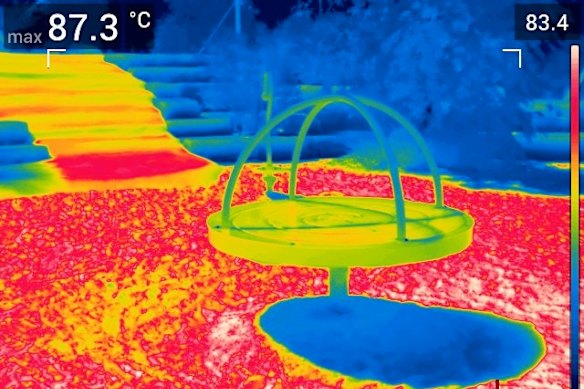
An infrared thermal image of Stargazing Park, Box Hill. The softfall was the hottest, with one point measuring 87 degrees.Credit: Max Mason-Hubers
So as Sydney sweltered through its hottest January day in six years, the Herald took two specialist weather measuring devices around the city’s west and north-west to see just how hot it felt. A heat stress tracker recorded the weather, and a thermal imaging camera revealed the heat on surfaces.
At the unshaded Stargazing Park playground, the northernmost point of the rapidly developing Box Hill, our camera showed the danger posed to anyone who would play on the space-themed equipment on such a day. The black softfall was 89 degrees. The blue version was 10 degrees cooler. The swing was 70, the cement 64.
Earlier at Penrith Beach, which was heaving with swimmers, our heat stress tracker recorded a conventional temperature at 12.36pm of 36.5 degrees. But it felt like 50.3 degrees.
At Schofields, peaking just before 5pm, 41.6 degrees was recorded, but the experienced heat was more than 10 degrees hotter at 52.1.
“The [device] takes into account the direct solar radiation,” said Sebastian Pfautsch, a heat researcher at Western Sydney University, whose equipment we used. “Once you cut [solar radiation] out, temperatures drop remarkably, 12, 13, 14, 15 degrees. That’s the importance of tree canopy shade. You’d be [up to] 15 degrees cooler if you had no direct radiation hitting you.”
That was true at a roadside park in nearby Angus, a new, mostly yet-to-be-developed suburb. The air temperature was 42.9 degrees. In the shade, it felt like 45.9 degrees. In the full sun, it felt like 53.7 degrees.
“That’s why we advocate so much for tree canopy in those new settlements, it’s just so uncomfortable and it becomes dangerous to be outside. It’s physically dangerous,” Pfautsch said.
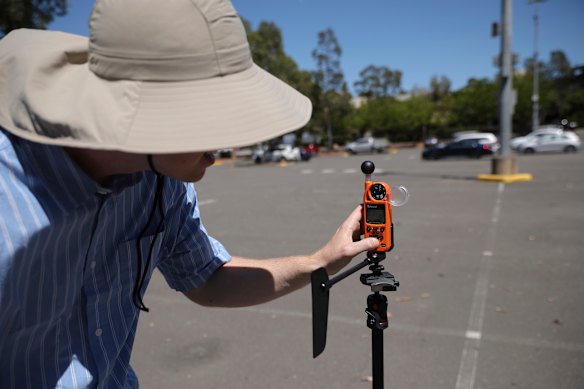
The heat stress tracker, pictured here in a Penrith carpark, recorded the air temperature as well as the “feels like” temperature.Credit: Max Mason-Hubers
Part of the reason Sydney’s west and north-west are so affected by the heat is geography: heat lingers around the base of the Blue Mountains, and cool coastal changes don’t reach so far inland. But it’s also a result of urban planning choices made over the past decades, and being made now.
Most of these developing suburbs are densely packed, with detached homes with black or dark roofs and few mature trees, contributing to the urban heat island effect.
Part of the problem in understanding heat in urban spaces is a lack of local weather data. “We are only looking at Bureau of Meteorology data, not the microclimate data,” Pfautsch said. The bureau’s weather stations are away from urban areas and are surrounded by metres of grass to meet international standards to ensure consistent figures around the world.
“In Box Hill, you’ve probably already had a four or five-day heatwave, but you don’t have that information because no one is telling you that.”
Loading
But Saturday’s temperatures were just the beginning of what these new suburbs will experience.
“This feels like an extreme day, but what happens in the future when this is a normal day?” asked Emma Bacon, the chief executive of Sweltering Cities, an advocacy group focused on urban heating.
“It feels scary and extreme, but it is going to become more and more normal, but we’re absolutely not ready for what it’s going to look like.”
Pfautsch is pushing for local governments to have their own sophisticated networks to measure local temperatures to communicate with local communities. “Without more targeted communication, you can’t prepare for the risk.”
Most Viewed in National
Loading