
Justice Arthur Engoron was walking his dog in the early morning darkness on Jan. 11, 2024, when he saw police lights in the distance, a lot of them. The New York Supreme Court judge realized they were descending on his home.
"There's been a credible bomb threat against your house. Is there anybody else in the house?" Engoron recalled a police lieutenant asking.
Yes, he replied, his wife and kids. He roused them. They walked away from the house in the cold winter air.
A few hours later, Engoron was in his courtroom, on the bench in front of the most famous and powerful defendant in U.S. history — Donald Trump. In a fitting finale to what had been a dramatic civil fraud trial, marked by near-daily shouting, hundreds upon hundreds of objections, and campaign antics, then-former President Trump went against the judge's instructions to deliver his own closing argument.
Now retired, Engoron sat down with CBS News for his first on-camera interview since the 2023 trial, reflecting on his career and the highs and lows of his moment in the spotlight. He sees a thread from that trial to the wider, harsh public discourse around judges today. It's an environment that led the U.S. Marshals Service recently to ask Congress for increased funds for federal judicial security, citing increased threats.
"I think that there will be some people that will be less inclined to become judges because the threat level has apparently increased," Engoron said. "Those are probably not the people that should be judges, though."
The early morning bomb threat was neither the first nor last threat Engoron received. He told CBS News he was subjected to a cascade of antisemitic and homophobic taunts, and sent an envelope with white powder. Engoron said he still gets harassing phone calls, and recounted a man walking up to him recently at his gym and calling him "a f—ing piece of s–t."
"Judges would know the primary rule: We cannot fight back," Engoron said. "That just goes with the territory. No matter what we're called."
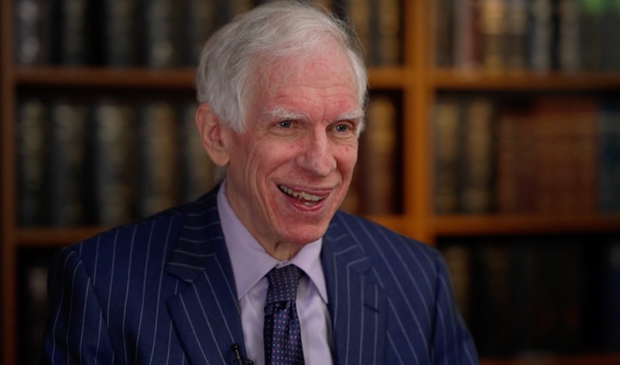 Arthur Engoron, the former judge who presided over President Trump's New York civil fraud trial.
CBS News
Arthur Engoron, the former judge who presided over President Trump's New York civil fraud trial.
CBS News
The quirky, wise-cracking judge really seemed to get under Mr. Trump's skin. The defendant frequently stepped just outside the courtroom, lambasting the case and Engoron. He and his supporters called the judge a "wack job," "lunatic," "deranged," "corrupt," "radical," and other derogatory names.
The judge never responded, but he drew a red line, which Mr. Trump violated: going after the judge's staff.
A court officer had to escort the judge's law clerk to and from her home after Mr. Trump repeatedly posted and talked about her, Engoron said.
"I sometimes say that law clerks are the greatest invention in the history of the world. They're just there to help … and we want to protect them because they can't protect themselves as much as we can," Engoron said. He added that "of course, it didn't affect my rulings, my thoughts about the case."
Engoron imposed a gag order on Mr. Trump that was replicated in two of Mr. Trump's criminal cases. The 77-year-old, who faced mandatory retirement from the judiciary at the end of last year, revealed that he never before had to bar a defendant from targeting his staff.
The Trump case elevated Engoron to a stature he hadn't experienced before or since, and he enjoyed the recognition.
"Just last night, somebody said, 'You were the most famous judge in America, for a while,'" Engoron said.
"Total strangers would walk up to me, look at me very sincerely and very seriously and say 'thank you.' That's all they would say. I knew what they were talking about," Engoron said, recounting being recognized by a ticket-taker on the Long Island Railroad, and even by Supreme Court Justice Sonia Sotomayor.
Engoron is now senior counsel at the Manhattan law firm Phillips Nizer LLP, but he misses the gavel.
"Being a judge is just the greatest job in the world. You get to help society. You get to set precedents. You get all this respect," Engoron said. "When people used to say, 'Your honor,' I would look around, like, who are they talking to? And then I'd realize it's me."
During Mr. Trump's trial, Engoron faced criticism from Trump allies who claimed he pandered to the media. New York Rep. Elise Stefanik said in a letter to the state's Commission on Judicial Conduct that Engoron "infamously smiled and posed for the cameras." One day, from the bench he instructed reporters on how to pronounce his name (En-GOR-on, not EN-gur-on). Another day he said he wanted reporters to note he "bounded" up the steps to the bench.
The criticisms, he said, "were silly."
"Had nothing to do with the trial. I bounded up the stairs to the bench because there's all these people waiting and I guess I was showing a little bit of enthusiasm. What do they call it? Hot-dogging," Engoron said.
There was plenty of hot-dogging to go around. Mr. Trump's team in particular was prone to long speeches and diatribes, and the judge rarely interrupted.
Engoron said he's "known as someone that lets people talk, that gives me more information."
And from a judge's perspective, there's a strategic element to that.
"Makes it less likely that I can be reversed, because the judge can be reversed for excluding evidence. And also they'll leave knowing that I considered everything. They had their day in court," Engoron said. "My staff would sometimes say, 'Come on, Judge, we've got to move on.' Nope, they can talk as long as they want."
Engoron's freewheeling approach to managing his courtroom was contrasted by his focused, scathing and serious written opinions, writing of evidence in the case, "the frauds found here leap off the page and shock the conscience."
"I wanted them to be no-nonsense. I didn't want to be criticized for not taking the case seriously. And I just wanted the facts and the law," Engoron said.
Engoron found Mr. Trump, his company and several of its executives — including Donald Trump Jr. and Eric Trump — liable for fraud before the trial even began. Once it was over, he sanctioned them about $350 million, a total that ballooned with interest to more than $500 million. An appeals court last year tossed out the financial penalty, but left in place the fraud finding. Both sides have further appealed. Mr. Trump asked the state's highest court in April to throw out the case completely, and James' office wants the financial penalty reinstated.
Engoron is following closely, but he's not concerned about how the appeals will affect his legacy.
"I had my moments of glory. I tried to do the right thing. I tried to be very even-handed when I made rulings. You don't count the rulings, but at the end of the day, I think I ruled for each side somewhat similarly, if it was quantified at all," Engoron said. "So it was a net positive. I was glad I got to do it."

















































