3 months ago
5
3 months ago
5
Opinion
November 18, 2025 — 3.37pm
November 18, 2025 — 3.37pm
On Wednesday afternoon at 2pm California time, the world is set to watch the most consequential announcement in equity markets this year. The globe’s largest company, Nvidia, will deliver its quarterly earnings.
Australian traders will have quaffed their first espressos of the day, with the big news breaking at Thursday 9am AEDT. And, as one analyst summed it up, on trading desks around the world “we will be able to hear a pin drop”.
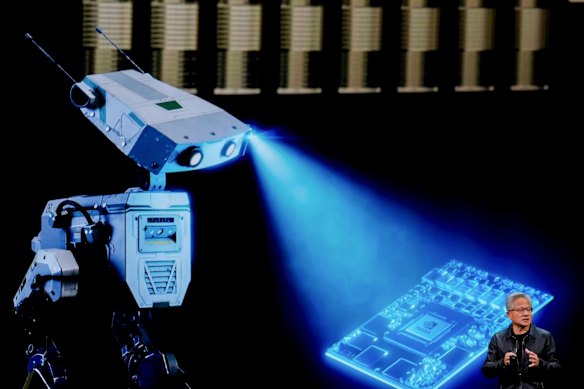
Chief executive Jensen Huang’s Nvidia last month became the first company to reach a $US5 trillion market valuation Much is riding on its continued growth.Credit: Bloomberg
Even Jerome Powell’s Federal Reserve rate decision in December is arguably less consequential.
Artificial intelligence is the engine room powering the US sharemarket, which in turn determines the fortunes of all stock markets around the world, including ours.
The result could go one of two ways.
If Nvidia disappoints, it may be a signal to the army of investors fretting about the AI bubble that their fears are justified.
This will cascade down to other tech stocks, whose share prices have been catapulted over recent months and years, and shift the overall US stock market down a gear.
The trouble is Nvidia will find it difficult to live up to profit expectations for its September quarter because expectations have become unrealistic.
That red flag will be flapping wildly for those AI bears who have been coming out of hibernation and questioning the valuations of the big AI tech stocks.
The trouble is Nvidia will find it difficult to live up to profit expectations for its September quarter because expectations have become unrealistic. In the past, even when Nvidia has hit it out of the park in earnings or even forecasts, the sharemarket response has been muted.
Nvidia’s earnings are always a big event because the chipmaker is seen as a bellwether for AI and the trillion-dollar giants that dominate it.
Loading
But Wednesday’s announcement is even more important because the chorus of AI valuation detractors is getting louder, and the size of the bets on the bubble bursting is growing.
Within that chorus, Michael Burry, who predicted the global financial crisis and was a central character in Michael Lewis’ book on those events, The Big Short, has become a soloist, taking big bets on Nvidia’s share price falling from the stratosphere.
If Nvidia does manage to outdo even the most bullish of expectations, investors like Burry, who have shorted the stock (betting the share price will fall), will feel the financial pain.
But not everyone is predicting Nvidia is headed for a fall. One of the loudest bulls, US-based Wedbush analyst Dan Ives, is anticipating its result will crush the detractors.
“While the bears will continue to yell ‘AI bubble’ from their hibernation caves, we continue to point to this tech cap-ex supercycle that is driving this 4th industrial revolution into the next few years,” he said in a note to investors last week.
To be fair, those who believe AI is trading in a bubble of overvaluation are not in artificial intelligence denial, they are just concerned about the extent of the frenzy.
There are a couple of reasons AI has been creating deeper furrowed brows of late. First is the hundreds of billions of dollars the big AI players are spending on capital expenditure - amounts that balloon each time they update the market.
Loading
This fear has been exacerbated by the need to fund this expenditure using debt (most often through issuing corporate bonds), rather than from cash flow.
The second risk emerging is the rise of second-tier companies with a more speculative business case that are cashing in on the AI fashion.
I would argue that the big players like Nvidia (which provides the chips for the technology) and the hyper-scalers like Microsoft, Google and Amazon are the major foundational pillars of the AI industrial revolution, and worthy of their investment attention.
Smaller start-ups that offer specialist AI applications or services are a riskier bet, but some are being valued in billions of dollars, despite the reality that many won’t survive.
This hype is often a feature of a new wave of technology - but many of these newer companies are riding the wave, not creating it.
Loading
It is this rush of new companies with unproven products hanging off the AI banner that give the market a feeling of 2000 dotcom deja vu.
Sensible analysis will look through the hype and the hangers-on, and take a broader look at the demand for AI across industry and for all consumers, and the extent to which it will become an entrenched part of our lives, like the internet or mobile communications.
Given generative AI is still relatively new, most people – including investors, analysts and commentators – can’t fully answer this question.
However, the big AI companies involved in this ecosystem that are spending hundreds of billions of dollars developing it don’t believe their capital will go down the gurgler.
All we can do is put a date in the calendar for Nvidia, and set the alarm clock.
The Market Recap newsletter is a wrap of the day’s trading. Get it each weekday afternoon.
Most Viewed in Business
Loading