
 4 months ago
90
4 months ago
90
Adam Scott can recall the exact moment he realised there was something a bit special about Hokum, the genuinely scary and delightfully old-fashioned horror movie he shot in Cork, in the south-west of Ireland, with writer-director Damian McCarthy.
“It’s that feeling like, ‘Jesus Christ, why are you doing this to me?’” he says of the spine-tingling sensation that signals the scare has landed just as the filmmakers intended. “It’s such a thrilling feeling.”
Scott got that feeling when he was in the audio booth, rerecording dialogue for a scene in which his character is alone in the honeymoon suite of a remote hotel when the ghost of his dead mother appears behind him.
Though he was well aware the actor had been present in the room when the scene was shot, “I was just scared shitless in the moment watching myself,” he says. “I was like, ‘Oh, wow, I think we’ve really got something here’ – because I’m in the thing, and it just scared the bejesus out of me.”
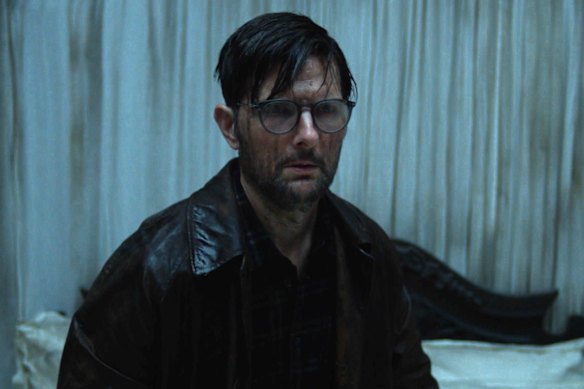
In the likes of Parks and Recreation, Big Little Lies and Severance, Scott has played largely likeable characters, often the voice of sanity amid all-consuming chaos. But in Hokum, he leans the other way.
His Ohm Bauman is a successful American novelist, visiting the scene of his parents’ honeymoon to scatter their ashes, though he can’t for the life of him figure out why. He’s a misanthrope, though he doesn’t like himself much better than anyone else. He’s carrying deep psychological trauma. And he’s struggling with the ending of his latest work, an adventure tale about a conquistador lost in the desert.
The character’s name – Ohm is a unit of resistance to electrical currents, Bauman is German for farmer – is unusual enough to arouse suspicion that it must have some meaning. So, Adam, any clues?
“That would be a question for Damian,” he says. “I remember asking him about it, but if he let me in on it, I’ve completely forgotten. I think he just wanted there to be an unusual-sounding name for this prickly character.”
As it happens, I’ve got the writer-director on the line to elucidate.
“It has everything to do with resistance,” says McCarthy, whose third feature this is (and the first with Hollywood backing). “The character is filled with resistance – to getting help, to facing his past, to letting down his guard, to believing in things he considers hokum.”
There’s a personal connection, too: before he pursued his dreams of making movies, McCarthy worked as an electrician.
“While it’s a great job, I never liked it that much and never would have been a successful electrician,” he says. “I know I wouldn’t have been a happy one.”
But because very few filmmakers succeed, he adds, “I was always worried about having to go back to my old job – so Ohm, the protagonist of my third feature film, was like my nod to that resistance. My own electrical resistance.”
When the screenplay for Hokum landed in his inbox, Scott was immediately interested because he knew and loved McCarthy’s earlier film Oddity.
“I was fascinated by the way he made inanimate objects terrifying by just sitting with them,” he says of the Irishman’s second film, a supernatural thriller in which a carved wooden doll – a golem – plays a central role. “He would have these shots of inanimate objects for an uncomfortable time, and he would make the viewer sit and look at these objects that shouldn’t be frightening because they’re just sitting there and they’re not alive, but he was able to make them frightening and to elicit a reaction from your imagination that’s pretty powerful. For me, he was a filmmaker who is kind of pushing me as an audience member in a new direction.”
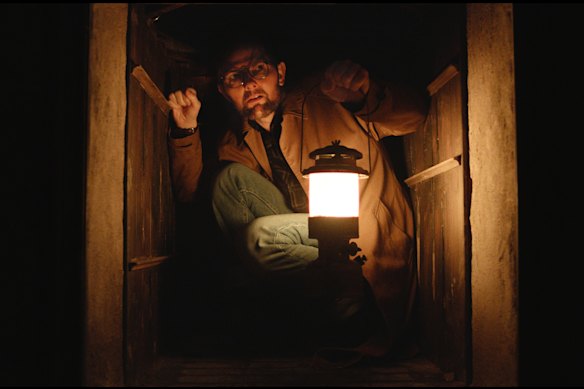
He loved the character McCarthy had written, too, the fact that Bauman is a “prickly” guy when we first meet him – “I mean, he’s beyond prickly, he’s just kind of an asshole” – and the story then follows his character arc backwards to reveal why he is that way.
“It’s not so much a redemption story as it is someone being forced into a corner to reckon with their past,” says Scott. “I just thought it was an interesting place to start, and a really fascinating place to end, and the way he gets from one place to the other was new territory for me.”
McCarthy is delighted with the way Scott brought Bauman to life. “He was brave in that he never pushed to make the character more likeable or heroic [early on],” he says. “He was into the idea that this is a guy who needs to push the audience away and then win them back, which I don’t think every actor would be willing to do.”
He did not, though, write the part with Scott in mind.
“The job of a director is to have a vision for the film, and if that vision is built around an actor who isn’t interested it can be a bad start, as the vision for the film is already collapsing.”
But once he’d finished the script, he did turn his mind to the cast. “And I was watching Severance at the time, and absolutely loved it, so when I started storyboarding and thinking about how I was going to film certain scenes, Adam kept coming to mind. I had always been a fan of his. He has this wonderful confidence on screen, and I always found he had a bit of an edge to him, even when he plays nice guys.”
He’s played darker characters in the past too, but they’ve tended to be smaller roles. Here, Scott got to lean into that aspect, and it was exhilarating.
“It is nice to switch,” he says. “I’m always looking for something that’s a little different than what I’ve been doing lately, and this was an opportunity to luxuriate in [an unpleasant character] a little bit. We got to dig in and really find out the causes for his behaviour. It was great to have an opportunity to paint more of a full picture.”
There’s one particularly memorable scene in which a bellhop at the hotel introduces himself to Bauman as he’s having a quiet drink at the bar. “I’m a writer,” the bellhop tells him, asking if Bauman might take a look at his manuscript. Bauman declines, but when the bellhop refuses to take the hint, the American heats a teaspoon in a candle then touches it to the intruder’s hand, burning him.
That wasn’t so hard to play, says Scott. “For my character, he’s doing nothing wrong,” he says. “This is what this person deserves. He hasn’t taken a series of hints; what’s it going to take to get rid of this guy? He was having a pleasant time right up until he walks up and starts asking inane questions, so it’s time to burn his hand.”
In Bauman’s own mind, his behaviour “is completely on the level and totally reasonable”.
What about Adam Scott in the real world – should overeager fans be wearing tungsten gloves if they intend saying hello in the neighbourhood wine bar?
“Oh, you know, people are friendly,” he says. “I’ve been very lucky that anyone who’s wanted to come up and talk to me has always been kind.”

It must be hard to maintain a sense of private space in the public domain when you reach a certain level of fame, though, right?
“It’s a bit of a frog-in-boiling-water thing,” he says. “It had gradually been building up, and then I guess it was around 10 to 12 years ago when I started on Parks and Rec, a network show that was in people’s homes every week, that really changed the experience of going out into the world. And then it intensified when Severance came around, it just widened the amount of people who come up. So, you know, it’s been a gradual thing, and I’m so used to it I probably don’t even really register it. It’s just a part of being out in the world now.”
Speaking of Severance, what’s your take on why the show has become such a phenomenon?
“I’m so on the inside of it, so it’s hard to really have perspective as to why exactly that is, but I think when season one came around, at the beginning of 2022, we were just coming out of all the isolation of the pandemic and a lot of people working at home and just starting to get back into the habit of going back to the office, so a show that was about cutting yourself off from the world and going into work – or cutting yourself off from work and going back out into the world – just seemed to strike a chord.
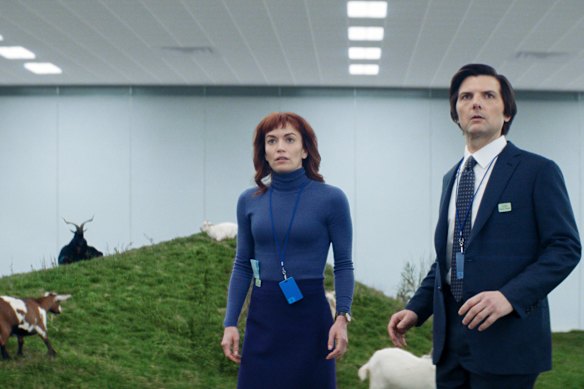
“Some of it was timing. And I think there’s a lot of isolated feelings out there – I certainly share that with the rest of the world,” he continues. “It’s a curious time when technology suddenly has such a prevalent place in all of our lives. And I think at its core, Dan Erickson just had a really good, simple idea, like a great Twilight Zone episode or something that is just really sticky and kind of sparks the imagination and is just a lot of fun. And like all great ideas like that, it leaves open myriad possibilities of stories and characters.”
Scott admits it wasn’t until people started watching and talking about the show that he realised there was an audience for Severance, the third season of which he is about to start shooting.
“We loved making the show, and we love the show itself, but we all thought it would probably be too weird for people,” he says. “I thought people were just going to make fun of us because it’s a big swing. So we’re all still just relieved and so happy that people have connected with it.”
Hokum is in cinemas from April 30. Severance is on Apple TV+
Must-see movies, interviews and all the latest from the world of film delivered to your inbox. Sign up for our Screening Room newsletter.

















































