3 months ago
61
3 months ago
61
Weighing a life as sprawling as Barry Jones’ is no simple task – least of all for the man himself.
At 93, with what he calls an eye on “the exit ramp”, Jones is not inclined to dwell on the accolades. After decades at the front line of politics and ideas, he knows he mightn’t be around much longer. What matters to him now is not what he has done, but what endures – and what has been left undone.
“I’m preoccupied with what hasn’t been achieved,” he says.
It is a disarming starting point for a figure whose career has few parallels in Australian public life. Long before he entered parliament, Jones was a household name as the brilliant TV quiz show champion of Pick-a-Box – a polymath whose recall dazzled audiences.
But even then, knowledge was only part of the story.
“I’m always interested in making linkages,” says Jones, one of the National Trust’s Australian Living Treasures.
“I can see patterns. I can see relationships between things somehow which other people haven’t.”
That instinct – to connect ideas, to think across disciplines and timeframes – became the defining thread of his career. It took him from high school teacher in Melbourne’s working-class suburbs to pioneering talkback radio host, to state politics, into federal parliament, into cabinet as science minister under Bob Hawke, to the presidency of the Australian Labor Party, and onto the global stage through UNESCO and the World Heritage Committee.
In September last year, Jones suffered a “ridiculous fall” at home in Melbourne, with a “three-point landing”.
“I hit my head, right buttock and base of spine,” he says. What followed was 40 days in a Melbourne hospital and respite care. In a piece for The Saturday Paper, penned while recuperating, he said his leg “had done an Optus”.
“The lines of communication were cut and I could no longer walk. My life changed forever.”
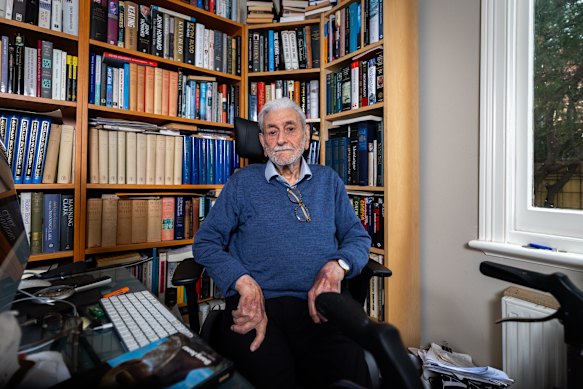
He’s now home and recovering, but frail. His famous mind, however, is sharp as ever. Among those to debate the world by his hospital bed were Nobel Laureate Peter Doherty, philosopher Rai Gaita, ex-prime minister Malcolm Turnbull, climate campaigner and political disruptor Simon Holmes a Court, ex-union boss Bill Kelty, former media executive Ranald Macdonald, teal MP Monique Ryan and champions of the arts such as Jill Smith and Ralph and Ruth Renard.
He’s keeping a close eye on the rise of Queensland senator Pauline Hanson and of growing anti-immigration sentiment. His stint in respite care sharpened his view in a way no policy paper could.
Of his 21 nurses while in care, only two were “Anglo”, he says. The other 19 were Nepalese, Hong Kongers, Indonesian or Somali heritage.
“If we didn’t have them, we’d be in diabolical trouble,” he says. “I will be increasingly dependent on that kind of skill.”
“You can’t look at the whole question of [immigration], whether it’s good or bad, have a particular fixed number of people coming in, before you make a decision about how many people you want, like me, living on into their 90s.”
The experience reinforces his long-held belief that Australia’s future depends on its ability to remain open – even as politics often drifts in the opposite direction. He fears too many people have picked up one of US President Donald Trump’s observations that empathy is “a very bad word”.
“Empathy means ‘weakness’,” he says. “If you think about somebody else’s interest rather than just your own, then you’re ‘weak’ in the situation. It’s quite troubling.”
Jones’ renowned curiosity has placed him at unlikely intersections of history.
He has “known or met” every Australian prime minister since Robert Menzies’ first stint in office in 1939, “give or take a few”. A chance meeting with Dame Patti Menzies in a suburban supermarket led to a friendship and many long conversations with her husband. The recordings remain in Jones’ vast personal archives.
A close friendship with Malcolm Fraser nearly created a new political party. He missed a chance to chat with Scott Morrison at the funeral of former Nationals leader Tim Fischer, but he can boast Billy Hughes, Australia’s seventh prime minister, on the list.
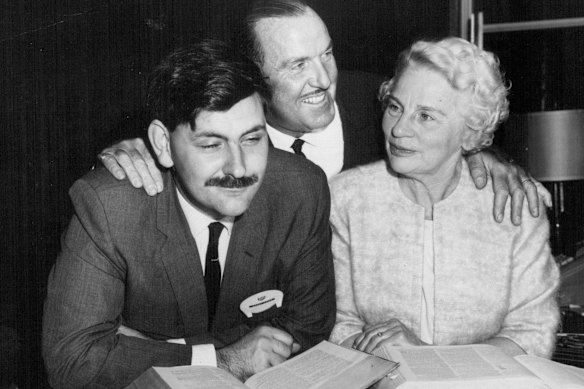
What was Hughes like, I ask. “Doddery, but interesting,” he replies. “Of course, he wrecked every party he joined.”
Hughes – the fiery wartime leader – was still in parliament when Jones encountered him, a living relic of an earlier political age. Decades later, in a collapsing Soviet system, Jones would meet another figure who at the time seemed entirely unremarkable.
He’d joined former foreign minister Gareth Evans to meet with St Petersburg mayor Anatoly Sobchak in 1990 but when the pair arrived, they were greeted by his assistant.
“Mr Putin will represent him instead,” Jones recalls being told. “This sort of colourless figure came in and we sort of looked at our watches and thought, ‘Oh, God, how long we’re going to sit here talking to him?’ We sort of waved him off after a while and thought, well, that’s the last we’ll ever see of him.”
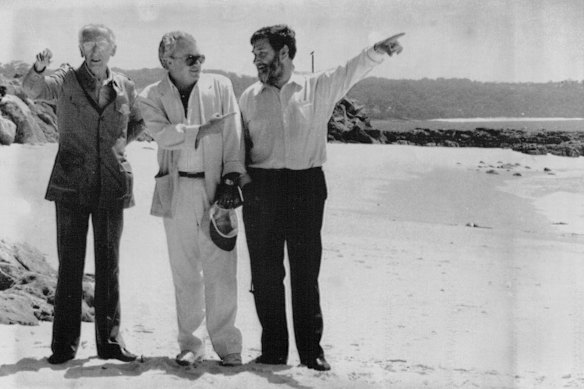
He pauses, almost amused by the memory.
“Well, we couldn’t have been more wrong.”
From Hughes to Vladimir Putin – an “odd couple” that captures the sweep of Jones’ life as both participant and observer. If there is a consistent theme, it is foresight.
He pioneered the campaign for homosexual rights and successfully advocated for the abolition of the death penalty as an MP in the Victorian parliament in the 1970s. He also dedicated much of his career to reviving the Australian film industry and preserving Antarctica from the threats of mining.
Hansard, the official transcript of federal parliament, shows Jones was the first person to speak of pending climate change. He spoke early about artificial intelligence, the genetic revolution and the implications of an ageing population – often decades before those ideas entered mainstream debate.
“Climate change was one of those things that drove a lot of my colleagues mad,” he says.
He had been thinking about it since the 1960s. But as he would discover, foresight rarely aligns with political incentives.
“I would say to Bob Hawke: ‘Look, we’ve got to take the issue of climate change seriously’,” he recalls. “And he’d say, ‘but when’s the impact going to be seen at its worst?’
“And you think, well, it might be another 25 years and he’d reply: ‘Well, you come back to me sometime later, before the 25 years is up, and we’ll do something about it, but I’ve got a problem this week’.”
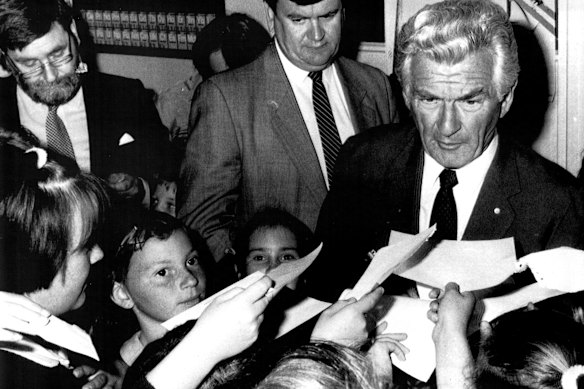
That exchange has stayed with him – a shorthand for the dominance of short-term thinking.
“I think it’s horrible,” Jones says of modern politics. “We don’t have debates any more.”
His assessment of Anthony Albanese is careful, but telling. He has a “very interesting mind”, Jones says, is “extremely diligent” with “a mastery of detail”.
But in Jones’ telling, those qualities have not always translated into the kind of political courage required to act on issues such as gambling reform – where he says the case for change is overwhelming, but the politics might be hard.
This is where he grumbles about the Albanese government’s lack of ambition. Jones points to the landmark inquiry led by the late Peta Murphy, which laid bare the social harm caused by gambling, and proposed sweeping changes.
“It’s an outstanding report,” he says. “But in fact, it’s been marginalised.”
The consequences, he argues, are visible in communities across the country.
“You’ve got people who are destitute, who then become suicidal, absolutely violent with their families,” he says.
“There’s an extraordinary amount of spending in it, and that’s indefensible. Our lack of social responsibility over gambling is simply appalling.”
In the days after this interview took place, Albanese announced several new measures to address issues raised in the report, including further restrictions in gambling advertising, but critics still believe the changes are wholly unsatisfactory.
Jones worries that Albanese has been too fixated about breaking promises from his days in opposition, such as with capital gains tax concessions and negative gearing. He also can’t understand why Albanese has “pushed aside” raw talent on his frontbench like his long-time friend, Tanya Plibersek.
“There’s some areas that I’d like to see him more interested in – in some of those quality-of-life areas. I wish he was much more interested in the arts, in heritage, in the preservation of great Australian places.”
Jones also laments the lack of Labor figures in the modern era, such as Whitlam-era minister Clyde Cameron, a former shearer and head of the Australian Workers Union.
“No tertiary education at all, but ferociously well-read. If people said, Clyde Cameron’s going to be up at eight o’clock, the House would be full because we knew there’d be a very lively, a very interesting, very challenging debate.”
“Now you think, well, who’s the equivalent of the Labor side of Clyde Cameron? I don’t know.”
Jones speaks of a parliament that once thrived on argument and intellect, where figures could hold the chamber with force of ideas alone. Now, he says, the system is thinner, more transactional, more cautious – shaped by money, factional deals and a relentless focus on the immediate.
And yet, even in his critique, Jones draws careful distinctions. Australia, he insists, still gets some things right.
“We take for granted the way in which we run clean elections,” he says, pointing to the independence of electoral authorities and the culture of compulsory participation.
But where the system falters, he argues, is where courage is required.
For a man now measuring time differently, those missed moments loom large. The climate warnings that came too early, the reforms that stalled, the debates that never happened.
Cut through the noise of federal politics with news, views and expert analysis. Subscribers can sign up to our weekly Inside Politics newsletter