3 months ago
18
3 months ago
18
What a remarkable thing it must have been, to hear recorded voices for the first time. You see it in The History of Sound, when young music students David and Lionel go into the houses of simple people in the backblocks of New England and ask them to sing into a microphone, recording them on the wax cylinders recently developed by Thomas Edison.
At first, there is confusion, then suspicion, then wonder. There is a sense of importance as people commit their voices to the machine. There is joy, too, that an overlooked culture is being heard, along with an undercurrent of melancholy for what has been lost. We feel it too, watching these eager young men, in love with each other but unable to name the feeling. The First World War has just begun. There is a great deal more loss to come.
Lionel (Paul Mescal) and David (Josh O’Connor) meet as students at the conservatorium in Boston, where they find themselves singing tragic folk songs together at the piano in the student bar. As their relationship intensifies, neither is seemingly conflicted about being in love with another man, at least as long as they don’t have to make decisions about it. They are neither repressed nor determined to come out.
“This felt like a spell to me, this relationship,” says O’Connor. “Paul and I were friends before we made the film, so there was a lot of love between us anyway.”
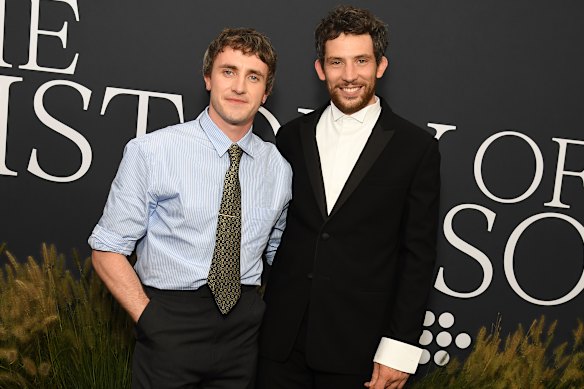
Paul Mescal and Josh O’Connor at the New York premiere of The History of Sound.Credit: Kristina Bumphrey
The film’s poignancy comes from the pair’s carelessness with each other. At the end of their research tour, David asks what Lionel plans to do next with his life. It is a heartbreaking moment.
“That’s a moment where you feel society has informed David’s patterns of communication in a way it hasn’t Lionel’s,” says Mescal. “He understands that they’re probably most likely not going to move in together, but he’s assuming they’re going to continue in some capacity. So it’s confusing for him, because he’s being confronted with a society that he doesn’t feel like he’s living with. He probably comes from a more conservative background than I would say David does, yet he still manages to feel more modern to me.”
Lionel, a Kentucky farm boy whose father played fiddle on the porch after a day in the field, has the special gift of seeing music as colour which, in a sense, the film does too.
The film is based on a short story by Ben Shattuck, who also wrote the script. Like Lionel, he grew up on a remote farm, where traditional music was as much part of life as getting in the hay. “I listened to fiddle music and was contra dancing by the time I was seven or eight; I played banjo,” Shattuck says via Zoom. “Whenever I’d be in a car with friends and they’d put on pop music, it would just sound like a wash of static to me. But then when I’d hear a reel of some Appalachian music, it sounded like the first real music. Who knows why that happens?”
It was the emotive power of music to evoke the past that provided the spark for the love story. “The story began with the idea that somebody would receive a message or sound from earlier in their life that would puncture their whole sense of their past,” Shattuck says. “Sound and music can elicit profound emotions – and one of the most abstract, profound, troubling emotions can be regret. That type of universal regret, that feeling of missing out, can be really pinned to love in your early 20s. So I had this idea in my mind that music and sound and early love would be all tied together.”
Mescal says he responded to that idea immediately. “I feel art in general is an amazing access point [to feeling],” he says. “Because sometimes it’s the lyrics that move me, sometimes it’s just about the sound in my ear that makes me want to run faster or dance or I listen to a song when I’m falling in love with somebody. Experiencing music isn’t cerebral; it can take you straight to the centre of a feeling. I can try to describe a scene to [director Oliver Hermanus], or I might say instead that I think the scene is like this song. And then it makes sense and you can just skip the noise of words.”
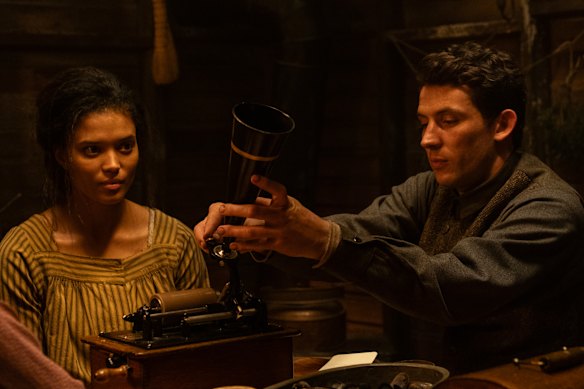
Briana Middleton and Josh O’Connor in The History of Sound.Credit: Universal Films
David devises their research project, which involves weeks of walking through woods, farms and settlements, camping along the way. “He creates this adventure out of love for Lionel,” says O’Connor. “He’s making this gap in time and filling it for the two of them, curating a space and time for just them. But I think David is naturally concerned with other people’s experiences and other people’s stories. It’s not just about collecting these songs; it’s about understanding communities and understanding other people’s experiences in the world.”
Loading
O’Connor’s David confronts the intensity of the relationship with avoidance, glossing over their situation by avoiding putting it into words, offering and then withholding love, parrying genuine emotion with a shield of genial bonhomie. He isn’t going to explain himself, but his face can convey several layers of feeling at once.
“In the world of characters in a film, that’s the dream,” O’Connor says. “The thing that makes a character interesting – and why film is so powerful – is you can tell so much with just your thoughts and the camera picks those things up, in a way you couldn’t on stage. In every interaction in this movie, there is something else happening beneath that is unspoken.”
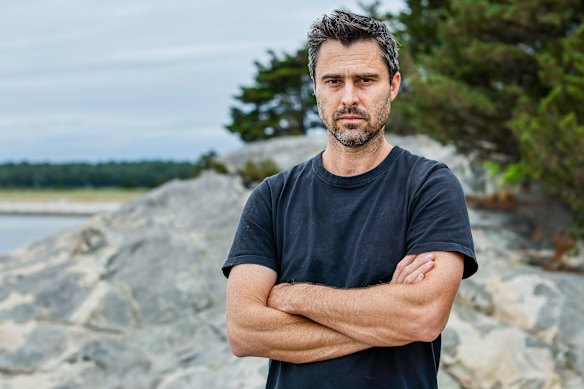
Writer Ben Shattuck: ″I had this idea in my mind that music and sound and early love would be all tied together.″Credit: Boston Globe via Getty Images
Shattuck says he didn’t want to package the relationship “in a way that we have seen before and that we understand”.
“Because anybody who has been in a relationship in any capacity knows it takes a thousand forms. I was interested to explore a relationship in which the language of what is going on between the two characters exists just a degree or two to the left or right of what is actually happening.”
It is only six years since Paul Mescal leapt to stardom in the television adaptation of Sally Rooney’s Normal People, but he is such an intimate, confiding actor that it can feel that he has been always with us. Over that time, he has brought that quiet intensity to the depressed young father in Aftersun, the lonely addict in All of Us Strangers and the bereaved Bard in the forthcoming Hamnet.
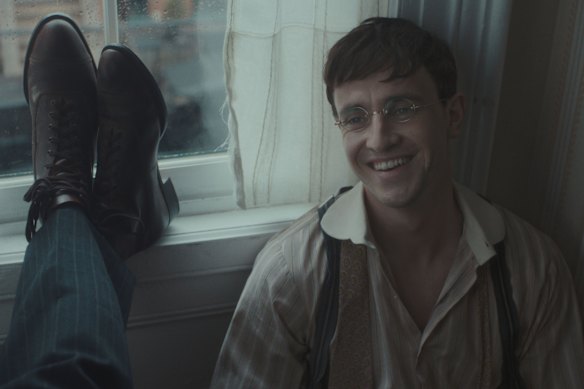
Paul Mescal in The History of Sound.Credit: Universal Films
In an interview with Harper’s Bazaar, Mescal acknowledged being drawn to characters with ravaged emotions. “I do think that both Josh and myself are ‘inside-out’ actors, if it makes sense,” he said. “I can only really draw from the work that I admire and from what I want to communicate. I love my life. I’m happier now than I have been … But I think that for young people today, and a lot of my peers and friends, life can be f---ing hard. And that’s my way into my work. I don’t think the characters I play are truly an accurate reflection of how I walk around day to day, but sometimes they’re close.”
Loading
That so much is unspoken is a rich irony in a film about sound, but that irony is at the heart of the story. Thomas Edison invented the phonograph in 1877; by 1908, he had developed wax cylinders that recorded for four minutes. “It was the only one of his inventions that just worked from the imagination to the drawing board to the mock-up,” says Shattuck. “It was as if he received a transmission from the divine.”
Edison, uninclined to the transcendent, thought it would be used to record wills. Others saw the poetry in it. “I loved the idea that this divine invention found its way into the hands of song collectors,” adds Shattuck. “And the most important thing in our culture: music.”
The History of Sound opens on December 18. Must-see movies, interviews and all the latest from the world of film delivered to your inbox. Sign up for our Screening Room newsletter.