3 months ago
6
3 months ago
6
Opinion
November 24, 2025 — 5.00am
November 24, 2025 — 5.00am
In June, the Liberal Party appointed Sussan Ley as its first female leader. This week, Jess Wilson was elected as the first female Liberal leader in Victoria and a few days later, Kellie Sloane and Natalie Ward made history as the first all-female Liberal leadership team in NSW. To say “Yeah the girls!” would be an understatement.
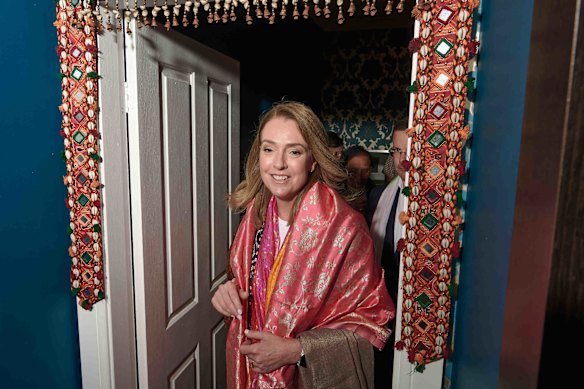
Kellie Sloane visits Harris Park in Sydney, a suburb with a large Indian population. She is wearing a traditional Indian shawl. Credit: Flavio Brancaleone
If I could say they were full to the brim with “merit” without rolling my eyes, I would. These women are all capable, competent and impressive. And for perhaps the first time, there are more female Liberal leaders (NSW, Victoria, the Northern Territory and federal) than there are female Labor leaders (Victoria and the NT). That is something worth celebrating loudly.
As an advocate for the Liberal Party adopting quotas, one of the most common pushbacks I hear is that “it’s not the people, it’s the policy”. That is correct. But the people create the policy.
No one expects that by merely installing women at the helm of the Liberal Party that overnight we’ll get back into government. I agree that people will vote for policy first, but by having women at the highest positions of power, it’s likely our policies will be better, or at the very least, that they will appeal to the cohort of voters we have lost.
Recent Hilma’s Network polling conducted by Resolve with 1750 Australians found the third-most desirable party attribute for women aged 18 to 54 was “understanding and representing women well”. Managing the economy and understanding modern Australia were the only attributes to beat it.
Loading
With women in leadership positions, the “representing women” part is beginning to take place: we now need to show we understand them.
Women’s policy goes well beyond childcare and aged care. The polling showed women were engaged in housing, wages, immigration, online safety, social cohesion and national service. Women do also want a keen focus on families, but through a modern lens.
For too long, we have simply looked on at the struggle of the juggle of work and family with sad eyes and sympathy without practical solutions to help. And now it’s become so untenable that people have stopped having kids, or drastically reduced how many they’re having.
New NSW Liberal leader Kellie Sloane used her first press conference to highlight the family unit as her top priority. The following day, she was speaking to the declining birth rate and reinstating IVF rebates. This is a practical measure differentiating us from Labor (which cut the rebate) and it provides with us with a real, material issue with cut-through, not just a culture war.
In the same realm but as a more specific experience, we must speak to the sandwich generation; the young parents – particularly women – who are in the trenches with young children while simultaneously looking after ageing or dying parents. This stress-inducing dilemma. which can be linked to a rise in burnout and depression for women, has so far been neglected by policymakers.
Loading
Aside from policy, there is finally a perfect opportunity for the Liberal Party to address its own ageing and shrinking membership. The party has been seen as being anti-women – a repellent for grassroots recruitment. But with women in positions of power, we can use this moment to flood the Liberal Party base with younger, modern members – and yes, women.
I have pitched before the idea of new Hilma’s Network branches that would be the antithesis of current branch meetings, which are often not appealing to people who don’t want to recite Sir Robert Menzies’ “Forgotten People” speech, tick off the minutes from the last meeting, argue about the party’s constitution, or have to make childcare arrangements to attend.
If we are going to do a mass flooding of the party to decrease the average age and increase diversity, we should also waive the wait time for new members to take part in preselection votes.
Right now across the country, different state divisions have different wait times (some take years) before you have the right to vote in the preselection of candidates. This means that members who are energetic and excited to join would be prevented from taking part in the upcoming preselections for state elections in 2026 and 2027, and possibly even for the next federal election.
In a world of instant gratification, it is unrealistic to think that new members would simply watch on while twiddling their thumbs and yet still remain engaged. The new recruits will lose interest and they will walk away before we’ve even got a chance to make a positive impact.
The idea of the wait times was a noble one; it was designed to prevent branch-stacking. But I fear some of the obstructions we put in place to prevent branch-stacking are also obstructing new interest and recruits.
The Liberal Party has a rare moment that many have been waiting a decade for; a moment where we can proudly showcase the intellect and power of Liberal women, talk about real policies, not cultural wars and fix systemic issues within.
We cannot waste the moment.
Charlotte Mortlock is a co-founder of Hilma’s Network, which supports Liberal women, and a former Sky News anchor.
Get a weekly wrap of views that will challenge, champion and inform your own. Sign up for our Opinion newsletter.
Most Viewed in National
Loading