3 months ago
15
3 months ago
15
The Great National Koala Park is not a firebomb. It’s the opposite.
Opinion
November 25, 2025 — 5.00am
November 25, 2025 — 5.00am
Recent print and radio media, together with comments from several (sadly ill-informed) politicians, have raised the (false) alarm that the proposed Great Koala National Park on the NSW North Coast is a firebomb. The argument is that the area should not be a park but rather that it has to be logged to make it safe from wildfires.
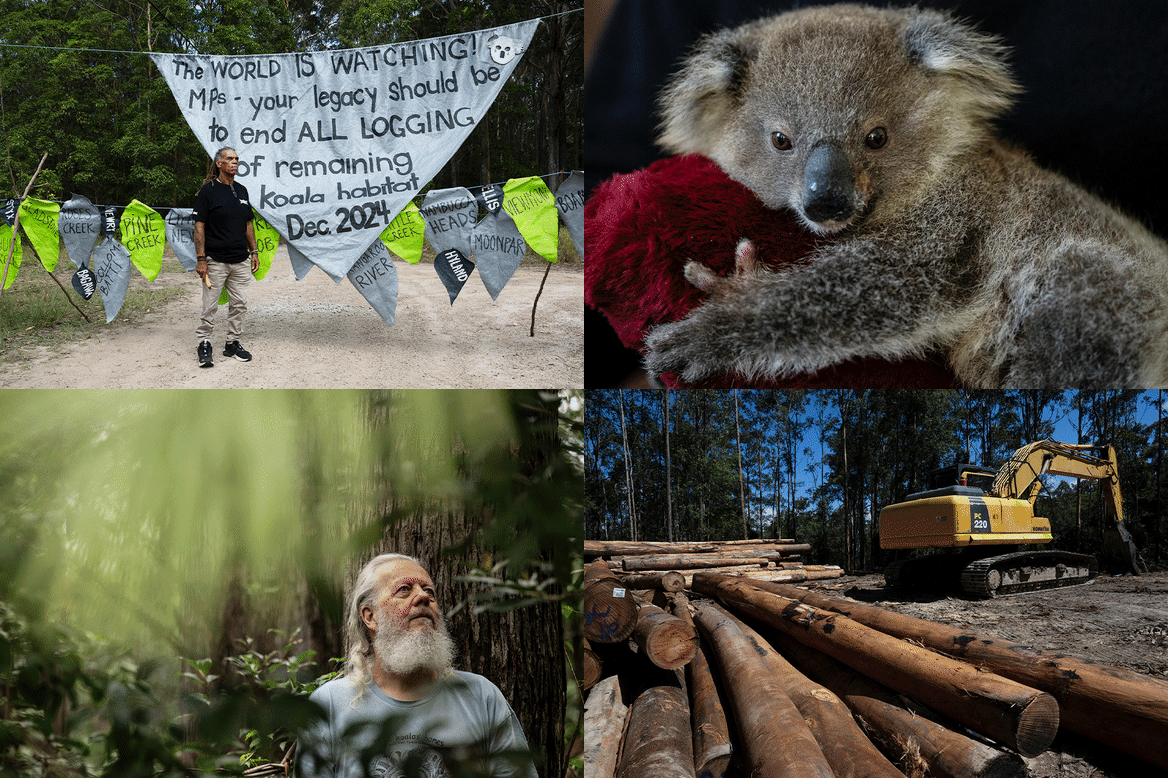
Great Koala National Park Credit: Janie Barrett
Detailed fire science shows these arguments are exactly wrong. The reality is the opposite: logging adds significantly to fire risks – and for decades into the future. That is, the Great Koala National Park is not only important for koalas and other biodiversity (such as the endangered greater glider), but also for reducing fire risks by being left intact.
There is an increasing body of robust scientific evidence demonstrating that logged forests are at significantly greater risk of high-severity wildfire than intact (unlogged) forests. An analysis of the 2019-2020 Black Summer fires showed that logged and then regenerated forests nearly always burnt at higher severity than intact forests.
Indeed, the effects are so strong that logged forests burning under moderate fire weather conditions still burn at higher severity than intact forests burning under extreme fire weather. These effects of logging are seen across the entire footprint of the Black Summer fires – from north-eastern Victoria, south-eastern NSW and northern NSW.
Importantly, other analyses of scientific data gathered by other researchers also show, independently, the effects of logging on subsequent wildfire risks. For example, a global study led by scientists at Cambridge University in England found that in Australia, logged and regenerated forests were four times more likely to burn than the nation’s plantations. This outcome is entirely consistent with the analysis of fire risks associated with the Black Summer fires.
Loading
Other work led by researchers at the University of Wollongong has shown that logged forests are more flammable for up to 70 years after timber harvesting. Studies from the University of Tasmania also demonstrate the links between disturbances such as logging and increased fire risks.
All of these results from rigorous scientific studies at different universities show basically the same thing. That is, a logged forest is at much greater risk of burning at higher severity than intact forests that have not been logged.
Why are logged forests more flammable? There are several reasons. One is that logging leaves behind a lot of debris – up to 450 tonnes of tree heads, branches, bark and unwanted understorey plants (such as tree ferns and wattles). This extra logging debris can become fuel in subsequent fires. Firefighters know this – it is routinely marked on their fire-control maps.
Another reason is that logged forests are drier, hotter and windier than intact forests. These changed moisture and climate conditions favour more severe wildfires. A third reason is that the structure of forests regrowing after past logging promotes the movement of fire from the ground layer to the understorey to the canopy, via a mechanism called ladder fuels.
Loading
The forest industry has argued that its workers are needed to help fight fires. There is no doubt that logging contractors have exceptional firefighting skills, particularly in the use of heavy machinery. But we don’t need to log forests (and make them more flammable) to retain these critical skills. What is needed, then, is not more logging but full-time professional firefighting workforces to tackle the fires threats in this country.
Contrary to the ill-informed views in the media, the science clearly demonstrates that the protection of the Great Koala National Park is important not only for animals such as the koala and greater glider and numerous other species, but also because of reduced fire risks. This mis-fire information, peddled in some branches of the media, is not only a bad outcome for the environment but it is putting human lives at risk in rural Australia. People’s lives are more important than the vested interests of the logging industry and logging unions.
Professor David Lindenmayer is a world-leading expert in forest ecology and resource management at the Australian National University.
Most Viewed in National
Loading