3 months ago
15
3 months ago
15
When it comes to the Wallabies in 2025, Charles Dickens said it best.
“It was the best of times, it was the worst of times,” Dickens wrote on page one of a Tale of Two Cities. “It was the age of wisdom, it was the age of foolishness.”
So far, so Wallabies. But then Dickens and Australian rugby diverge: “It was the spring of hope, it was the winter of despair.”
The Wallabies, of course, did it in reverse. Theirs was a winter of hope and a spring of despair. And Australian rugby supporters, already among the most masochistic fans in world sport, were given a particularly brutal ride on the emotional rollercoaster in 2025.
A strong start to the Test year, including wins over the Lions and world No.1 South Africa, created the sort of vibes about Australian rugby not felt in years, and even some long-lost global respect. But after four wins from their first seven Tests, the wheels then came off with just one win from the next eight, and that was against Japan.
They were winless on their tour of Europe for the first time since 1958 and the Wallabies ended with an unprecedented 10 Test defeats for the year.
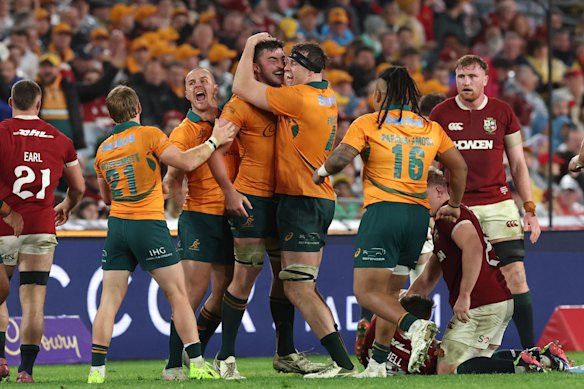
The Wallabies celebrate victory over the Lions in the third Test in a real moment of hope for long-suffering fans.Credit: Getty Images
The response from Wallabies fans has ranged from being crestfallen to seriously annoyed. After years of similar – and even worse – returns from Wallabies teams, this one somehow stung a bit more. Why?
The pain of 2025 was worsened by the promise. After showing they had raised their performance ceiling during winter, the Wallabies – and the spirits of their fans – then crashed back to the earth in spring. Signs of progress were followed by signs of regress, leaving question marks about 2026 and the big dance of a home World Cup in 2027.
So let’s look under the hood of Australia’s year.
The good
Two-thirds of the Lions series: Defying all the condescending predictions, the Wallabies turned up against the British and Irish Lions. They lost the series 2-1 against the star-studded Lions, but with the Wallabies getting better with each game, it could have easily swung the other way if a contentious call at the end of the second Test in Melbourne had gone the other way. In three Tests, the cumulative score was 68-67 to the Lions. It didn’t add up to victory, but it was an enthralling series, and showed Australia could beat the world’s best.
South Africa success: That was evident again when the Wallabies knocked off the world No.1 Springboks in Johannesburg next up. The critics, again, had mocked Australia. But after conceding 20 points in 18 minutes, the Wallabies then routed the hosts, scoring 38 unanswered points. It was a win for the ages and the true believers, and the Wallabies almost repeated the dose a week later in Cape Town. Australia, at this point, were back, baby.
Will Skelton: He was only on the field for 227 minutes of the Wallabies’ total of 1200 minutes in 2025, but the giant lock was still their most influential player. Skelton almost single-handedly took on the Lions in the second and third Tests, physically and mentally. That continued in South Africa. In four massive Tests with Skelton on deck the Wallabies’ cumulative score was 108-103 with a 50 per cent win rate.
Guns blazing in Townsville: The hairy-chested belief of the new Wallabies was never more apparent than in Townsville against Argentina when they turned down a draw to go for a win after the siren. And got it. Harry Wilson pointed to the corner with a “let’s f---ing go”, and the Australian public agreed.
Max aura: Of many good candidates for Australia’s best in 2025 – Fraser McReight, Wilson, Skelton, Tom Hooper and Len Ikitau – the star who shone brightest was 21-year-old Max Jorgensen. Time and again, the young flyer delivered on the big stage with solo tries he had no place scoring. A special talent.
The bad
One-third of the Lions series: Forget being happy with a competitive effort, the Wallabies could have (should have?) won the Lions series. But they were physically insipid (not picking Skelton was an all-time bad call) for the first 50 minutes in Brisbane, and the killer blow was the second half hour in Melbourne, when the Wallabies gave up most of their 23-5 lead. The decision on Jac Morgan’s cleanout was a howler, but it wasn’t why Australia lost the game, and thus the series.
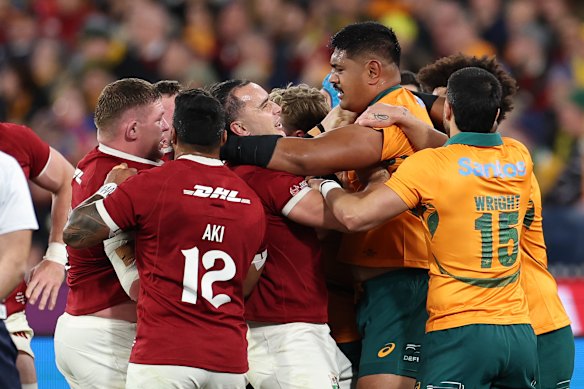
Will Skelton’s physicality was vital against the British and Irish Lions.Credit: Getty Images
Botched Bledisloe: The Wallabies had a genuine chance to beat New Zealand in Auckland and end the 39-year Eden Park curse. But they botched it by falling behind early, as they’d done all year: 19 points down against the Lions, 22 against the Boks and 21 against Argentina. Wallabies fightbacks – and some wins – showed character and resilience but, unsurprisingly, giving up big leads is not a path to sustained success. And so it proved in another losing Bledisloe Cup series.
Passive defence: Most teams are aggressive with their line speed in defence, but the Wallabies persist with a passive, connected strategy – essentially conceding the gain line but not offering gaps in most parts of the field. It routinely allows rivals to make worryingly easy ground and set up camp in Australia’s half. The Wallabies conceded an average of 27.4 points during the year, and most of the world’s top five sides average fewer than 20. There is time for a rethink.
The ugly
Winless European tour: Enough said. Four losses in Europe, two record scores conceded and a get-out-of-jail result against Japan. The calm confidence, resilience and hard-won self-belief washed away in real time.
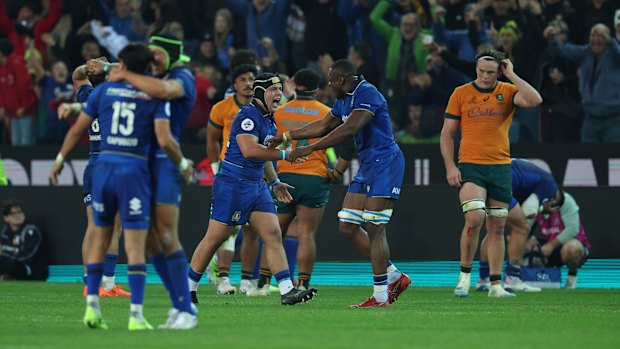
Australia come to terms with the shock loss to Italy in Udine.Credit: Getty Images
Prioritising tomorrow over today: The loss to Italy was a prime example of the self-destructive thinking in Australian rugby for many years: using Tests as opportunities to provide “experience”. Australian rugby needs better depth, for sure. But rightly or wrongly, it cannot survive, let alone thrive, without Test wins. Picking anything other than the strongest team each week has led to a string of humbling and confidence-sapping losses. Forget prepping for the future and focus on building belief in the present.
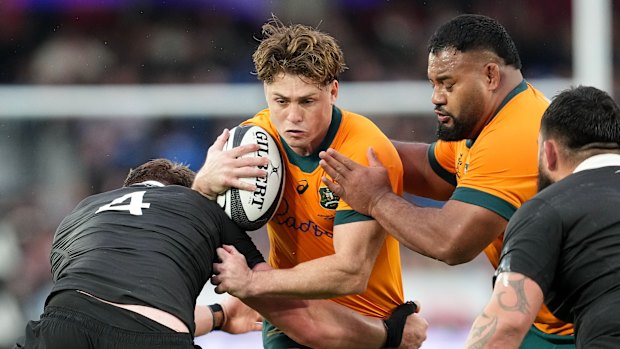
Australia’s James O’Connor takes on the All Blacks’ defence.Credit: AP
Ten lotto and JOC handling: Schmidt is a first-rate coach, but his handling of the No.10 position – and particularly James O’Connor – this year has been perplexing. The No.10 jersey changed hands often, and while some of that was injury-related, the cohesion and game management clearly suffered. Schmidt’s recalling of O’Connor to the starting side after a trip to England (for a game against New Zealand) and a holiday (to play Ireland) also seemed unnecessarily messy. So too letting him leave the squad before the France game. Meanwhile, we are all a year older and still have no idea who is Australia’s preferred No.10.
Mourinho’s blanket: Jose Mourinho once said trying to fix Tottenham’s problems was like having a small blanket in bed. Pull it up, and you get cold feet. Cover your feet, and your body is now cold. That was the Wallabies in 2025: fix one problem and a new one (or old one) would pop up. Sometimes in a previously solid area. Like discipline, which went from good in the first eight Tests (8.1 penalties a game) to loss-inducing in the last seven (11.2 a game). But the small blanket was perhaps best seen in the lineout: it went from a solid platform to dysfunctional on the spring tour.
Contestable kicking: Another area that fell away badly – and contributed to Test losses in London and Dublin – was Australia’s work under the high ball. Of the world’s top 10 sides, the Wallabies were the second worst, and it all prompted the question: why don’t they have a specialist coach in that area?
Loading
Gruelling schedule: RA suits need to accept their share of the blame for the Wallabies’ spring tour collapse. In what was already a tough year (a Lions series closely followed by South Africa away, plus a Rugby Championship that is now an annual cage fight) the Wallabies had two extra “money” Tests thrown in to the spring tour: Japan and England. With 20-20 hindsight, it was too much, and opened the door for the buzz-killing end to the year. Particularly given RA had already trousered $120 million from the Lions tour.
Knives out for Schmidt: Showing old coach-blaming habits die hard, some have now lazily sharpened their knives for Schmidt and questioned why he is in charge for three more Tests in July before handing over to Les Kiss. The reality is Kiss (and Australian rugby) will benefit more from coaching the Reds for another season than sitting in the stands in a Wallabies polo. And regardless of the past few weeks, let’s not lose sight of the deep dark hole the Wallabies were in at the end of 2023. In 18 months, Schmidt took them to within a whisker of beating the Lions.
Most Viewed in Sport
Loading