3 months ago
25
3 months ago
25
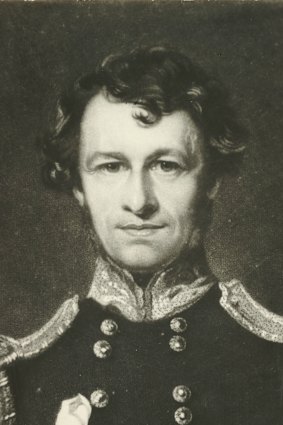
Port Phillip District Superintendent Charles LaTrobe.
Here, according to local lore, was one of the places where the numerous onshore campfires of Indigenous people spied in 1802 by rival navigators, Englishman Matthew Flinders and Frenchman Nicholas Baudin, were snuffed out forever.
The Port Phillip District Superintendent Charles LaTrobe took the trouble to note, without elaboration, in his annual report of 1846 that a group of “very loose men” had passed through Peterborough in October 1843 from Port Fairy en route to Johanna and back again.
Those “very loose men”, presumably bent on “clearing” the coast for white settlement, are said to have herded the men of the local Baradh gundidj clan of the Keerray Woorrong people over a cliff and murdered women and children at a nearby wetland. Such was the nature of the frontier wars during the 1830s and 1840s in south-west Victoria.
Less than a century later, the road itself was built by veterans of the most brutal war in history – World War I – and became the world’s longest war memorial, its 243km dedicated to the 60,000 Australians who died in the slaughter.
Some of those who survived the foreign kill lost their lives building the road.
Armed with gelignite, picks, shovels and wheelbarrows, they got ten shillings and sixpence a day and lived in tents in often cold and storm-wracked conditions. The 3000 ex-Diggers were considered fortunate to have any work in a nation suddenly flooded with returning soldiers.
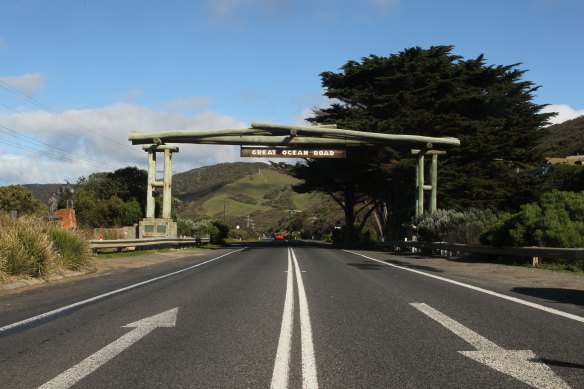
The Great Ocean Road memorial arch.Credit: Ken Irwin
These, then, are awkward narratives to accompany today’s travellers experiencing the pleasure of cliff-hugging curves rising from the Surf Coast, dripping forests of the Otway Ranges and jaw-dropping views of limestone stacks from the Twelve Apostles to the Bay of Martyrs (next to Massacre Bay).
But what of the most haunted of all the bewitching places along the Great Ocean Road?
For that, you must stop and stroll through to a dip in coastal scrub out of sight of the ocean, a bit beyond the Twelve Apostles and not far short of the lovely village of Port Campbell.
When I was a child, my family called this place the Devil’s Blowhole.
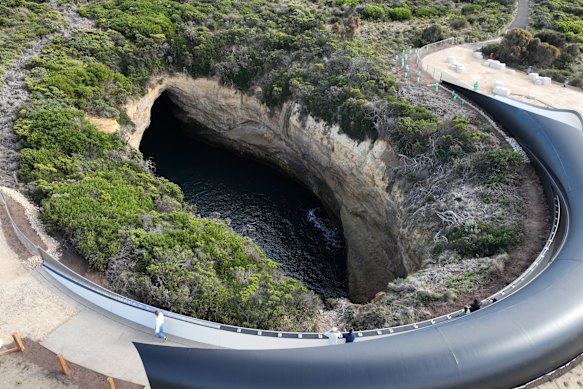
“Breath of a whale”. The Poombeeyt Koontapool viewing platform transforms the old terror of the Loch Ard blowhole.
More properly known as the Loch Ard Blowhole, it’s an eerie gash in the earth into which the Southern Ocean forces its way through a tunnel that begins as a fissure in the cliff more than a hundred metres away.
When storms rile the ocean, great gushes of seawater thunder down the tunnel, compressing the air trapped within, and explode into the blowhole, angrily climbing its high walls.
This year, in a neat reversal of fortune, the blowhole has been transformed into a captivating work of art.
The Keerray Woorrong and the Eastern Maar people have reclaimed the landscape.
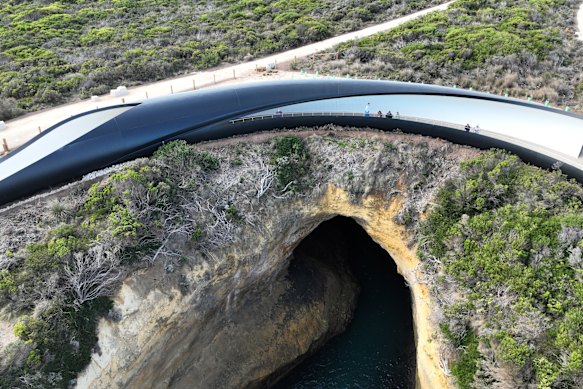
Another view of the platform at The Blowhole.
The “Devil’s Blowhole” has been transformed into another form of blowhole altogether: that of the “breath” of a southern right whale, known in the ancient language as Poombeyet Koontapool.
An elegant sculptural representation of a whale wraps itself above the northern end of the blowhole, welcoming visitors to stand within it to hear the roar and the suck of the ocean amplified by its smooth curves.
But there remains a haunting here. Fifty-five years ago, on the deep winter night of July 1, 1970, a traveller came this way in his family car, weighed with an evil secret.
Elmer Crawford wasn’t about to stop and walk through the scrub, however, and there was no beautiful “breath of a whale” viewing platform to give him pause.
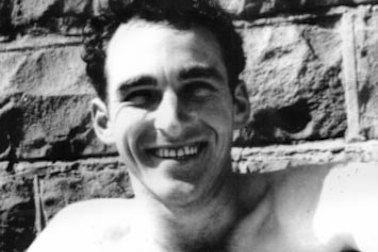
Elmer Crawford.
He drove as far as he could before fashioning with rocks a bridge over a drainage ditch that was supposed to deter vehicles from proceeding.
With his bridge complete, he set about rolling his 1956 FE Holden into oblivion.
That’s where it all went wrong for Elmer Crawford.
In the dark of the night, he probably didn’t know he’d utterly botched his act of depravity.
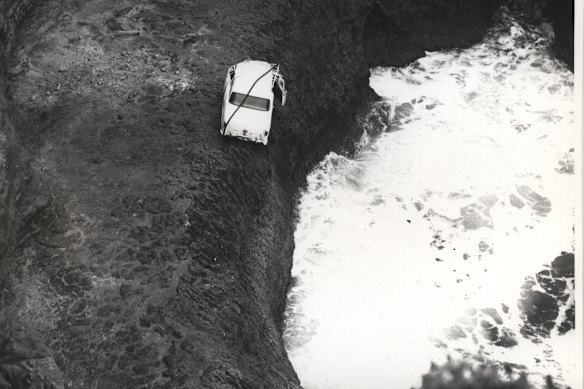
The Crawford family’s car teeters on a ledge above the water 16 metres down the walls of the Loch Ard blowhole.Credit: Victoria Police
All of Australia and a large news audience across the world would soon learn that this was a case of mass murder.
Worse, of familicide: Crawford had killed his entire family.
In the back of the family car, wrapped in blankets beneath a tarpaulin, lay the bodies of his pregnant wife, Therese, and their children, Kathryn, 13, James, 8 and Karen, 6.
Crawford chose the spookiest place on the entire spooky coast to complete what he planned to be the perfect crime.
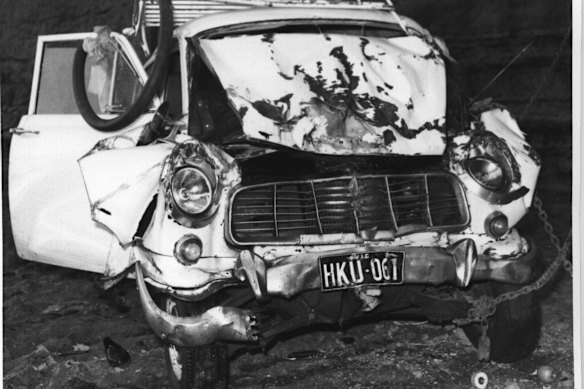
The wrecked car.
Terror has long been the fascination of this place.
A few hundred metres away in the pre-dawn of May 31, 1878, the clipper Loch Ard, lost on a voyage from England to Melbourne, smashed into an island off the cliffs. Fifty-two of her passengers and crew perished.
There were two survivors, both aged 19: ship’s apprentice Tom Pearce made it to the beach in what became known as Loch Ard Gorge, from where he heard the cries of Eva Carmichael, who was clinging to a chicken coop and ship’s spar.
Pearce saved Carmichael, whose parents, three sisters and two brothers drowned.
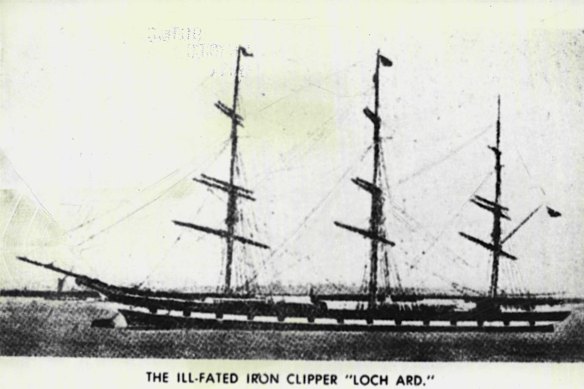
The Loch Ard, which now lies in the waters off the Great Ocean Road.
It was a world sensation, the press lapping up every detail.
One of the lesser-reported details was that 11 bodies from the Loch Ard washed into the blowhole, there to be tossed back and forth before they disappeared.
Elmer Crawford wanted his family and the evidence of his wickedness to disappear in this unearthly place, too.
And in case the car was eventually found in the deep, he constructed an elaborate deception to suggest his wife had killed the children and committed suicide herself.
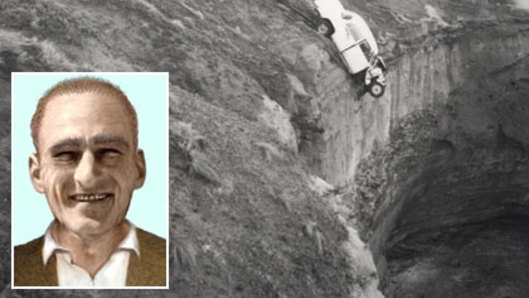
Elmer Crawford (inset) went missing after the bodies of his pregnant wife and children were recovered from his car winched out of the Loch Ard blowhole in 1970.
He connected a pipe from the exhaust and jammed it into the driver’s window.
But this was no murder-suicide. Crawford had murdered his family in their beds in their home in the Melbourne suburb of Glenroy.
Loading
He smashed his children’s skulls with a hammer.
He spared his wife such a disfiguring injury. It would ruin his suicide fabrication. He knocked her unconscious with a cosh and electrocuted her with a device rigged up from the house power supply and clipped to her ears.
Two of the children were also given the alligator clip treatment, as if the hammer had not done enough gruesome work.
Police later discovered that Crawford and his wife had signed wills only two weeks previously. Elmer would be worth about $250,000 if his wife died before him. It was a fortune in 1970.
But the murdered family did not disappear into the blowhole.
The car toppled 16 metres and landed on the only ledge of rock jutting from the sheer walls above the water.
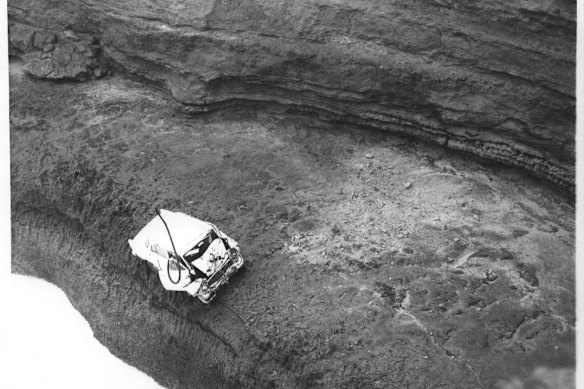
The wreckage landed on a rock platform.
There it teetered as Crawford returned to Melbourne, possibly by a motor scooter brought along in the boot of his car.
The Holden was discovered the next day, dragged back from the precipice and eventually winched up the cliff to reveal its horrifying secret.
Loading
When police initially traced the car’s registration to the Crawford home in Glenroy, not yet realising murder had been done, Crawford didn’t answer the door. By the time police returned and broke in, they discovered unfinished attempts to clean up pools of blood in the Crawford home.
Elmer Crawford was gone.
He is still gone, despite a 1971 coroner’s inquest determining that he murdered his whole family.
After 55 years of attempts to track him down, Crawford remains a spectre.
A former acquaintance reported that she had spoken to him in Western Australia in 1994. He insisted he was a visitor on holiday from New Zealand.
An unidentified body lying in a morgue in Texas bore a resemblance. Intriguingly, its fingerprints had been removed. DNA tests proved it wasn’t Elmer Crawford.
Police never settled on a motive.
There was some evidence that Elmer tried unsuccessfully to persuade Therese to abort what would have been their fourth child.
It also emerged Elmer ran a racket selling stolen goods. Did his wife threaten to expose him?
Loading
Elmer Crawford is only person who could tell.
He would be 95 now. If he were alive.
Instead, he is simply another ghost haunting the story of the Great Ocean Road.
Start the day with a summary of the day’s most important and interesting stories, analysis and insights. Sign up for our Morning Edition newsletter.