3 months ago
20
3 months ago
20
The final eight lived, in different formats, for 32 seasons and was successful in winning the confidence of the public, the clubs and the players.
Which raises the question of why, given the success of the eight, it has been killed off and replaced by what should henceforth be known as the top 10.
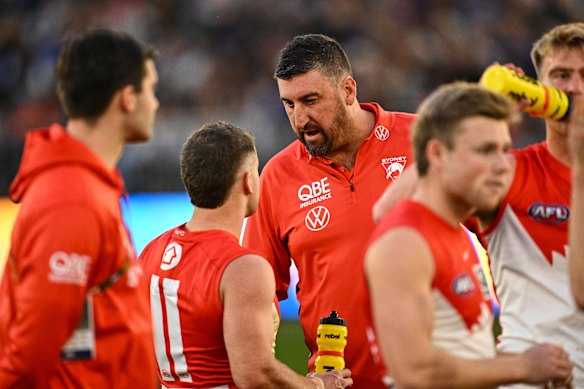
The Swans finished 10th in 2025 with a percentage of less than 100.Credit: AFL Photos via Getty Images
To many fans, including this one, eight is enough.
In 1990, the AFL had a final five for a 14-team competition. This expanded to a final six for 15 teams when the Crows arrived the following year, and then the great leap forward was made in 1994 when the league introduced the top eight.
Herein lies a case where the AFL’s wish for more product and revenue supersedes other considerations, such as integrity and the value of finishing seventh compared with 10th.
The AFL has been bold over the post-season period, having binned the centre bounce and now consigned the final eight to the dustbin of history, where it joins the final four, the five, suburban grounds, 3KZ and Peter Landy in footy’s archives.
The case for the top 10 – you can call it the wildcard round, but the fact is that 10 teams are in the finals – is much less compelling than the decision to scrap the bounce, which will not be mourned except by old ruckmen and some purists.
The best arguments for the top 10 finals system are that it will a) maintain interest for teams mired outside the top eight – especially from 11th to 13th – for longer; b) that it will create two further events, thereby increasing the AFL audience; c) it will increase revenue, at a time when free-to-air and pay television networks are fragile.
The case against is more compelling, however.
First, it is not right to have a team that finished in the bottom half of the ladder given an opportunity to win the premiership.
Had the system existed this year, the Hawks (eighth) would have hosted the Bulldogs (ninth), while Gold Coast (seventh) would have copped the 10th placed Swans, who won 12 of 23 games and had an underwhelming percentage of 97; Gold Coast won 15 games and had a percentage of 124.9, yet they would meet on equal footing.
The 2025 season was anomalous in that there was a huge gulf between the top nine sides, and the bottom eight (Sydney belonging to neither group). This was proven in the finals, when the Hawks stormed to the preliminary final and the Suns upset the Dockers in Perth.
The top eight was remarkably even, albeit the Brisbane Lions’ innate talent was supreme when everything was on the line.
The 10th team didn’t deserve to stay alive in September. In 2019, 2021, 2022 and 2023, the tenth team won 11 games three times and just 10 (St Kilda, 2021) once; from 2023, there have been 23 regular season games.
Yes, the Crows were fleeced of a finals berth in 2023, but that was due to a goal umpire’s blunder and irrelevant to the finals system.
When Tasmania arrives, likely in 2028, it will be 10 finalists from 19 teams – that’s slightly less egregious than 10 from 18 teams. Yet, the same principle applies; a majority get to play finals. Tenth is the embodiment of mediocrity.
The league has had an expansion of finals on its agenda for a while. In July, when it was put to the club chief executives, there was no pushback. The sentiment was “why not do it” from those in the room, who could see the dollars it would generate.
Loading
The clubs are at odds with their own fans, who are admittedly conservative on such reforms (77 per cent oppose the wildcard according to the AFL Fans’ Association survey). But they will not care so much once it’s established.
I would contend that 2023 and 2024 were more representative of the new norm than 2025, when so many teams fell away relatively early in the season and were out of finals contention by round 12 or 13.
Carlton and the Giants revived from bottom five in 2023 at the midpoint to reach preliminary finals, while the Hawks transformed from 0-5 to be within a James Sicily kick of reaching the penultimate last year. There was no need for a top 10 to maintain the rage and enthusiasm of clubs outside the top half of the ladder then.
It is a reform, once suspects, that derives from the AFL’s wish for further “big tent” events that will draw eyeballs, in particular. It could well reflect concerns the AFL harbours about the NRL’s advantage in state of origin – handing it four grand final-level broadcast events – as a television product. Note that the final 10 follows the resurrection of state of origin footy in pre-season.
Loading
But adding more all the time doesn’t necessarily mean improving the product.
A final observation, to so speak: the Bulldogs miracle of 2016 saw Bevo’s boys achieve the most improbable of premierships, from seventh.
Improbable and a fairytale then, it is more like scaling Mount Everest without oxygen now.
Last year, when the Americanised notion of the top 10/wildcard round concept was exhumed by the league, I wrote that this was an AFL idea that kept being regurgitated like a bad, burpy attack of reflux.
Alas, it is one we must all swallow now.
Most Viewed in Sport
Loading