3 months ago
23
3 months ago
23
It is possible to realise just how inconsequential you are in the grand scheme of the universe, and simultaneously feel totally fine with that. It’s a thought that came to me while lying blissfully in a hammock, staring at the canopy of treetops above, reaching metres into the sky. The trees are so tall they alter my idea of scale: I feel like an ant among them.
The hammock was courtesy of the Evergreen Lodge on the outskirts of Yosemite National Park. The lodge is summer camp-coded: think Moonrise Kingdom or The Parent Trap, all timber-lined rooms, packing trunks and towering dark-green pines, with activities such as ziplines, giant chess and bocce scattered among the buildings and campground. There are make-your-own s’mores (an American confection of toasted marshmallow, chocolate and biscuits) each evening at one of the campfires dotted around the property.
The trees were either Ponderosa or Sugar pines, yawning above like an optical illusion, giving the feeling of a kind of ground-floor vertigo. Though shorter than the giant sequoias that Yosemite is best known for, these trees can reach more than 250 feet (76 metres) – or the height of a 20-storey building.
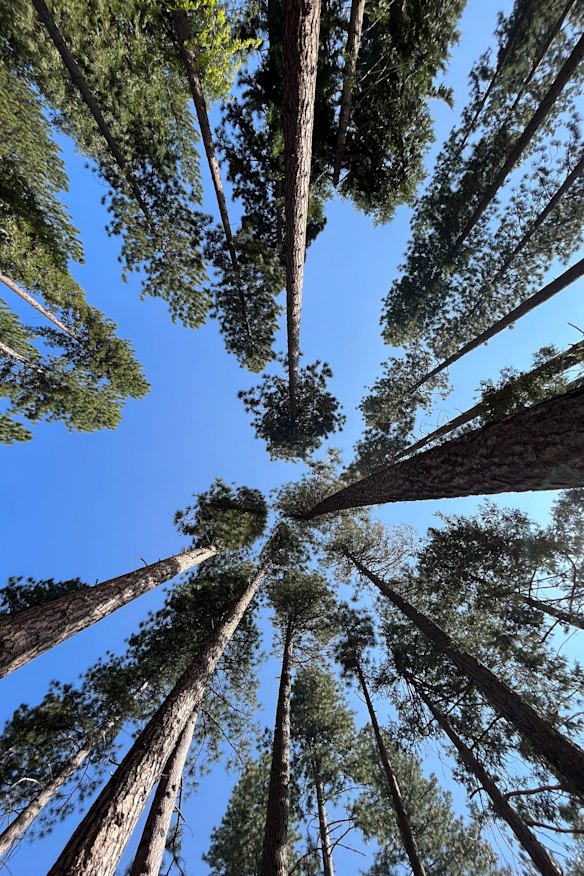
The view from Aarti Betigeri’s hammock during a visit to Yosemite in 2023.Credit: Aarti Betigeri
And, despite the s’mores, it was the trees I was here to see. Giant sequoias captured my attention when I was a very young child, leafing through a 1970s-era Childcraft encyclopedia. Encyclopedias, as I tell my child, are bound sets of books that we used in the time before Google to learn about the world. In the ’80s, rich people would have an entire set of Encyclopedia Britanica on their shelves, a flamboyant visual cue about their dedication to learning. At home, we had Childcraft, an American-published set of 15 books aimed at children, each with a theme such as “The Green Kingdom” or “How Things Work”.
I adored these books. In 1980s suburban Melbourne, my world was bounded by school, home, the 59 tram and the occasional trip to Lygon Street. It was multicultural, but not particularly wide. The books simultaneously drove and fed my insatiable curiosity about the rest of the world. I grew up one street north of the Essendon Airport boundary fence, and numerous times each week I’d hear a roar and see the undercarriage of planes taking off. Where were they going? To places and worlds I might not experience in real life, but I had access to via the Childcraft pages.
I was still learning to read, so would stare in fascination at the black and white photos of people gathered at the base of a giant tree, looking like twigs or branches against the thick trunk. Twenty or more people could stand at the base holding hands, I guessed. There were close-ups of bark, leaves, insects, squirrels. As my reading skills developed I’d sound out the words. Yosemite, California. I thought it was pronounced Yowsee-mite, like Vegemite, until someone corrected me. Being able to say “sequoia” didn’t land for a long time after that.
The photos showed the trees from underneath, reaching up towards the sky, much like the scene from my hammock, many years later. It felt a long way away, but at the same time, a key part of how I understood the natural world.
I’d added Yosemite to my bucket list and didn’t think much about the giant sequoias until the COVID lockdowns, when my travel wishlist would appear to me in dreams. There I was at The Peak in Hong Kong, or at the Montreux Jazz Festival. But the trees kept edging their way in, climbing to the top. I looked them up again and there they were, in high-res photos far more sophisticated than what I remembered, towering overhead and dwarfing the people beneath them. Your sense of scale changes in adulthood, but not these – they still looked unconquerable. They reminded me of the ents in The Lord of the Rings.
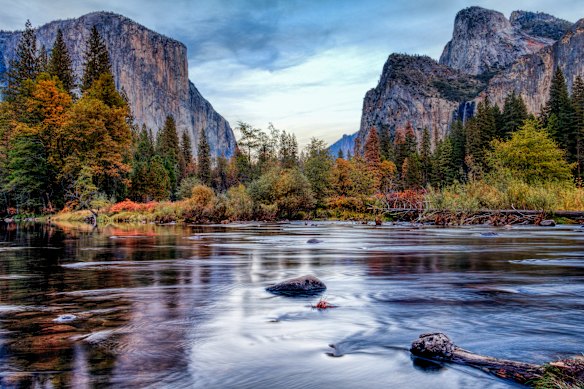
El Capitan seen from Yosemite’s Merced River.Credit: iStock
I also watched the 2018 documentary Free Solo, about the American climber Alex Honnold, who climbed Yosemite’s famous El Capitan numerous times before becoming the first person to free solo climb the vertical rock face – that is, without ropes or protective gear. El Cap is about 2300 metres tall, and Honnold climbed it in just under four hours.
Loading
“Imagine an Olympic gold medal-level achievement that if you don’t get that gold medal you’re gonna die,” says fellow climber Tommy Caldwell in the film. “That’s pretty much what free soloing El Cap is like.” In the film, Honnold undergoes an MRI, which finds that his brain doesn’t respond to fearful images the way most brains do: his amygdala doesn’t activate. “I’ve had several ex-girlfriends tell me there’s something wrong with me,” Honnold ruefully tells the camera.
I couldn’t shake the thought of Honnold dangling from a sheer cliff face by his fingertips. Yosemite took on a more urgent quality in my mind: a place where the tension between nature and the human desire to dominate it is front and centre.
Finally, in 2023, I gave in, and booked a family trip to see the trees in person. My child was eight at the time, around the same age I’d been when I’d leafed through the encyclopedia. “They’re trees the size of a skyscraper, taller than probably the highest building in all of Canberra!” I said. She shrugged, and bent her head back down, absorbed in Minecraft.

Aarti Betigeri: “I would stare in fascination at the black and white photos of people gathered at the base of a giant tree.”
In San Francisco I hired a car, against the murmurs of concern from family members. “Are you sure you want to drive? The road isn’t great.” I blithely shrugged off their concern and insisted that driving was the only way. And the first two hours were relatively easy compared to central San Francisco, where I got stuck on top of a hill, unable to descend, desperately ignoring the cacophony of beeping from the cars behind.
But after those two hours I realised my folly. Once the road swung upwards, there was no going back. The right side of the road, on which Americans drive, was on the outside edge of the peak, and packed with hairpin bends. There were no guardrails or trees, and the drop quickly became perilously steep. As I inched my way up, I kept my eyes on the crest. But there was nothing to see except bright blue sky and the sheer cliff faces of neighbouring peaks. As far as I knew, there was no road beyond it, just an edge into nothingness.
Loading
The road was New Priest Grade Road. There is an Old Priest Grade Road, in use since the 1800s, that is far steeper and more direct. In some spots, it has a gradient of 20 per cent, according to the dangerousroads.org website. Locals use it with little fear (much like Honnold, he of the missing amygdala).
While it was built in 1915 as a less treacherous alternative, New Priest Grade Road was still an intense experience, particularly for someone who’d been driving in the US for less than a day. It took me about 40 minutes to drive less than 10 kilometres. There were pull-over spots, hanging precipitously over the side of the sheer-drop cliff, but they were smaller than a Kia hatchback, with no discernible space to enter or exit. The idea of pulling into one of them to let cars pass was more terrifying than the road itself, and I couldn’t bring myself to do it. At one point a truck driver sped up to overtake and hurled Mountain Dew in an open plastic bottle at my window; the sticky substance exploded on the glass. Thankfully the window was closed. I didn’t blame them, I would have done the same.
Finally it was over. I might have cried a bit.
Evergreen is about an hour’s drive outside of Yosemite National Park so it wasn’t until the next day that I finally landed in the Yosemite Valley, surrounded by trees and foliage. The park is massive, a bit more than 3000 kilometres square. It contains major sights including El Capitan, Half Dome, Yosemite Falls, Tunnel View and Glacier Point. I’d flirted with the idea of hiking the Panorama trail to Glacier Point, but my kid held firm: no hard walks, no steep terrain. I pointed out that the youngest person to summit El Cap was 10: Selah Schneiter in 2019, who spent five days climbing, meaning she spent four nights sleeping on a portaledge attached to the rock face. My child’s eyes widened as El Cap came into view, counting the tiny colourful dots of the climbers, wondering how many were closer to her age than mine.
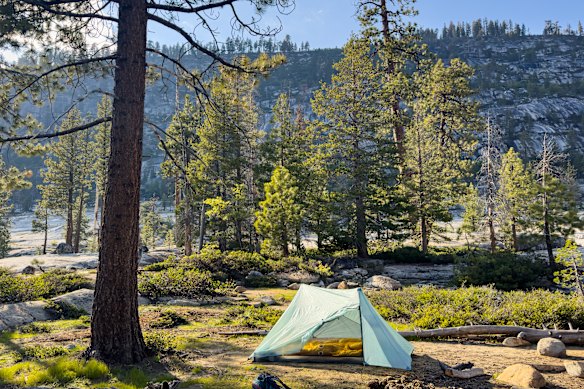
A place among the pines: A campsite in Yosemite National Park.Credit: iStock
Finally I was there, in among the gargantuan trees that had lived in my head since childhood in those grainy, black and white photos. They were finally in front of me, in living, breathing vibrant colour: cinnamon red bark, lush green at the base level studded with white, purple and yellow wildflowers. I had goosebumps. I stood among them, wondering how many pairs of arms it would take to wrap around this trunk. Some of the trees are more than 3000 years old. I wonder what they’ve witnessed throughout the arc of time. Here, humans are dwarfed by the presence of much larger living things that will remain long after we’re gone.
The sequoias and their towering pine friends are, perhaps, some of the last remaining ways in which nature truly dominates humans. Lying in my hammock, looking up, I realise how inconsequential everything about my existence really is: my professional wins and losses, my concerns and worries, all of it. In the shade of these giants, I’m really nothing but an ant.
Start the day with a summary of the day’s most important and interesting stories, analysis and insights. Sign up for our Morning Edition newsletter.