3 months ago
20
3 months ago
20
By Tony Wright
November 11, 2025 — 5.50am
It was so mid-70s Australia, so perfectly Canberra on that dying day of the freshly executed Whitlam government.
A roiling crowd, overwrought with excitement and outrage, spilled across the road in front of the squat old Parliament House and on to the lawns beyond.
Gales of chanting swept the zone. “We want Gough! We want Gough!”
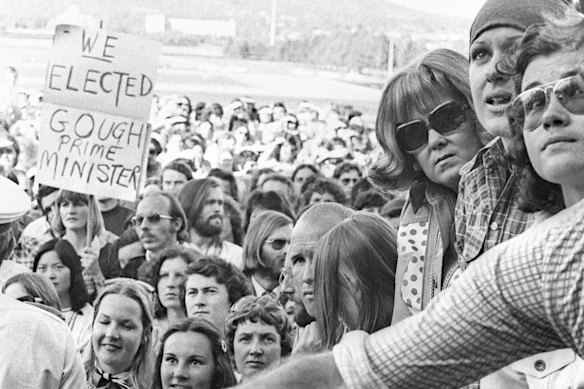
Part of the crowd outside Parliament House, Canberra, on November 11, 1975.Credit: Michael Rayner
Well, of course.
The crowd was overwhelmingly of young people – hair everywhere – and Whitlam and his government had swept aside a lot of old Australia for them.
Military conscription was gone, a university education was free, the vote was granted to those aged 18, down from 21, multiculturalism was blessed with official approval, universal health care eased fear of hospital bills, no-fault divorce replaced the need to hire creepy bedroom investigators, there was a new sole-parent pension and laws were passed to provide equal pay for women.
Cocking a snook at lingering conservatism in the arts, Whitlam approved the purchase, for a scandalous $1.3 million, of Jackson Pollock’s abstract expressionist drip painting, Blue Poles. The Establishment howled, unable to comprehend that it would become among the most popular works in the National Gallery of Australia, valued today in the hundreds of millions.
“We want Gough,” cried the bereft, forgiving him the chaotic economy, the crazy loans affair and all the rest that so offended middle – and middle-aged – Australia.
And there with all the political players gathered on the steps of the white-painted parliament building stood Norman Gunston, the little Aussie battler with a microphone, interrogating the crowd.
“What I want to know, is this an affront to the Constitution of this country?” cried Gunston of the Dismissal.
“Yes,” screamed the gathering.
“Or was it just a stroke of good luck for Mr Fraser?” continued the marvellously gormless, knowing Norman.
“No,” roared the crowd.
“Thanks very much, just wondering,” said Gunston, grimacing madly.
No Australian comedian has since touched such a peak of audacious absurdity as that scaled by the actor Garry McDonald in the guise of his alter-ego Norman Gunston that day.
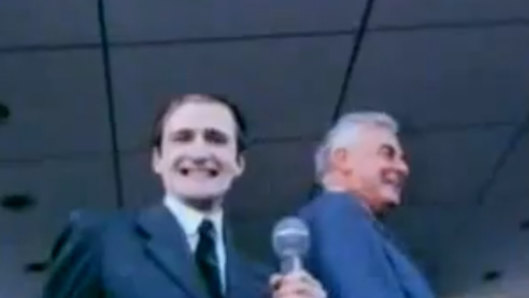
Norman Gunston, on the spot in 1975 with the sacked Gough Whitlam. Credit: ABC-TV screen grab
The professional cringe-maker Gunston, thrusting his microphone at the imperious but amused Whitlam, not a hint of intervention from security, was a scene that could not have occurred anywhere but in Australia.
Everyone up to a prime minister, particularly a freshly ex-PM, knew Gunston’s camera team could make them immortal.
Amid it all, a young man climbed the hideous statue of King George V stuck away in a corner of the lawn.
He sat up there puffing a huge joint, a blissful smile on his face, high (literally) above the bellowing crowd.
There were police about, but the boy was safe. No one in Canberra had been successfully busted for smoking marijuana since the start of 1974.
Whitlam’s attorney-general, Kep Enderby, ordered Commonwealth police to quit arresting pot smokers in Canberra after it became plain anyone who could string three words together in front of an ACT magistrate could waltz through a loophole in the law.
In an attempt to clear things up, criminal penalties in Canberra were replaced with a $100 fine for possession of less than 25 grams, but the police appeared to be over the whole damn thing by then.
“We want Gough!” Cool.
I was a mere gawker on the lawns on the afternoon of that turbulent day.
An awkward outsider.
I’d been a journalist for the previous four years, and had even worked a year at The Canberra News (an afternoon tabloid published briefly by Fairfax) back in 1972-73.
But I’d cast myself adrift from the craft in 1975, intent on recapturing my youth.
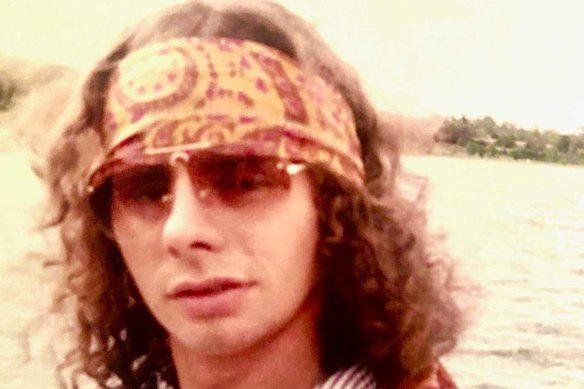
Tony Wright, rock’n’roll roadie, in 1975.
I was employed as a roadie for rock’n’roll bands and as a novice sound-mixer at concerts.
On November 11, a couple of mates and I were at Canberra’s funkiest music lair, where we kept a mountain of high-powered sound equipment.
The radio blared that Whitlam had been sacked by the governor-general, John Kerr.
We had trouble digesting this. It was remote from our world.
“Far out,” one of my mates muttered, continuing to play a riff on his guitar.
Crowds, we heard, were gathering outside parliament house.
I climbed into my clapped-out sports car, got the boys to give it a push-start and headed to the parliamentary zone.
History and old newsreels will forever report the high drama of Whitlam’s thundering condemnation of Kerr and Fraser: “Well may we say God save the Queen because nothing will save the governor-general” followed by his mighty sledge at Fraser: “Kerr’s cur”.
Out on the edges of the crowd on the lawn, I was at a rueful remove from it all, having voluntarily detached myself from the privilege of all those journalists gathered on the parliamentary steps to absorb the peak moments of this political history. Feeling adrift and awkward, I contented myself with memorising the surreal performances of Gunston and the boy on King George’s horse.
A couple of weeks later, politics and rock’n’roll merged when Whitlam’s people hired my mates and I to deliver the amplified sound for a Whitlam re-election campaign rally.
Ahead of Whitlam’s speech in the town of Queanbeyan, the “we want Gough” rising to the clouds, bands mounted on a semi-trailer parked on a football ground fired up the crowd.
We supplied a massive 10,000-watt amplification system, enough to blow down the Walls of Jericho.
My mates and I, perched on the flat roof of a nearby concrete toilet block, sat around a sound-mixing desk that wouldn’t have been out of place at a Rolling Stones concert. The dunny-desk was connected by cables to a forest of microphones on the semi-trailer.
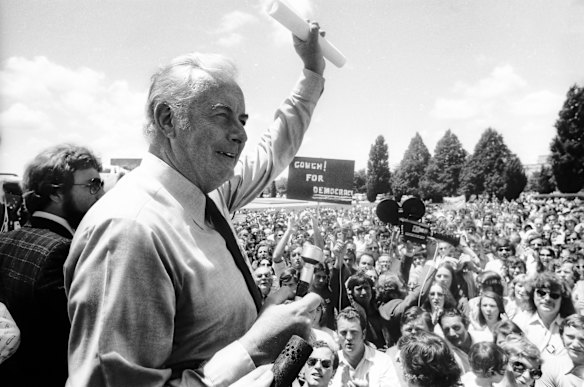
Gough Whitlam at one of his campaign rallies after the Dismissal in November, 1975.Credit: Michael Rayner
Just as Whitlam approached his microphones and began to speak, I accidentally kneed the mixing desk, its internal reverberation spring creating a crashing echo rolling like thunder.
I’d made Gough sound like the voice of God.
Nothing, however, could save him when the post-Dismissal election rolled around on December 13 and conservative middle Australia got its own back with interest.
I returned to journalism a few months later. After 1975 and the business with the accidental voice of God, a typewriter seemed mercifully tame.
Cut through the noise of federal politics with news, views and expert analysis. Subscribers can sign up to our weekly Inside Politics newsletter.
Most Viewed in Politics
Loading