3 months ago
9
3 months ago
9
It’s typical that when someone raises a valid point about our immigration levels the facts are dismissed or people are called racists (“Marchers were scared by numbers that don’t even exist”, September 3). Between 2014 and 2024-25 Australia’s population increased by four million people. An increase exceeding 16 per cent. The majority of those were immigrants. It doesn’t matter who they are or where they’re from, that is an unsustainable number of additional citizens. No country could/should have to absorb that percentage increase in population in such a short time. The governments, state and federal, are blamed for housing shortages. No building program could keep up with that level of new arrivals. Successive federal governments have taken their eye off the ball in tracking our population increase. Australia is obviously a targeted destination for people seeking a new life, and this means governments can afford to be selective in terms of overall numbers, what skills they possess and what other benefits they may offer the country. We don’t need an ongoing free-for-all. The government needs a plan. Have they got the skills to develop one? Stewart Copper, Maroubra
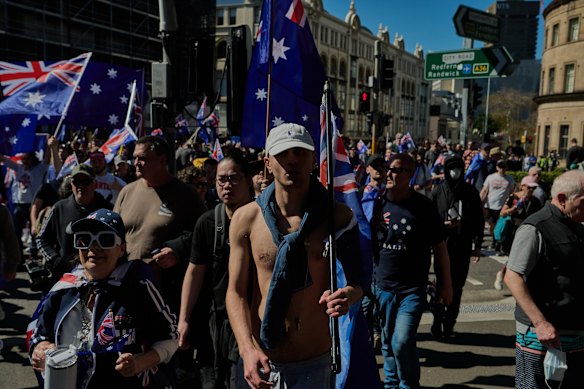
Anti-immigration march in Belmore park in Sydney on Sunday.Credit: Flavio Brancaleone
Alan Gamlen’s article should be compulsory reading for every sovereign citizen who is angry about “mass migration”. To move to Australia in 1970, I had to pay the outrageous fee of 10 pounds. I didn’t realise it at the time, but another qualifier was being in possession of white skin. The White Australia Policy was abolished shortly afterwards. These days it’s far more expensive to migrate to Australia, with applications for a standard partner visa starting at $9000. Nick Franklin, Katoomba
For some reason, if you want to rouse the populace, just bring up immigration. It is a fail-safe rabble-rouser. And in a country that is a migrant nation, where 50 per cent of us were born overseas. A country where we are not even having enough children to maintain our “Australian Culture”; if it were not for migration, our population would be declining, as would our economy and our standard of living. Australia is one of the most successful countries in the world at incorporating people of all ethnic backgrounds into our wonderful community. Michael McMullan, Avoca Beach
A lot of Australians were very disappointed with our prime minister’s words about the “some of them are good” participants at the so-called Marches for Australia. “Good people” do not join a march when neo-Nazis are running the show. You can’t be half in half out. And ignorance is not an excuse. You stay away. Albanese imitating Donald Trump is not a good look. Trump wanted us to believe there were also “good people” marching with the Ku Klux Klan at Charlottesville. Albanese’s response showed a lack of leadership and thoughtlessness, and did nothing to reassure Australia’s migrant communities. Pathetic really. Something you would expect from our Coalition but not a Labor leader. Wendy Atkins, Cooks Hill
Right to speak
In a democracy, one cannot silence people of opposing opinion by making the expression of contrary opinion a crime. One cannot destroy hate by being hateful oneself. It is those in power who are fuelling hate (“PM warns opponents against fuelling hate”, September 3). Many a person today not only feels abandoned by government but actually feels oppressed by the state. People must be allowed to speak, not condemned. As long as governments fail to respect people and to understand their differing points of view, the problem of conflict in a diverse community will only grow. Ross Drynan, Lindfield
Katter unworthy
Bob Katter’s behaviour has always made me cringe. Now reports reveal he is a bludger politician, as he often does not attend parliament (“Katter’s a piece of work, but he often doesn’t show up there”, September 3). Voters in his electorate need to think before they vote. The Independent Parliamentary Standards Commission should suspend him. Australians expect to hold their heads up high for our representatives to uphold our values of behaviour in debate, of listening and responding with respect. Katter continues to show he is unworthy of votes. Bea Hodgson, Gerringong

How much should we cater to Katter?Credit: Nine News
I do not condone violence or threats of violence. But imagine if Big Bob Katter, the Kennedy Seat Mauler, had taken a swing at the younger, fitter journalist. The younger may have dodged or blocked the punch. In either case, Bob probably would have lost his footing and broken a hip or similar. Bob, in the words of the bard, “for octogenarians, discretion is the better part of crankiness”. Kate Coates, Wangi Wangi
Jenna Price exposes the critical statistic that Bob Katter has failed to vote, on behalf of the electors of Kennedy, in any division since the commencement of this current parliament. He also failed to vote 70 per cent of the time last year. It would be mind-boggling to know how seldom Katter votes in divisions over a full term of a parliament, but it certainly isn’t doing the job of representing the views of the voters in Kennedy. Surely the Speaker of the House of Representatives has powers to reprimand Katter over his frequent non-attendance. Mark Berg, Caringbah South
Senator Sarah Hanson-Young’s reasonable call (“Calls for action over Katter outburst”, September 3) for the Independent Parliamentary Standards Commission to censure Bob Katter over his threatening outburst at a journalist is about heeding the wise advice that “We are judged by what we let pass by”. Steve Ngeow, Chatswood
Sanctions strategy
Yulia Navalnaya suggests sanctioning individual members of Putin’s corrupt autocratic regime, obviously including him (“Yulia Navalnaya is in Australia with a blunt message about Putin, the president who murdered her husband”, September 3). Sanctions tend to work better on smaller, less militarised countries whose economic resources are limited, and whose assets residing overseas can be frozen, in the style of Sergei Magnitsky, the Russian tax adviser who exposed corruption and misconduct by Russian government officials. Unless these circumstances prevail, how can applying sanctions on Russian individuals be expected to work, especially when most of their assets are, for all practical purposes, out of reach? Russia is heavily militarised, resource rich and vast. Russia has powerful allies in China, North Korea and India. A concerted effort to apply targeted economic and trade sanctions could spark the kind of revolution needed to oust Putin and hopefully lead to a “normal” Russia. Frederick Jansohn, Rose Bay
Timor shame
Your correspondent (Letters, September 3) rightly shows the levels of sacrifice made by the Chinese and the Russians in World War II, but proportions are also essential in understanding history. The average wartime deaths as a percentage of their 1939 populations shows China losing 3.38 per cent, the Soviet Union 13.7 per cent and Australia 0.58 per cent. Timor-Leste (then Portuguese Timor) lost 11.45 per cent. Portugal was neutral during the war, and it is debatable whether the Japanese would have invaded the eastern half of the island of Timor in February 1942 had Australia not done so two months beforehand. What is certain is that the Timorese sided with the 700 Australians – guiding, nursing, befriending them. We pulled out after 14 months, leaving the Timorese to the mercy of thousands of Japanese. No wonder one of our returned men said to me, “The only people I can’t look in the eye are the Timorese”. Sister Susan Connelly, Croydon
PM has to acknowledge t-word
Ross Gittins identifies two of the major problems facing the nation (“PM should go if he’s lost his bottle”, September 3). He might also add funding the NDIS, increasing defence spending and caring for an ageing population. All cost money, and it has to come from somewhere, namely in the form of tax. John Howard provided two significant examples that Mr Albanese would do well to consider. The first was the introduction of the “never ever” GST and the second was WorkChoices. Only one lost Howard the next election. Philip Cooney, Wentworth Falls

Anthony Albanese: As good as ever, or time to go?Credit: Alex Ellinghausen
As someone who would know, I wholeheartedly agree with Ross Gittins that there is no shame in being past it. But the statement begs the question: is Prime Minister Albanese past it? Just because he leads a Labor government does not rationally mean he needs to be, day in and day out, locked into pursuing reform for reform’s sake. There is much more to being a prime minister than that. Sometimes the astute thing to do is to be steady as she goes, especially, I might suggest, in a world, and country, that are increasingly fuelled by war, hatred and violence. There is much to suggest of late that Anthony Albanese is far from past it. His careful navigation of Australia’s position on the two-state solution and recognition of Palestine, his measured approach to what was, frankly, Mr Netanyahu’s abuse, his prompt and decisive action against Iran and his firm, methodical denunciation of last weekend’s racist tirades all demonstrate that far from being past it, Albanese is the leader we need right now. It just goes to show that once every 30 or so years even I must disagree with Ross Gittins. Rob Reitano, Lane Cove West
The Albanese government promised major reforms but is dragging its feet. Albo’s steady-as-she-goes approach is wearing thin, even with Labor supporters. It may have worked for the tortoise, but slow and steady is overrated. The Coalition will scream blue murder, no matter what is proposed – so what? There is wide support for action on climate change, health, education, housing and taxation. Can we please get on with it? Graham Lum, North Rocks
Agreed, Ross; ego may not be a dirty word, but mention tax and our leaders are MIA (with apologies to Skyhooks). Michael Blissenden, Dural
Bondi alternatives
The people (“Bondi neighbours lose battle over parking plan”, September 3) planning to spend over $300,000 each to build an underground garage might consider investing the money and using the income to pay for all necessary transport costs. Owning a car also involves costs, and Bondi residents have more than adequate public transport. Penelope Graham, St Peters
Merry migrants
If “we can’t agree on what ‘well planned’ looks like” (Letters, September 3), try Australia House London in the 1960s. Their officials made it clear that Australia’s immigration regime balanced population increase against demands upon infrastructure, employment opportunities, housing, education, hospitals, environment, transport and therefore prospered assimilation. That “common people” could end up in paradise at the ends of the earth, and within weeks employ their skills, have a mortgage, the beach, car, rescue mongrel, magpies demanding breakfast, attend schools and actively integrate now seems miraculous. European immigrants were not “the prey” to be exploited in competition with local and foreign property speculators (and their agents). It seemed that everyone’s objective was to forget World War II and build a better life for all children. Ronald Elliott, Sandringham (Vic)
Aussie Joe had a go
“Aussie Joe” was a proud Australian fighter who has hit the canvas for the last time (‴Aussie Joe’ Bugner, who fought Ali, dies”, September 3). Our adopted son has left the ring and entered our glorious folklore. Britain’s loss of his righteous and harmonious fists was our gain. In the best of Australian traditions, he had a go. Repeated concussions can predicate dementia and both onsets have now sadly claimed him. Athletes and military strategists should both heed Mike Tyson’s sage mantra: “A well-aimed blow can thwart the cleverest plan”. Vale to a warrior we can also claim as our own. Mike Fogarty, Weston (ACT)
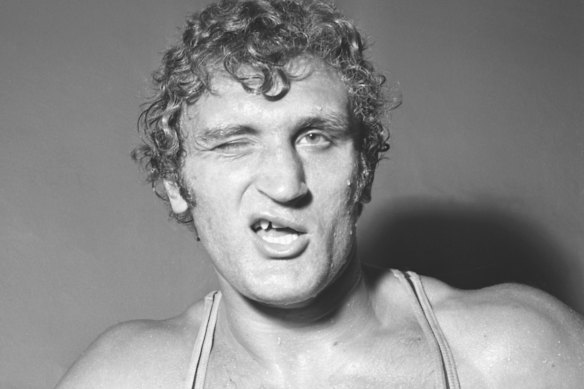
Then British Heavyweight boxer Joe Bugner winks towards the camera, after completing his daily training sessionCredit: AP
Train the jobless
The simple facts are that house prices are too high in relation to salaries, too many tax benefits are applied to the wealthy and Australian cities are beyond their capacity to support the population. There is no simple solutions, but negative gearing needs to be cancelled. Not many realise how this works. If you have an investment property and you have a loss, you can apply that to reduce tax on income from other sources. It should only apply to the investment and be applied to reducing capital gains when the property is sold. Further capital discounts need to be removed. Franking credits were introduced to offset against income tax. The Liberals foolishly legislated them to be paid in cash. Hence, a person paying no tax got a cash payment. That must go. Future migration needs to be settled in country areas. Businesses must train their employees and stop relying on migrants to fill positions. We have many unemployed who need training. Barry O’Connell, Old Toongabbie
Overly familial
We can assure your correspondents (Letters, September 3) that we are related by marriage and have achieved a daily double of letters published previously. We never collude, but will admit to a (mostly) friendly rivalry. Robert and Lorraine Hickey, Green Point
I believe that, on one day, the Herald did publish one of the Alison Stewarts in Letters and the other in Column 8. I only keep clippings of my contributions so my files couldn’t confirm that. Alison Stewart, Waitara
Does my printed letter, followed by my son’s comment, followed by my reply, count? Janet Scilly, Waterloo
To submit a letter to The Sydney Morning Herald, email [email protected]. Click here for tips on how to submit letters.
The Opinion newsletter is a weekly wrap of views that will challenge, champion and inform. Sign up here.