
 3 months ago
66
3 months ago
66
Lachlan Campbell has shadows under his eyes. It’s the morning after a “typical night” in Kramatorsk, a Ukrainian city on the frontline of the war with Russia, where sleep is snatched in increments between air raid sirens, anti-aircraft fire and explosions.
Behind Campbell, a building reduced to ruins fills the frame on our video call in mid-May. Wires dangle from what’s left of the ceiling, exposed beams look like they could fall anytime. He picks up a car brochure from the ruins, the only visible sign of the business that operated here before Russian bombs hit.
We haven’t been speaking for long before the war interrupts. Our call drops out and when Campbell comes back online a few minutes later, he calmly explains that another air raid siren is sounding, a high-pitched, whirring noise that often cuts out his phone signal.
The 46-year-old father of two from Queensland drove into Kramatorsk – in the Donbas region of eastern Ukraine – in early May. The day before he arrived, aerial bombings killed six people and injured 13. A popular restaurant was among the sites hit. “People were sitting down to lunch … and were killed in that strike,” Campbell says. “Somebody just going out, having lunch with their friends.”
The dangers of being in a war zone are not new to Campbell. He first went to Ukraine just a month after Russia invaded in early 2022 and received a fierce induction to the conflict’s brutality when he came across the bodies of people who’d been shot as they tried to flee.
During four trips to the war-torn nation, he’s repeatedly returned to frontline areas to help with evacuations and treat dozens of injuries. But he has no military training, and he’s not a medic. He’s a vet from the Sunshine Coast, and his patients are animals caught in the chaos.
Ukraine has been under bombardment from its more powerful neighbour for more than four years, and the human toll has been devastating. More than 15,000 civilians have been killed, according to the United Nations Human Rights Monitoring Mission in Ukraine. Military casualties are more closely guarded, but the Center for Strategic and International Studies (CSIS) in Washington, D. C. estimates that as many as 140,000 Ukrainian soldiers have died.
Animals have not been spared. In 2022, Ukrainian President Volodymyr Zelenskyy told the G20 summit in Bali that millions of domestic animals had died. Some were killed by bombs, while others were caught in crossfire, put down by owners or perished from hunger, say animal welfare organisations.
Countless dogs and cats have been left behind in conflict zones, with civilians often unable to take pets with them as they fled the Russian invasion. According to the World Health Organisation, this has also led to an explosion in the stray population and a resurgence in rabies, a disease deadly for both animals and humans. Vaccination programs have become yet another casualty of the conflict.
In times of war, when human lives are on the line, animal welfare is pushed to the sidelines. Ostensibly, Lachlan Campbell travels to Ukraine to rescue and treat dogs and cats. “I’m here for the animals, and the reason why I do what I do here is because I obviously have a certain skill set, and I have the ability to be able to help,” he says.
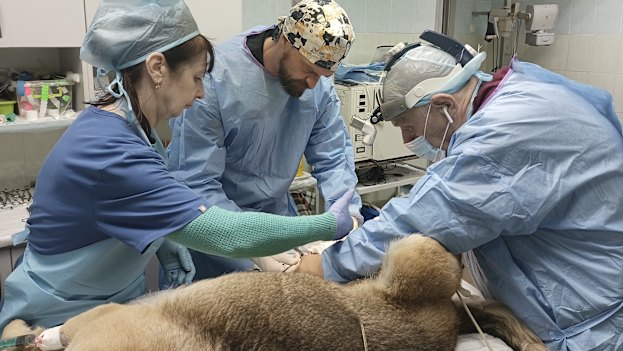
But as he describes the people’s suffering, their struggle to carry on with daily life when drones can deliver death from above at any moment, it becomes clear that, for him, the plight of the country’s citizens and animals are linked. “The people of Ukraine have already experienced such significant hardship and loss,” he says. “Animals just provide that support, that unconditional love, and to be able to assist in that, people really appreciate it.”
When Russian President Vladimir Putin launched troops and missiles into Ukraine in early 2022, Campbell was working as a vet in Caloundra. His two young kids had not long started primary school, and he often did volunteer work in his local community, such as treating pets belonging to the homeless.
War was a distant concept for a man who’d grown up in Melbourne and Brisbane before settling on one of Australia’s idyllic stretches of coastline. But after Russia’s full-scale invasion, he saw footage of Ukrainians streaming across the border into Poland, many of them carrying pets. “That made me think, ‘Is there anything I can do to help?’ ” he recalls. “Quickly I realised, ‘Yes, actually, there is.’ ”
He booked a flight to Poland and, at his brother’s suggestion, started a GoFundMe page to help buy pet food and other supplies. He had only planned to go as far as the Polish border but, at a warehouse that was distributing animal food, he met a member of Nowzad, a British animal charity, who asked if he wanted to go into Ukraine with them.
When they crossed the border, they went to a university in Lviv, where refugees were sleeping on the floor of a basketball stadium. Campbell set up a pop-up clinic to treat their pets. “I saw I could do so much more in Ukraine than just sitting on the border,” he says.
He teamed up with Pen Farthing, a former British royal marine who founded Nowzad in Afghanistan in 2007. Travelling in a van, they followed a Ukrainian military convoy into Irpin, on the outskirts of the capital, Kyiv. It was just a day after the Ukrainians had pushed Russian troops out of the area, which saw some of the deadliest fighting in the early stages of the war. Afraid that the Russians may have left landmines, the Ukrainians warned them not to venture off the road.
“There were cars with bullet holes through the windshields, with blood splattered all over the car,” Campbell recalls. “There were dead bodies on the side of the road.”
‘You’ve got to compartmentalise things to manage what’s going on. Family, work, here …’
Lachlan CampbellAt a bus stop, he came across people trying to pick up the dead. “They were struggling, so I helped them lift these bodies into the back of their van … These were just elderly people … There was [also] a lady who would have been about 30.”
Campbell says his experiences are nothing compared to the trauma Ukrainians face daily. “I’m here for a brief period,” he says. “This is what the people of Ukraine are experiencing on a day-to-day basis. This is where they live.”
On that first trip, he found many animals – some alive, some already dead – who had been left behind when their owners fled. He helped treat many of those who survived for malnourishment. Since then, Campbell has returned every year to spend about a month rescuing dogs from the front lines, vaccinating and desexing hundreds of cats and dogs, and treating injured animals, including birds, goats and a lizard.
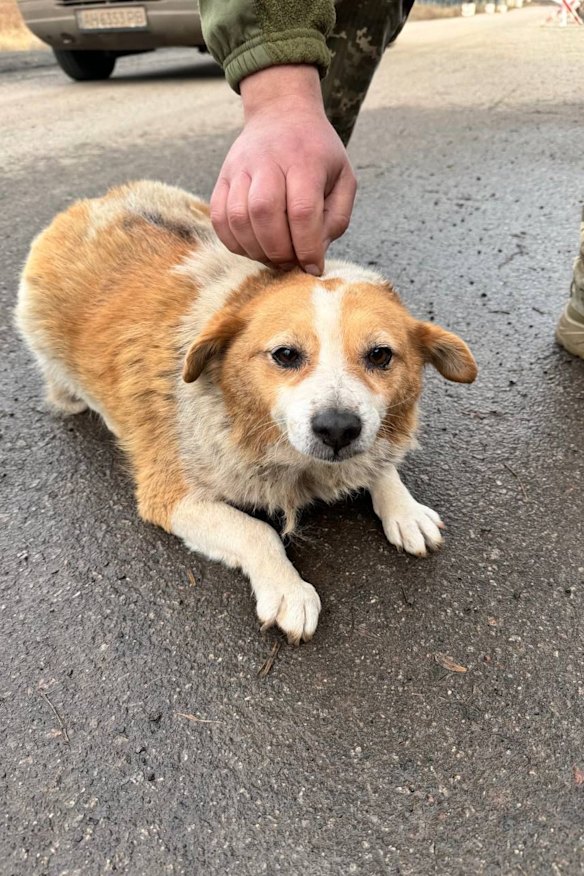
He takes unpaid leave from his job in Australia, working for free in Ukraine with local volunteers and staff at animal shelters supported by Nowzad, and has become the charity’s veterinary advisor. In May, he helped evacuate a small, older dog with long white whiskers and tan ears called Baba from a Kramatorsk army base. Soldiers had been caring for Baba for the past 10 years but the base has increasingly become a target for drone strikes.
“The soldiers, they’re just normal people wanting to take assurance in having animals around, and being able to give an animal a pat and a cuddle,” Campbell says. “But they realised it’s time for Baba to go and get a better home that’s less dangerous.” He helped evacuate Baba to a shelter west of Kyiv, and Nowzad is trying to find her a permanent home. Just days after Campbell picked up Baba, he learnt one of the soldiers who had cared for her had been killed.
“He’s got a wife and children, and his name was Oleg,” Campbell says. “It’s just so sad.”
In Kramatorsk, where Campbell spent much of his time in May, evidence of the war is everywhere. Turning his phone camera around, he takes me on a walk around the area near the local animal shelter, where dogs are housed in small wooden sheds. A bomb landed just 20 metres away in 2023. Shrapnel flew into the shelter but no volunteers or animals were injured.
Campbell points out a road sign pockmarked with bullet holes; a service station barricaded with concrete blocks; netting suspended above the road like a spider’s web, designed to repel incoming drones. He usually travels around the country with another volunteer. One of them drives while the other watches the drone detector, a small rectangular black box that alerts the user if a drone is in the area. They work closely with local contacts who have access to Ukrainian military intelligence.
“What this war is becoming, honestly, it’s surreal,” Campbell says. “With these drones, these guided bombs that actually can see where they’re going … the fact that I’m having to walk around with a drone detector, it’s like, ‘Is this World War III?’ ”
Campbell’s work with Nowzad has also taken him to Afghanistan, where he operated on animals and trained local vets behind the concrete blast walls of the charity’s Kabul clinic. He knows that his trips away impact his family, and says he doesn’t tell his wife, who is also a vet, much about the traumatic scenes he encounters in Ukraine. When he calls home, he likes to show his children, now aged nine and 10, snippets of everyday life, like buying ice-cream at the supermarket.
Campbell has visited Kramatorsk on three of his four trips, and seen the city’s population dwindle as the frontline has drawn closer. Recent reports indicate that Russian forces were as close as seven kilometres away.
It is not known how many Australians have travelled to Ukraine to help with aid work or fight with the country’s military, but reports suggest as many as eight Australians may have died. Given the inherent dangers of this war zone, why does Campbell risk his life to save animals?
“I understand why people see it as risky, particularly when I have a family and life back in Australia,” he says. “We mitigate that risk as much as we possibly can, but the reality is a lot of it comes down to being in the wrong place at the wrong time. I focus on the help I can provide. The people and animals living there don’t get to leave the war each day. They still have to go to work, buy food and try to live normal lives through it all. I get to go home. I feel the least I can do is stand alongside them and help where I can.”
He says Ukrainians who remain in frontline cities such as Kramatorsk are desperately trying to care for the animals they find. Campbell recently met a couple and their young son who are looking after about 70 cats in their apartment. “They’re just doing what they can do to support the animals that are here,” he says.
In May, just a few days before we spoke, soldiers phoned the Kramatorsk shelter. They had found a dog caught in razor wire. When Campbell rushed to the site, he found a grey and white dog suffering from blood loss, overheating and on the brink of organ failure. “Ten minutes later, that dog wouldn’t have been alive,” he says.
A video taken by another volunteer shows Campbell stabilising the large dog on the roadside, hooking him up to a drip and loading him into a car, beside a shotgun on the backseat. “That shotgun is there as drone defence. If a drone is following, you’ve got to evacuate the vehicle, you’ve got to get out, but … you’ve got to try and shoot the drone down,” he tells me, explaining that the gun belonged to a local volunteer. “It’s a surreal thing to go to locations and vaccinate animals with somebody carrying a shotgun and a drone detector, and watching out for what’s going on in the skies.”
The dog is now in a foster home and expected to make a full recovery.
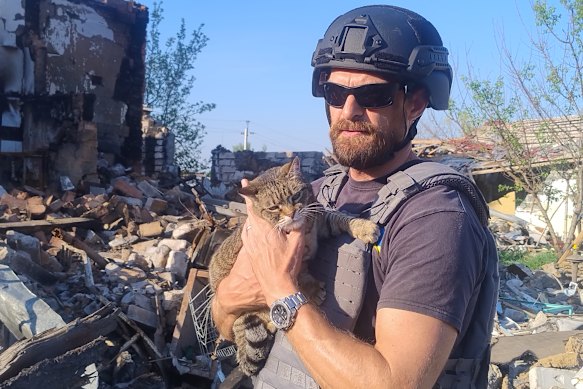
In some cases, Campbell has been called in to help in the aftermath of Russian attacks. One such case came in May, when a bomb partly destroyed the home of a woman who had been caring for about 20 stray and abandoned cats. “She got injured quite badly in the leg, half her house was totally destroyed,” he says. “The cats got free and ran off.” Campbell and other volunteers searched for the cats, but he only managed to catch one, a large, brown cat with a striped tail. After he vaccinated the cat, another carer took it in, as the injured woman was no longer able to care for animals.
With shelters across Ukraine already full, Campbell says it’s become harder to find places for animals in need. Nowzad evacuated six dogs to the UK in the early days of the war, when some European countries granted emergency exceptions to allow animals to be brought in. But regulations have since tightened, making it difficult to find homes for animals outside of Ukraine. The Ukraine rescues come after the charity evacuated 171 dogs and cats from Afghanistan as the Taliban seized control in 2021.
In conflicts throughout history, animals have suffered alongside people. Millions of horses, cattle and dogs perished during the two world wars. In Britain, 750,000 pets were euthanised in just one week at the beginning of World War II, following a government campaign warning people that it would be better to have their animals destroyed if their neighbours couldn’t care for them when evacuating.
But each conflict seems to bring stories of heroic rescues. As civil war raged in Syria in 2017, animal welfare organisation Four Paws evacuated a lion named Saeed and 12 other animals from an abandoned amusement park near Aleppo. The organisation rescued an emaciated lion called Simba and a bear called Lula from a zoo in Iraq the same year. Both lions were eventually sent to a sanctuary in South Africa.
After our conversation, Campbell set off on a two-day drive from Kramatorsk to Kyiv. He delivered five dogs to another shelter before continuing the long journey home to his family and his regular job as chief veterinary officer for a chain of more than 80 vet clinics across Australia and New Zealand.
“It does take a little bit of a mind shift,” Campbell says. “You’ve got to compartmentalise things to manage what’s going on. Family, work, here … I guess it puts life into perspective a bit in that, who really cares if you have to wait a couple of minutes to buy some milk.”
Last month, a few days after returning to the Sunshine Coast, Campbell received an update from Kramatorsk. Cluster munitions had landed near the animal shelter. Shockwaves from the blast had knocked one of the dogs unconscious and he had begun having seizures.
Campbell suspected the dog suffered a blast lung injury, which can result in lung haemorrhage and breathing difficulties. No volunteers were injured, and the dog, a black and tan mixed breed, is now improving. “It’s really difficult to not be there and be able to look at the dog myself,” says Campbell, who continues to advise local volunteers on the dog’s treatment.
With the war grinding on into its fifth year, Campbell is already planning his next trip to Ukraine, and may return later this year. “I keep coming back because I see the need for these people and for these animals,” he says. “If I’m fortunate enough to be able to help, I want to help and I think it’s something that I just have to do.”
Read more from Good Weekend:
- The terrible need that propelled Ukraine to the top of this market
- Sending ‘gifts’ to Russian soldiers: The punk rocker making drones in a Kyiv basement
- The complicated mix of rage and shame felt in Australia’s Russian community
Get the best of Good Weekend delivered to your inbox every Saturday morning. Sign up for our newsletter.

















































