3 months ago
25
3 months ago
25
The Ashes teams have lost faith in Snicko. It’s now facing its own review
That conversation will run parallel with growing pressure from broadcasters, players and match officials for the International Cricket Council to agree to a standardised and funded system for third-umpire technology.
While they enjoyed their Ashes victory celebrations, Australia’s players were in agreement with England captain Ben Stokes in wanting more consistency in both the technology used, and the processes by which decisions were made.
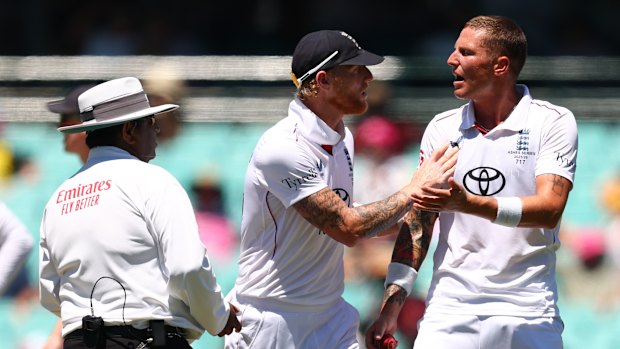
Stokes pushes away Carse before having words with the on-field umpire.Credit: Getty Images
Stokes’ frustration about the Weatherald decision, which was the catalyst for heated exchanges between England’s captain, the umpires, fast bowler Brydon Carse, Weatherald and Travis Head, was driven partly by how he felt the sequence of events ran contrary to how he’d been briefed about the system earlier in the series.
“Consistency is the word there,” Stokes said. “I don’t know, really. There’s rulings for umpires, in particular third umpires, to go off.
Loading
“Especially after the carry-on in Adelaide, where I went up and had a good chat with [match referee] Jeff Crowe after what happened there [when Alex Carey was given not out]. That decision was actually correct based on how an umpire actually has to make the decision.
“The murmur was nowhere near where the guidelines are given for overturning a decision, even though we all knew it was wrong, the umpire could not have given Alex Carey’s out under the process ... but this one here, I just thought it was out. There was a noise, a frame after the ball obviously passes the bat ... so it should have been given out. Where has the consistency gone? I just don’t get it.”
The peak body for making changes to the DRS is the ICC’s cricket committee, chaired by former Indian skipper Sourav Ganguly, and due to meet later this year. India are known to prefer the use of UltraEdge rather than Snicko, having made that clear ahead of previous series.
The most complicated part of the issue is financial, given that bilateral series are played and paid for by host boards, rather than the ICC itself, which controls global tournaments such as the looming Twenty20 World Cup in Sri Lanka and India. Any standardised system would need to be paid for out of ICC funds, which are largely split between member countries (India gets around 40 per cent of the windfall).
"Why do we not use the same technology all around the world?" Stokes asked. “This kind of stuff shouldn’t be spoken about, because that’s not the reason why we’ve lost 4-1, but the fact that it keeps on coming up ... something should be done about it. Just use the same technology everywhere just so we don’t have to sit up here and have these conversations.”
Loading
Meanwhile, during Australia’s Ashes celebrations, Mitchell Starc had his first beer in months after sticking to a disciplined fitness and recovery regime to get through all five Tests.
It has been typical for Australian fast bowlers like Starc, Pat Cummins and others to keep drinking to a minimum during series to aid recovery, and it was a tell-tale sign the captain was “one and done” after Adelaide when he kept pace with Travis Head for the team’s celebrations after retaining the urn by going 3-0 up.
Most Viewed in Sport
Loading