3 months ago
28
3 months ago
28
In 1937, when Australian states started trying to reduce the risk of shark attacks, the best approach available was to stick a large rectangle of woven mesh cotton or hemp out in the water and hope it caught and killed a few of the ocean predators.
While other states only use non-lethal shark control, that same technology is still used in NSW and Queensland – only now the mesh nets are nylon. There is no evidence the nets are effective, scientists say, and plenty of proof they kill a lot of other marine life, but getting rid of them remains a thorny political problem.
After an unprecedented spate of shark attacks has left four people injured in NSW since the weekend – two critically – there is renewed focus on what might be done to mitigate against shark attacks beyond urging swimmers to avoid turbid waters or killing some of the animals that live in them.
What if you could stop sharks from entering the beach without hurting them or any other animals by deploying magnets?
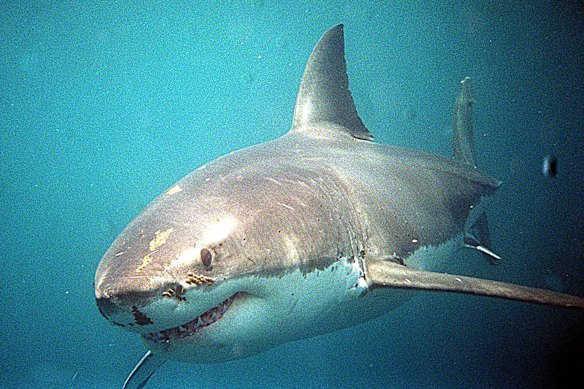
Sharks are sensitive to magnets.Credit: AP
It sounds like science fiction, but that is the promise made by SharkSafe Barrier Australia, which is spruiking technology developed by the University of Stellenbosch in South Africa and already used in the Bahamas.
Director Neill Laurenson says it works because the magnets disrupt the small, sensitive receptor pores at the tip of a shark’s head, called ampullae of Lorenzini.
“It creates an overwhelming sense for them, so they just don’t go through it,” Laurenson says. “It’s like sort of tear gas for sharks. It doesn’t hurt them, it’s just uncomfortable.”
For several years, SharkSafe Australia has been doggedly trying to convince state governments to install its product. The company has developed proposals for dozens of Australian beaches, from St Kilda and Warrnambool in Victoria to Mooloolaba, Coolum and Noosa in Queensland.
The most encouraging response so far has been from the NSW government, which requested a detailed pitch for Wattamolla in Royal National Park that remains under consideration.
In the SharkSafe Barrier system, Laurenson says, there is generally a stainless-steel base anchored to the seabed and covered with a concrete foundation that is designed to mimic a limpet so it does not roll over in the waves. Stainless-steel connectors are attached to durable plastic pipes that mimic a kelp forest that protrude from the water by 200 millimetres, but can be easily pushed aside by a boat or animal or person swimming through. The plastic pipes contain the magnets.
SharkSafe Barrier Australia says it has hundreds of hours of underwater footage from trials in South Africa, in the Bahamas in the Caribbean, and Reunion Island in the Indian Ocean that show great white sharks present a third of the time yet never entering the exclusion area, even when the researchers placed bait on the other side.
The first commercial deployment of the barrier, a 30-metre section at a private resort in the Bahamas, has lasted through rough seas and hurricanes for more than two years, the company says, and the client has now commissioned a second installation.
A number of published peer-reviewed articles in scientific journals confirm the technology has promise, though at least one study suggests that bull sharks consistently penetrate the barrier, and using electromagnets could produce better performance. This is contested by the company.
Professor Charlie Huveneers, who heads the Southern Shark Ecology Group at Flinders University, says the SharkSafe Barrier is not a complete physical barrier, but deters sharks because of the kelp-like strands acting as a visual barrier and the magnets. “The SharkSafe Barrier can therefore reduce risk but might not completely eliminate it,” he says.
The SharkSafe Barrier technology has won the support of Humane World for Animals, which campaigns against the mesh nets because of the high bycatch.
“We are very supportive of barrier technologies that physically and non-lethally exclude sharks,” says the charity’s marine biologist Lawrence Chlebeck. “The SharkSafe Barrier has been proven effective at excluding sharks from an area, and does not entangle and kill wildlife and therefore does not risk attracting sharks.”
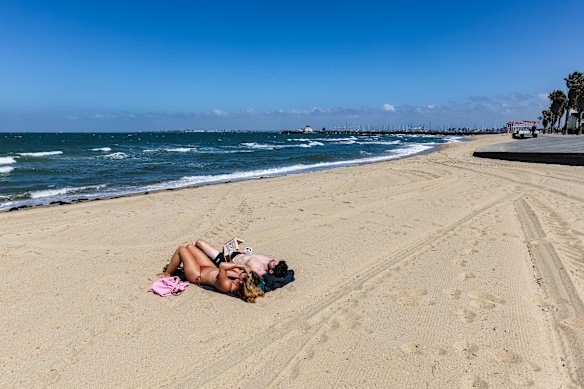
SharkSafe Barrier has proposed an installation at St Kilda Beach in Melbourne.Credit: Justin McManus
However, Chlebeck says the SharkSafe Barrier installations may not be suitable for everywhere since the magnetic barrier would deter all sharks and this could include harmless species, including critically endangered grey nurse sharks, Port Jackson sharks, wobbegongs, and potentially some species of rays.
The research suggests the magnetic effect is strongest on bigger sharks because their receptors are bigger, and Laurenson says the company would not support installing the barriers somewhere that would have a bad environmental outcome, such as in an estuary used as a breeding ground.
Humane World supports any permanent shark barriers that do not kill sharks or other animals. This includes the three-sided nets in place for decades at locations such as Sydney Harbour and Pittwater beaches, which create barriers between swimmers and the open water. These stiff nets are static and do not harm wildlife, but are unsuitable for large ocean beaches with shifting sandbars. They are unlike the mesh shark nets that are installed at 51 beaches from Wollongong to Newcastle every summer that do not create an enclosure, but do kill wildlife.
A modern variation on the stiff physical barrier is the Eco Shark Barrier, which is anchored to the sea floor in the desired shape and made from strong plastic with marine-grade rope, providing a complete enclosure from seabed to surface. This is in place at several Western Australian beaches; it was first installed at Perth’s Coogee Beach in 2013, and is now also at Sorrento, Cottlesloe and Esperance. There is also a small installation at Bermagui in NSW, next to the boat harbour, and like the SharkSafe Barrier, Eco Shark Barrier has its first international contract in the Bahamas.
However, the NSW Department of Primary Industries and Regional Development, which runs the state’s shark mitigation program, attempted to trial the Eco Shark Barrier at Lighthouse Beach in Ballina and Seven Mile Beach in Lennox Head in 2016. The Ballina installation could not be completed and the Lennox Head installation was abandoned mid-construction because of rough ocean conditions.
Eco Shark Barrier owner Craig Moss says his installations are suitable in swells up to three metres if there is not too much sand movement. Most Perth beaches qualify, but most ocean beaches on the east coast do not. He has, however, priced jobs in Sydney Harbour.
While the upfront cost is a lot higher than the mesh nets, Moss points out that it is more effective. “The one in Cottesloe has been there for nearly seven years and a lot of locals didn’t like it at the start, but now they love it,” Moss says. “When I go every morning, the turnover from 5 o’clock in the morning to 8 o’clock at night is 1000 people swimming in the barrier, so it does make people come to the location and enjoy time in the ocean, feeling safe.”
A department spokesperson says staff first met SharkSafe Barrier Australia representatives in 2018 to discuss the company’s proposal for trials on the Far North Coast. The discussion identified Wattamolla and Garie beaches in Royal National Park as more suitable locations for a trial.
There was a further meeting in January 2025, the spokesperson says, and the company submitted a formal proposal in March 2025.
“The department will be reviewing the SharkSafe Barrier proposal over the coming months,” the spokesperson says. “At this stage the department considers the proposal to be commercial-in-confidence and cannot discuss the details.
“The NSW government will always consider emerging technologies which may offer further protections to ocean users, while continuing to deploy evidence-based shark mitigation measures under its $24 million shark management program, such as drones, SMART drumlines, tagging and tagged shark listening stations.”
The Queensland Department of Primary Industries says it has previously engaged with SharkSafe Barrier representatives to understand the technology, but the proposals submitted for Mooloolaba and other beaches were not requested by the government and no commitments had been made.
“Any future consideration of the SharkSafe Barrier would require robust scientific evidence demonstrating its effectiveness in excluding species such as white, bull, and tiger sharks,” the spokesperson says.
“Additionally, the suitability of any shark barrier for Queensland’s physical environment is a key consideration. Factors such as strong currents, large tidal ranges, and the potential for marine life entanglement or habitat disruption must be carefully assessed to ensure the safety of both marine life and beach users.”

Sunshine Coast Council and the Queensland government have been briefed on shark barrier options for Mooloolaba Beach.Credit: Dan Peled
A spokesperson for Victorian Fisheries Authority did not respond to questions about the SharkSafe Barrier proposals, but gave a statement urging anyone who spots a shark to ring police on 000 and provide details about the location, time and estimated size.
Victoria does not use mesh nets, which the authority’s website says is for several reasons, including the fact there had not been a fatality caused by a shark bite in the state since 1987, concerns that nets can be damaged by migrating whales, and the evidence from NSW that the nets mostly catch other species.
The NSW Threatened Species Scientific Committee wrote in its performance review of the 2024-25 shark meshing program that: “The lack of evidence that netting provides any additional benefit to bather protection above and beyond alternative management methods that avoid harm to wildlife suggests that investigation into the necessity for continued use of the nets is urgently needed.”
NSW recorded 223 entanglements of marine wildlife in 2024-25, 49 of which were threatened or protected species. Among the critically endangered or endangered species entangled in the nets were four grey nurse sharks, one scalloped hammerhead, two leatherback turtles and one loggerhead turtle.
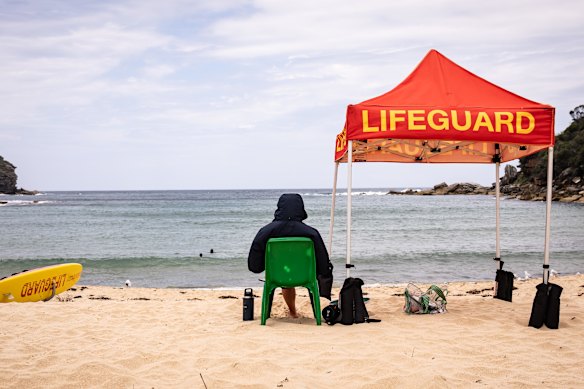
A lone lifeguard at Wattamolla Beach in the Royal National Park in January.Credit: Wolter Peeters
A department spokesperson says the main objective of the program is to protect the safety of beach users, while minimising the impact on sharks and non-target species. New conservation measures last year included placing lights on nets to deter turtles and prevent their entanglement, increasing drone surveillance over the nets, increased frequency of net inspections, and removing the shark nets a month early to respond to increased turtle activity in April.
The total number of entanglements was down from 255 the previous year, but the review found the additional measures had not decreased the proportion of creatures that died after being caught in the nets.
The intention of the nets was always to kill – news articles back in the 1930s discussed how the strategy would “rid the ocean of sharks” over time. A trial to remove them from three Sydney beaches this summer was aborted after surfer Mercury Psillakis died from a shark attack at Dee Why in September, just a few days after nets were installed for the season.
Loading
Baited drumlines, which catch sharks on hooks and leave them to die in the ocean, were introduced in the 1960s and are still used in north Queensland. NSW now has SMART drumlines fitted with sensors that alert a contractor to attend the site soon after an animal is caught, raising the prospects of survival. Non-target species are released, while target sharks are tagged and released further out to sea.
The Queensland department says it will stick to mesh nets and traditional drumlines until non-lethal shark control technologies are proven.
One potential downside for the SharkSafe Barrier could be the high up-front cost. Laurenson says it works out at $9000 a metre because the installation needs to be done by divers – and for a beach like Bondi that is a kilometre wide, that would be a potential cost of $9 million.
Laurenson says it could last for 25 to 30 years if properly maintained and be funded as infrastructure rather than the capital expense of the current program. By contrast, he says the plastic barriers such as the Eco Shark Barriers in place in Perth only last a few years and often have to be pulled out in winter.
Moss, however, says it depends on the location; the one in Esperance, which gets swell up to 1.5 metres, has not needed anything fixed in three years.
Huveneers points out that all shark-bite mitigation measures have costs. “While these barriers might be costly, so is the meshing program,” Huveneers said. “Most of the costs are initially when purchasing and installing the equipment, but servicing costs are less than the beach meshing program requiring contractors to frequently check the nets.”
Is it worth it? Fatalities from shark bites are rare, but many people in the community want shark deterrence.
Get to the heart of what’s happening with climate change and the environment. Sign up for our fortnightly Environment newsletter.