3 months ago
5
3 months ago
5
Entertainment reporter Justin Hill had just 4½ minutes when he sat down with Cynthia Erivo and Ariana Grande in Sydney last November.
But he spent 30 seconds of that offering them thanks – twice.
“I give you my gratitude for taking care of these characters, and how you have put so much thought and effort into taking care of them for us,” Hill told the pair, who would go on to be Oscar-nominated for their roles as Elphaba Thropp and Galinda “Glinda” Upland in Jon M. Chu’s Wicked: Part One.
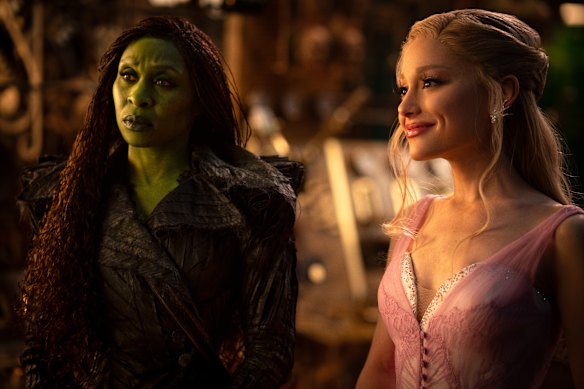
Wicked comes to its conclusion this week in Australian cinemas. Cynthia Erivo (left) and Ariana Grande (right) have been taking care of Elphaba Thropp and Glinda Upland for almost four years.Credit: Universal Pictures
The emotion of that globe-trotting press tour is dominating the zeitgeist again a year later, with Erivo, 38, and Grande, 32, once again on the Yellow Brick Road – though this time with fewer interviews, tears, and fingernail holding – promoting the movie-musical’s second act, Wicked: For Good.
If you tried to explain to a non-fan how Erivo and Grande were visibly honoured to be called “my autism” and “my ADHD” by Em Rusciano, they’d be baffled. But Erivo liked the Rusciano interview – which ended with all three in tears as Rusciano thanked the actors for their service – so much she personally requested the Australian comedian’s presence at For Good’s Singapore premiere last week, and then ran towards Rusciano the second she spotted her from the red carpet.
Loading
Hill and Rusciano are not alone in their gratitude which reflects the challenges in adapting the beloved musical – it took more than two decades for power producer Marc Platt to bring Wicked from Broadway to the big screen.
“I felt pressure on myself and an obligation to the fans who protected and loved these characters,” he told Variety in February. “It meant so much to them … the bar was very high for me.”
The bar was very high for Jess Filby too. The 28-year-old Wicked fan first saw the musical in 2009 when it first played in Sydney. She has three tattoos dedicated to it.
“Growing up, I think I related to Elphaba a bit, being an outsider and feeling different to everyone else,” says Filby. “That is still true to me today.”
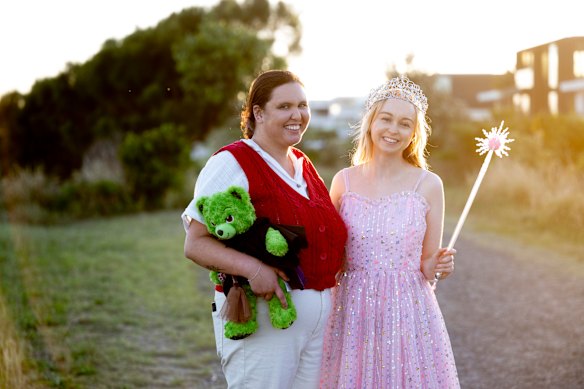
Jess Filby, left, with her best friend, Samantha Phillpott-Moore. The duo are attending multiple screenings of Wicked: For Good together and they’ll be wearing these Fiyero and Glinda costumes.Credit: Janie Barrett
Filby has spent at least $900 on tickets to see both films. Last year, she saw Part One in cinemas eight times, and has booked tickets to seven showings of For Good so far. On Friday, she and best friend Samantha Phillpott-Moore, 27, will be attending three back-to-back screenings dressed as Fiyero and Glinda.
Loading
“It’s an immersive experience when watching the film and seeing everyone else dressing up as well,” says Filby. “It gives a real sense of inclusion and coming together to enjoy the one single interest.”
Cosplayer Brooke Littler, 29, can attest to this. She dressed as Dorothy Gale to attend For Good’s Melbourne preview screening last week, where conversations among strangers were sparked by their various costumes. It’s how Littler and Sarah Thompson, 25, got talking.
“We’re just a bunch of nerds who are playing dress up,” says Thompson. “It creates a sense of belonging for all of us, which is so lovely.”
Thompson spent days working on her Nessarose costume, the centrepiece of which were two 3D-printed replicas of the character’s bejewelled silver slippers. Each one took 17 hours to print, and five hours to rhinestone.
Those 44 hours do not include the time spent designing and hand-painting them – but it was all worth it to dress as a character played by Marissa Bode, says Thompson.
Thompson is an ambulatory wheelchair user and became a Wicked fan after watching the first film, which marked the first time a real-life wheelchair user played Nessarose in the character’s history. She calls Bode – who inspired the subsequent casting of ambulatory wheelchair user Jenna Bainbridge as Nessarose on Broadway – “an amazing representation for the disabled community”.
Loading
What Wicked stands for and the people it uplifts is, in part, why Sascha Samlal believes there hasn’t been the tension one would expect between theatre diehards and fans who have jumped aboard because of the movie.
“Any story that is an anti-fascist story needs to be told during these times,” says Samlal, who is a PhD candidate in cultural studies at the University of Melbourne. Samlal calls Wicked a “beautiful allegory for marginalised people working against power systems”.
“Elphaba is really relatable,” says Samlal. “Not in just the sense of feeling marginalised and feeling othered for something that you can’t help, like being born with green skin, being gay or being trans or being queer, but also having… to accept that people are going to project certain views onto you, and you can’t help that.”
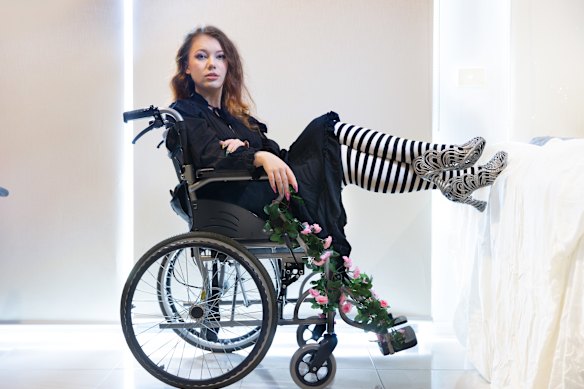
Sarah Thompson is a huge Wicked fan and an ambulatory wheelchair user. She appreciates that in the film Nessarose is played by real-life wheelchair user Marissa Bode. Credit: Simon Schluter
Wicked is one of the few safe fandoms left for the LGBTQIA+ community, who may no longer feel comfortable within franchises that once might have been a progressive haven, but have since been associated with regressive politics (yes, we’re talking about Harry Potter). That doesn’t mean there haven’t been teething issues.
Loading
The stage show’s journey to silver screen came as execs, thanks to Taylor Swift’s The Eras Tour, and Greta Gerwig and Margot Robbie’s Barbie, realised the commercial power of treating big releases as community events.
A truly “scandalacious” amount of merchandise – Deadline reports Universal Pictures’ 450 brand partnerships racked up $US350 million ($537 million) for the studio – has marked each film’s release, alongside social media content that leans in to the audience’s parasocial connection to the story, characters and cast. (Lionsgate got in on this strategy ahead of its Twilight re-release, hiring fan editors to populate TikTok with fancams).
Seasoned veterans who remember the shame that came whenever fan art broke out of Tumblr and into the mainstream, not to mention the copyright battles, know to treat studios’ newfound appreciation for fandom with caution. But a new generation of fans has yet to be burnt. And, because idols are more accessible than ever on social media, the lines have never been more blurred.
“Part of the difficulty is, in this rapid expansion of the visibility of fandoms … a lot of etiquette that came from being in fandoms in more closed environments has been lost,” says Dr Georgia Carroll, who holds a PhD in fandom and celebrity studies.
We’ve seen the results of negotiating these new norms in real-time. In October 2024, Erivo took to Instagram to blast a fan-made Wicked poster as the “wildest, most offensive thing” she had seen. Last week, an Australian man was jailed in Singapore for ambushing Grande on the red carpet.
The bad behaviour, however, goes both ways. Prime Video apologised last month after making fun of a woman’s engagement ring to capitalise on an in-joke among The Summer I Turned Pretty fans. But, Carroll emphasises, it’s not the norm.
When it does happen, she says, it’s called out by celebrities, studios and fellow fans. The bigger trend is the yearning for community – and Wicked’s will endure long after the hype around the film dies down.
“[Wicked] really resonated, as someone who sometimes felt like I didn’t fit in... as well as struggling to find friends and people around me when I was younger,” says Thompson. “It felt very personal … [it’s] a story that I feel a lot of people can relate to.”
Must-see movies, interviews and all the latest from the world of film delivered to your inbox. Sign up for our Screening Room newsletter.
Most Viewed in Culture
Loading