2 months ago
22
2 months ago
22
Brisbane: Nothing was more telling about Jake Weatherald’s third Test innings than how, in partnership with Travis Head on a steamy and noisy Gabba afternoon in the second Ashes Test, the junior man could easily have passed for the senior partner.
Where Head took the leading role in Perth to gallop home in pursuit of 205 to win, now Weatherald showed a method both fearless and decisive, to ensure that England were unable to replicate the success of Mitchell Starc on day one.
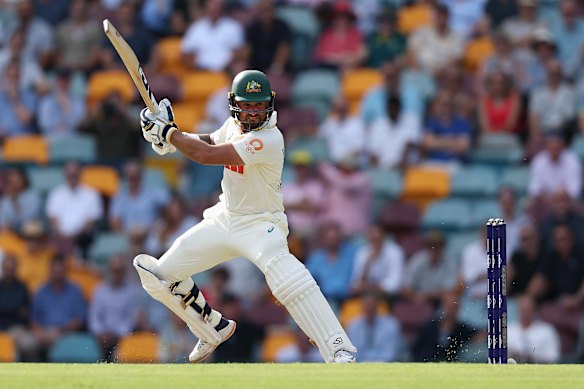
A genuine prospect: Jake Weatherald cuts.Credit: Getty Images
By doing so, Weatherald gave Australia’s selectors a tick after the contentious call to drop Nathan Lyon on day one. He also demonstrated that, for the first time since David Warner’s retirement, there is the genuine prospect that the national team has found a new opener capable of setting the agenda in a sustainable way.
A score of 72 was not the hundred Weatherald would dearly have wanted, and he finished it with a sore foot from the Jofra Archer toe crusher that pinned him lbw.
But his runs came with sufficient authority and speed to put a significant dent in England’s pace attack, and to make life far easier for Marnus Labuschagne and Steve Smith as day turned into night. Weatherald was not quite as spectacular as Sam Konstas on Boxing Day last year, but he showcased a method that looked far more repeatable.
Labuschagne took advantage of the start he was given, playing with the same freedom and scoring threat that had characterised the run of form that vaulted him back into the team after missing three Tests in the Caribbean.
After Ben Stokes found Labuschagne’s edge just as the floodlights took over, Smith and Cameron Green got to the cusp of total dominance.
There were still some twists to come in the nighttime. Green, Smith and Josh Inglis all falling within the space of 38 runs. But Australia had a 44-run lead to grow on through Alex Carey and Michael Neser because of what Weatherald had wrought.
Earlier on Friday, Usman Khawaja posted cheekily about his recovery work in a hyperbaric chamber, and he would doubtless have enjoyed batting with Weatherald this afternoon.
Vitally, Weatherald showed good judgment around the off stump in his first 20 balls – leaving half of those – before unsheathing his cut, pull and drive to tuck into what Sir Ian Botham has referred to as “buffet bowling”.
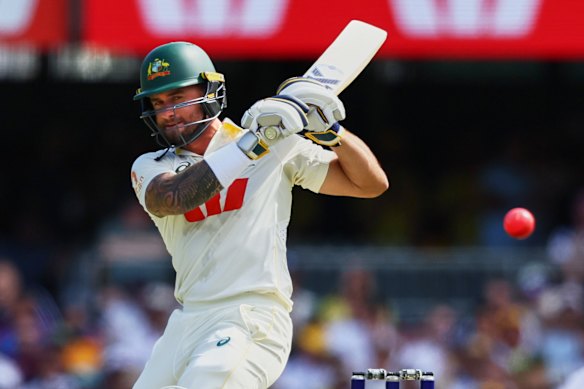
Jake Weatherald lets one through to the ’keeper.Credit: AP
For a time, Weatherald ran well in advance of Head’s scoring, having reached 29 from 28 balls while the vice captain was becalmed on four from 29 balls. There was some method to the differential: Head absorbed most of Archer.
England, it must be said, bowled more like the second innings in Perth than the first. Archer’s first spell was of a high standard, but he dropped his head, if not his bundle, when Jamie Smith turfed a straightforward edge from Head, and the rest of the attack varied between anonymous and awful, and certainly not match-hardened.
Stokes delivered a couple of canny spells in the evening but was struggling with camp by the close. The shelling of no fewer than five catches reflected an untidiness that is seldom seen in Ashes-winning teams: especially away from home.
“There is a big difference between bowling in nets and bowling in matches,” said Stuart Broad in the Seven commentary box. “We know Perth was only a two-day game – the workloads of these bowlers weren’t particularly high, and all they have been able to do leading into this game is bowl in nets or bowl to a [baseball] mitt.
Loading
“[This is] such a different scenario when each ball matters and there’s a result in each ball. They just look like they’re short of match awareness, match fitness [and] the sharpness in the brain to be able to bowl six balls in the same spot.”
Before his debut in Perth, Weatherald spoke frankly to this masthead about how he saw the opening exchanges of an innings in conditions that help bowlers but still offer scoring opportunities.
“Bowlers are constantly searching,” Weatherald said. “They’re under pressure to take wickets and, for me, that’s the way I try to view it now.
“Five years ago, I probably would have thought, ‘What a shitstorm this is, I’ve got to walk out against the top bowlers in Australia and try to survive’. Whereas now, if I get out, I know that my record suggests that over the long run I will find a way to score.”
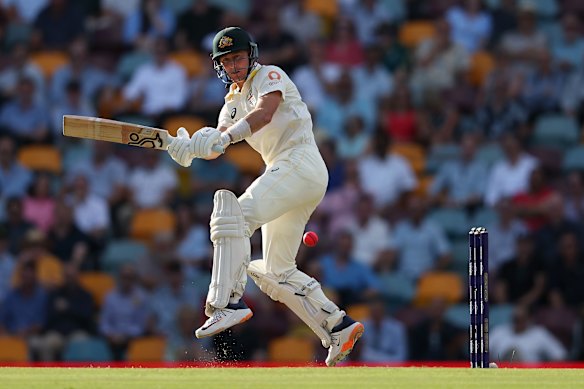
Marnus Labuschagne made 65.Credit: Getty Images
That attitude was evident at the Gabba as Weatherald chose his shots with conviction. There were none of the half-hearted shots that often bring disaster – just ask Ollie Pope – but neither was there too much that could be considered overly ambitious. Weatherald respected anything back of a length, but it did not take long before England struggled to put the ball there.
It was ultimately an innings of which Warner might have been proud. And in an earlier era, it would also have been the kind of performance put on the board by Matthew Hayden, another left-handed opener of attacking intent.
Weatherald, by the way, shares one of Hayden’s traits: that of spending hours in the middle the day or two before a Test match, shadow-batting, visualising and preparing for the innings to come.
On Friday, it was possible to visualise Weatherald as a proper Test opener for a few years to come. Australia may finally have found one.
News, results and expert analysis from the weekend of sport sent every Monday. Sign up for our Sport newsletter.
Most Viewed in Sport
Loading