3 months ago
37
3 months ago
37
Anthony Albanese’s personal standing with voters has taken a sharp hit following weeks of political brawling and mixed messaging since the terror attack on a Hanukkah celebration on Bondi Beach, and dragged the federal government’s support to its weakest point in a year.
The Resolve Political Monitor poll, conducted for this masthead, found Labor’s primary vote had slumped 5 percentage points in a month to 30 per cent, its lowest level since February last year, before the party clawed its way back to win government in May.
The Coalition, up 2 percentage points to 28 per cent, failed to capitalise directly on Labor’s slide, but a continued surge in support for One Nation (18 per cent) narrowed the two-party-preferred contest to 52-48 Labor’s way, from 55-45 in December.
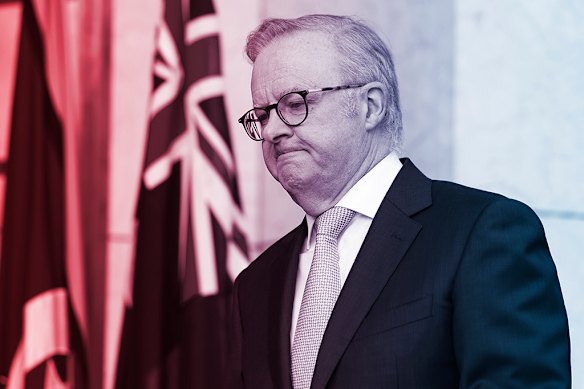
Anthony Albanese’s status as preferred prime minister and his likeability have been affected in the past month.Credit: Alex Ellinghausen
Most stark was the verdict on the prime minister himself, with Albanese’s net performance rating having fallen to minus 22 from plus 6 on December 7, while his net likeability dropped to minus 15 from plus 9.
His lead as preferred prime minister (33 per cent) has shrunk by 11 percentage points over Opposition Leader Sussan Ley (29 per cent) since before the Bondi attack, voters also marking him down sharply on leadership, competence, communication and team performance.
Albanese has recalled federal parliament this week to offer official condolences to the victims of the Bondi attack and to debate emergency legislation as he was forced into another major backdown at the weekend.
On Saturday, he announced that the government would split its proposed legislation for gun laws and hate speech after political support collapsed for his original package in response to the Islamic State-inspired attack on December 14, which killed 15 people and injured 40 more.
The backdown followed a dramatic about-face this month when Albanese gave in to weeks of public campaigning for a royal commission into rising antisemitism, having repeatedly told the Jewish community an inquiry was not needed at a national level.
Support for a royal commission into rising antisemitism has continued to increase, up from 48 per cent in a poll after the attack in December to 61 per cent this month.
More than half of respondents (56 per cent) believed Albanese’s response to the attack was poor, with 32 per cent of voters saying it was good and 13 per cent undecided. Despite accusations of being overtly political, 53 per cent of voters said Ley’s response was good and 29 per cent believed it was poor.
Resolve political analyst Jim Reed said the poll pointed to a clear loss of confidence in Albanese’s authority when voters were looking for leadership and clear direction.
“The prime minister has clearly taken a personal hit in the last month, and the feedback from voters is that they are questioning his competence and consistency,” Reed said. “In other words, their trust has been eroded.”
Just 34 per cent of voters rated Albanese’s overall performance as good compared to 48 per cent before the Bondi attack, while the proportion of people who thought he was performing poorly jumped from 42 per cent to 56 per cent. A growing number of voters polled this month also said the prime minister was out of touch.
Ley was also marked down by voters, with the proportion of those who think she is doing a good job dropping from 39 to 35 per cent in the past month, and those who think she has been poor increasing from 37 to 43 per cent. About 22 per cent remain undecided on her job.
The poll of 1800 voters was conducted between January 12 and 16. It has a margin of error of 2.3 percentage points.
Asked who would win the next federal election, just 23 per cent of voters believed the Coalition would win, down 4 percentage points in a month, compared to 41 per cent for Labor. About 36 per cent were undecided.
Reed said the voter perception was that Ley had “gone hard on the politics”, but appeared “light on policy alternatives”.
“One Nation has a far clearer message on immigration, net zero and gun reform: no,” he said.
Labor’s primary vote remained below the 34.6 per cent recorded at the May election, reflecting growing frustration among voters about delays, reversals and what many see as inconsistent messaging from the government.
Poll respondents repeatedly cited the handling of the Bondi attack and the subsequent debate over a royal commission, alongside confusion around proposed gun law changes, as reasons for their dissatisfaction.
While Labor has borne the brunt of the backlash, the Coalition has been unable to translate the government’s woes into a clear primary vote gain. Instead, Pauline Hanson’s One Nation has recorded its strongest primary vote on record, up 4 points in a month to a mark three times higher than its 6.4 per cent share of votes at the last election.
A record 42 per cent of voters say they would now cast their primary vote for a party other than Labor or the Coalition, despite the Greens dropping a further point since December to be at 10 per cent, the party’s lowest result in this poll for two years.
Loading
The shift suggests protest votes and disaffection are being parked outside the major parties rather than consolidating behind the opposition. Reed said that was a problem for both Albanese and Ley.
“One Nation have taken a big chunk of the Coalition’s base since the election, but since the Bondi massacre they’re also hoovering up votes from Labor too,” he said. “If this trend continues, we may have to stop referring to them as a minor party.”
Cut through the noise of federal politics with news, views and expert analysis. Subscribers can sign up to our weekly Inside Politics newsletter.
Most Viewed in Politics
Loading