
 4 months ago
77
4 months ago
77
2 hours ago
Becky MortonPolitical reporter

 BBC
BBC
The prime minister has suggested there may be a case for banning some protests, following calls for a suspension of pro-Palestinian marches.
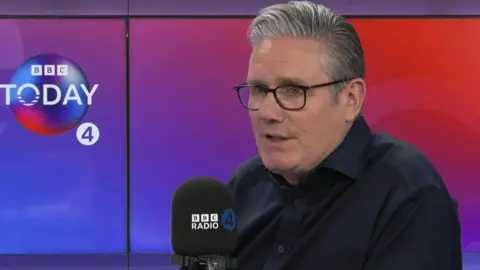
Asked if he wanted tougher policing of language used during marches, or if he wanted to stop some protests altogether, Sir Keir Starmer told BBC Radio 4's Today programme: "I think certainly the first, and I think there are instances for the latter."
The PM said he would always defend the right to protest but he was concerned about the "cumulative" effect of repeated marches on the Jewish community.
It comes after two Jewish men were stabbed in Golders Green, north London, on Wednesday.
Essa Suleiman, 45, appeared in court on Friday charged with attempted murder over the attack.
The attack, which has been declared a terror incident by police, is the latest in a string of violent incidents targeting Jewish people.
The government commissioned a review of public order and hate crime legislation last year, after two Jewish people were killed in an attack outside a synagogue in Manchester.
It was expected to report back in February but is yet to be published.
Earlier this week, Jonathan Hall, the government's independent reviewer of terrorism legislation, called for a "moratorium" on pro-Palestinian marches.
He said it was "clearly impossible at the moment" for the protests "not to incubate within them some sort of antisemitic or demonising language".
Chief Rabbi Sir Ephraim Mirvis has also called for a temporary ban on the marches after the Golders Green attack.
He told the BBC the protests had contributed towards a "tone of Jew hatred within our country".
Asked about the call for a moratorium, Sir Keir said: "I think it's time to look across the board at protests and the cumulative effect."
He added: "In relation to the repeated nature of the marches, many people in the Jewish community have said to me, it's the repeat nature, it's the cumulative effect.
"Now, I accept that, which is why we intend to deal with cumulative effects."
Pushed on whether some protests needed to stop altogether, the PM said: "We need to look at what further powers we can take."
In response to concerns about linking protests to attacks on Jews, Sir Keir said: "I will defend the right of peaceful protest very strongly and freedom of speech."
He added: "I'm not saying, of course, that there aren't very strong, legitimate views about the Middle East, about Gaza. We all have deep concerns about it."
Hall's call for a moratorium has been criticised by the Stop the War Coalition, a campaign group that has helped organise several previous marches.
The group said it condemned "all forms of antisemitism and racism", but it was "wrong" to connect the marches to any attacks on Jews.
The Green Party and Jeremy Corbyn's Your Party have also warned the response to the "abhorrent" attacks should not restrict civil liberties.
However, the Conservatives and Reform UK have called for the government to take a tougher approach to the demonstrations.
Police forces in England and Wales can restrict protests in certain circumstances, including by stipulating a particular route or saying when it must end.
They can apply to ban marches outright where these powers are deemed insufficient to prevent "serious public disorder", but this requires the approval of the home secretary and is not regularly used.
Last month the government approved a request from the Metropolitan Police to ban the Al Quds Day march in London, marking the first time a protest march had been banned since 2012.
Meanwhile, Sir Keir said chants like "globalise the intifada" - based on an Arabic word for uprising - were "very dangerous" to the Jewish community and should be prosecuted.
"If you are on a march or a protest where people are chanting, 'globalise the intifada', you do have to stop and ask yourself, why am I not calling this out?" he said.
"Why am I on a march where this is the chant?"
The term intifada came into popular use during the Palestinian uprising against Israeli occupation of the West Bank and Gaza Strip in 1987.
Jewish groups have described the term as a call for violence against Jewish people. Pro-Palestinian groups have said it is a call for peaceful resistance to Israel's occupation of the West Bank and actions in Gaza.
In December, the Met and Greater Manchester Police said they would adapt their approach to the slogan in the wake of the attack on a Jewish festival on Australia's Bondi Beach, and arrest those using it in chants or on placards.
Sir Keir was also asked about criticism from the Jewish community that the government had not done enough to keep them safe.
He told the BBC he acknowledged "the depth of feeling" and that many Jews were "feeling very scared", saying: "I'm not here to criticise that in any way."
However, Sir Keir added: "It's not right to say we haven't done anything."
He pointed to enhanced police security in areas like Golders Green which "has been in place for some time".
The government has also announced increased funding for protecting Jewish communities.


















































