3 months ago
23
3 months ago
23
Venus Williams was 17 years old when Sports Illustrated put her on its cover and dubbed her “Party Crasher”.
The subhead next to the teenager with beaded hair and braces was “Venus Williams shakes up tennis”. The September 15 issue of 1997 was a fair summation of what had occurred earlier that month.
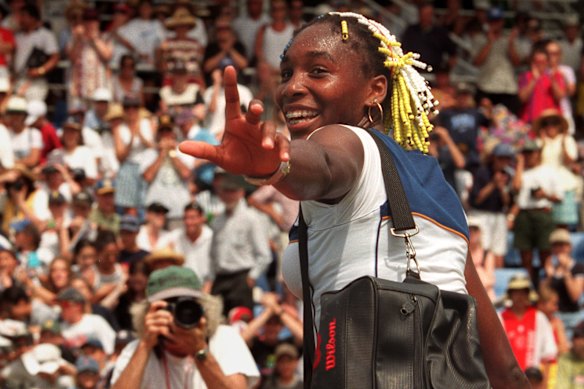
A 17-year-old Venus Williams during her 1998 Sydney International victory over world No.1 Martina Hingis at White City.Credit: Fairfax
Venus had just made her first appearance in the main draw of a US Open and became the first unseeded player in the open era to reach the final, which was the youngest grand slam final of the open era because her opponent was 16-year-old Martina Hingis. Hingis prevailed 6-0, 6-4 to claim her third major crown of the year, but it was Venus on the next SI cover.
And after a tournament stained by racism allegations from her father, Richard (“I’m tall, I’m black; everything’s different about me,” the young Venus said during that Open. “Just face the facts.“), she was making the mould for others to step into. Her sister Serena did so first, for her main-draw major debut at the Australian Open the following January.
Venus, also making her Melbourne Park debut in 1998, defeated Serena in the second round before losing her quarter-final to world No.3 Lindsay Davenport. By then, Venus had already got even with Hingis, beating the world No.1 in three sets in round two of the warm-up Sydney International.

“Party Crasher″: Sports Illustrated’s September 1997 cover featuring a 17-year-old Venus Williams.
I watched her final against Arantxa Sanchez Vicario from the front row at White City. She lost convincingly but the power of that open-stance backhand still shocked a 10-year-old.
To try and comprehend that the same player I saw 28 years ago is about to play another grand slam makes me feel old. Technically, then, she should feel old, which of course is being pointed out repeatedly to the 45-year-old.
But we are talking about Venus Williams: the queen of the renaissance. Who better to be granted an Australian Open wildcard? Who better to become the oldest woman to feature in the main draw? Who better to attract additional spectators to the Hobart International on Tuesday, when she will face German 38-year-old Tatjana Maria for a first-round (the oldest combined age of players in a WTA main draw match)?
Written off regularly, Venus has long been seen as the default Williams sister (with her measly seven grand slam singles titles to Serena’s 23), her comparatively self-contained demeanour perhaps giving the impression she possessed less hunger. But the resilience evident since she turned professional aged 14, the 1000-plus top-level singles matches and the 11 weeks at world No.1 all suggest otherwise.
Yes, she ping-ponged up and down the WTA rankings with each injury setback, while her 2011 diagnosis with autoimmune disease Sjögren’s syndrome surely spelled the end – until she came back to win Olympic gold at London in 2012.
Then there was that 2013 back injury and surely the writing was on the wall this time. Until, of course, she made the 2017 Australian Open final at age 36 – her first major final since her 2008 Wimbledon win (she lost to Serena and, as it turned out, her future niece; Serena later revealed she was two months pregnant at the time). Venus became an expert at working with her age. When her body could not cover the court as quickly as her opponents, she played smarter, hit harder, made them run.
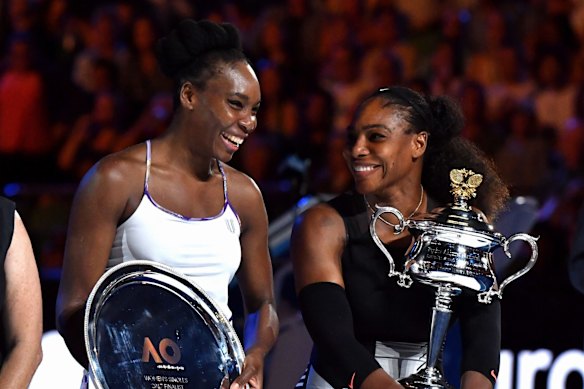
Venus Williams after being beaten by younger sister Serena in the 2017 Australian Open final.Credit: Joe Armao
She did it to Johanna Konta at 37 in the 2017 Wimbledon semi-finals, returning second serves twice as fast as they’d arrived and wearing her down. She couldn’t overcome Garbine Muguruza in the final, but a US Open semi-finals appearance that same year returned her to the top 10.
By January 2018, when she appeared at Bondi for the 2018 Sydney International draw announcement, her career had spanned such an improbable duration that she had to be reminded she had even played that 1998 final against Sanchez Vicario (“Did you say I was in a final? … Oh, I forgot about that”) before winning Sydney 2000 Olympic gold.
Venus may have forgotten, but I never did.
Even the casual tennis fan will hold at least one enduring memory of their favourite Venus moment. It might be that epic 2005 Wimbledon final triumph over Davenport, when she came back from 5-1 down in the first set to push the world No.1 to 6-4, and in the second, with Davenport up 6-5 and serving for the match, hit four winners to break her to love and ultimately win 4–6, 7–6, 9–7.
“I feel like Serena and I were part of a big change in women’s tennis,” Venus said on Sunday on arrival in Hobart from Auckland, where she took a set off world No.52 Magda Linette in last week’s opening round loss.
“Over time, too, the equipment has changed. I’ve had to adjust my game based on [things like] new strings. I think I’m a student of the game, I like to watch and learn from other players. [But] when you walk on the court, I’m so focused on what I want to accomplish. Winning and losing knows no age.”
Loading
Or the memory might be off the court, where she was an outspoken political voice lobbying for women to receive equal prizemoney at the French Open and Wimbledon, in a legacy of grace and gravitas to follow that of Billie Jean King. Her 2006 essay in The Times titled “Wimbledon has sent me a message: I’m only a second-class champion” was endorsed in the Baritish prliament and created enough international pressure that both majors caved and awarded equal prizemoney to all competitors from 2007.
Would you buy a ticket to the Australian Open to watch any old 45-year-old wildcard ranked 582 in the world?
Maybe not.
But to see the Venus Williams for potentially the final time? As if you’d miss that.
Most Viewed in Sport
Loading