3 months ago
21
3 months ago
21
Deputy Liberal leader Sam Groth has settled his legal case against the Herald Sun, reaching a deal that will include a public apology from the publication.
The Age has spoken to three sources, speaking anonymously to talk openly about legal proceedings, who confirmed the parties had come to an agreement that would avoid a costly court battle.
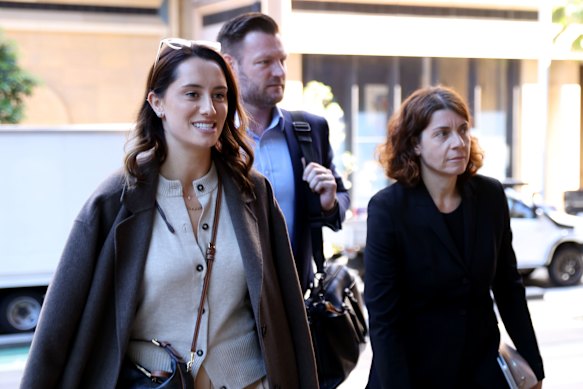
Brittany Groth (left) and Sam Groth arriving with barrister Sue Chrysanthou at the Federal Court of Australia in Sydney.Credit: AAP
Former professional tennis player Groth and his wife, Brittany, sued News Corp’s Herald Sun over a series of articles published in July alleging the pair might have begun a sexual relationship when she was aged 16 or 17 and under his care or supervision as a tennis coach.
Brittany Groth had sued parent company The Herald and Weekly Times, reporter Stephen Drill and Herald Sun editor Sam Weir for a serious breach of privacy, while Sam Groth had sued for defamation.
If the case had gone to court, it would have been the first test of Australia’s new privacy laws that allow claims of up to $478,000 in damages.
However, all three sources confirmed the matter had been settled to the agreement of all parties within the past week.
No settlement figure has been publicly revealed, although one source put it in the hundreds of thousands of dollars.
The Groths and News Corp Australia have been contacted for comment.
The sources said an apology was part of the settlement deal and was expected to run in the paper in coming days. Online links to the article and related stories are no longer active, suggesting the Herald Sun may have agreed to take them down as part of the deal.
Loading
Under the tort for serious invasions of privacy, a person can take action against individuals and organisations for either physically intruding on their private space or misusing information that relates to them in circumstances where they have a reasonable expectation of privacy.
The laws contain a defence for journalists who are bound by professional standards, if the content they produce has “the character of news, current affairs or a documentary”.
If tested, the case could have had consequences for all media outlets in outlining what constitutes newsworthy content under this defence.
Lawyers for the Herald Sun had previously argued the stories were not “idle gossip” and that details of the Groths’ relationship were already public through a previous interview with the couple that stated they met at the tennis club.
They also argued that the claims about the relationship were being weaponised internally by members of the state Liberal Party.
The Groths’ barrister, Sue Chrysanthou, SC, told a Federal Court hearing this month that the articles did not constitute “journalistic material” as they were not a “factual presentation of information”.
“News is not fantasy,” she said at the time.
Chrysanthou also noted that in the defamation case, the paper was not seeking to use a truth defence, and would instead apply a public interest defence.
To rely on this defence, the Herald Sun would have had to establish there was a public interest in publishing the stories about Groth and his wife and that the paper acted reasonably in doing so.
At the hearing, Justice Shaun McElwaine said it would be an “extraordinary outcome” that malicious, false, completely fictitious articles could be considered to have the character of news, and one that parliament “didn’t really focus attention on” when the laws were drafted.
“I think we can agree this is not simple,” he said.
Herald Sun editor Weir previously defended the stories, saying: “We stand by our reporting on a matter of public interest, covering important issues which could have a major impact on Victorian politics in the lead-up to an election.”
Start the day with a summary of the day’s most important and interesting stories, analysis and insights. Sign up for our Morning Edition newsletter.
Most Viewed in Politics
Loading