3 months ago
32
3 months ago
32
What in the World, a free weekly newsletter from our foreign correspondents, is sent every Thursday. Below is an excerpt. Sign up to get the whole newsletter delivered to your inbox.
Singapore: In South Korea’s beauty-obsessed capital, the green “O” of Olive Young stores is to skincare aficionados what the golden arches are to hungry travellers on a highway – a beacon guiding them to their holy place.
For the uninitiated, Olive Young is the South Korean cosmetics juggernaut that has helped cement the country as the gold standard for skincare products and a booming destination for beauty tourism.
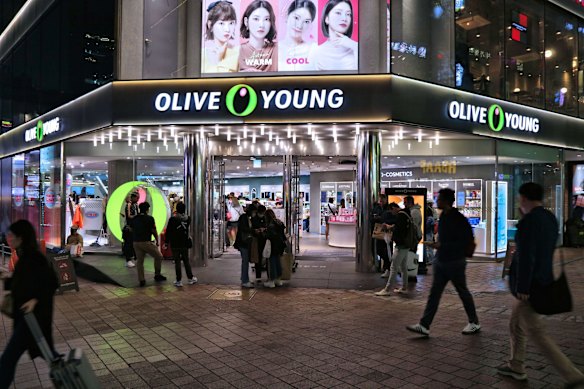
An Olive Young Korean beauty store in Myeongdong shopping district in Seoul.Credit: Alamy Stock Photo
Its stores are concentrated in Seoul’s tourist hotspots, and its shelves are lined with slickly marketed and affordable Korean brands selling confidence and self-improvement in the form of sheet masks, ampoules, serums, toners and gels – all making various claims to tighten, brighten, whiten, plump, firm and boost your skin.
In the first half of this year, about 6 million overseas travellers accounted for more than a quarter of the brand’s bricks-and-mortar sales, as K-beauty trends swept TikTok and online influencers cashed in by reviewing their shopping hauls, sometimes so breathlessly that it suspiciously resembles undisclosed advertising.
Loading
There were eight Olive Young stores within walking distance of my hotel in Seoul last month, when I visited on a week-long reporting trip to cover North-South Korea relations in the Trump era, among other stories.
And so, on a free evening, I found myself in the scrum of Olive Young’s much-hyped quarterly sale, grasping a mung-bean cleanser and weighing up how much to lean in and burnish the coffers of a global industry that has long made a pretty buck out of exploiting women’s insecurities.
As far as K-beauty viral trends go, snail mucin is out. Salmon sperm is in. And sheet masks promising to boost collagen – that holy grail of skin elasticity, which women over 30 are apparently perilously lacking – are vital.
What sets the cosmetics industry apart in Korea, though, is its gateway into the broader K-beauty ecosystem. One that is renowned for its high standards, and where plastic surgery has become so normalised that a quarter of South Korean women in their 20s have had at least one procedure, according to a 2020 Gallup poll.
The beauty benchmark has been set by K-pop idols with flawless glassy skin, V-shaped jawlines, narrow noses and wide eyes. Procedures such as jaw reshaping, nose jobs and double-eyelid surgery to give eyes a wider, almond-shaped appearance, are among the most commonly performed in South Korea.
“People are so obsessed with looks that they keep getting plastic surgery’.
18-year-old Lee Chae-minIn Hongdae, Seoul’s trendy student bar district, 18-year-old Lee Chae-min says she feels the pressure to conform to these exacting beauty standards and has a lot she wants to fix about herself.
“This extreme focus on appearances – where people judge everything by the face – seems really intense. People are so obsessed with looks that they keep getting plastic surgery. And after surgery, everyone’s faces start to look similar,” Lee tells me and my Korean colleague, Sean Na.
“When students move from middle school to high school, a lot of them get double-eyelid surgery. It has basically become a standard procedure.”
Another student, Ko Min-ji, 19, says she is also considering plastic surgery.
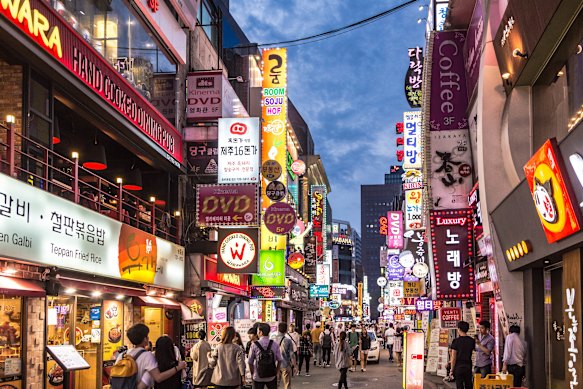
South Korea’s capital has become a magnet for beauty tourism.Credit: Shutterstock
“When I see celebrities, it really lowers my confidence in my own appearance,” she says.
The link between Korean beauty standards, K-pop idolisation, plastic surgery rates and low self-esteem among women (and men), is its own subset of academic inquiry. Researchers frequently point to its roots in socio-economic factors such as South Korea’s famously hyper-competitive jobs market, where many employers require CVs to include photos, fuelling a push to improve appearances as a way to get an edge.
In Seoul’s affluent Gangnam district, there are between 400 and 500 plastic surgery clinics concentrated in a few square kilometres. Many of them cater to a surging billion-dollar “glow up” tourism industry that saw almost 800,000 foreign patients travel to South Korea in 2024 for cosmetic procedures such as Botox and plastic surgery.
The latest hyped treatment is the Korean-pioneered “salmon sperm” facial. In the pursuit of wrinkle-free glassy skin, this involves a dermatologist injecting the face hundreds of times with a drug derived from the DNA fragments of salmon sperm. It can cost between 300,000 and 1,200,000 won ($325-$1300) and, according to post-treatment vlogs from swollen, punctured TikTokers, is very painful.
It’s tricky to identify the point at which the natural human desire to look and feel good feeds into more pernicious societal beauty standards and the low-volume message that physical imperfection and ageing are only for the determinedly uninfluenced or the poor.
That point probably isn’t in the sheet-mask aisle of a K-beauty store.
Loading
But I do find it depressing that a generation after we bid adieu to the era of air-brushed magazine models and celebrities – which, in Western countries at least, contributed to a generation of teens with body dysmorphia – this hasn’t eased the chase for perfection.
Instead, we have an algorithmic barrage hammering it home to new generations of young people and an industry forever innovating ways to cash in.
Get a note directly from our foreign correspondents on what’s making headlines around the world. Sign up for our weekly What in the World newsletter.
Most Viewed in World
Loading