3 months ago
6
3 months ago
6
One of the nation’s leading bankers says Australia should be an energy superpower with some of the cheapest electricity in the world, describing the nation’s failure to resolve its political impasse over energy as a sad development that should never have happened.
While warning younger Australians faced living standards lower than their parents in part due to the nation’s housing market, NAB chief executive Andrew Irvine said more renewables and natural gas in the power grid would ensure the country could meet its net zero commitments while maintaining its industrial base.
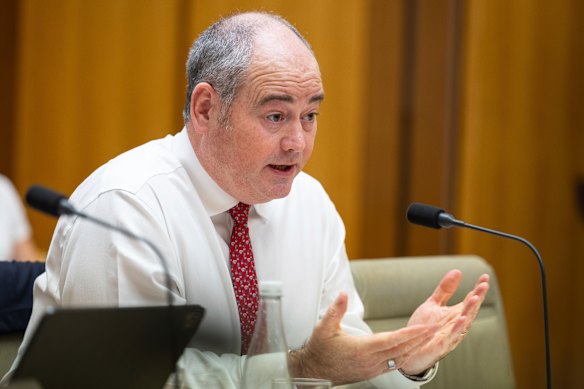
Andrew Irvine addresses the House standing committee on economics on Wednesday.Credit: Alex Ellinghausen
His concerns over the state of the national debate over energy were mirrored by ANZ chief executive Nuno Matos, who cautioned that any energy transition had to be balanced or the “medicine could kill the patient”.
The Coalition this week agreed to ditch the nation’s legislated climate targets while pledging to keep coal plants operational for longer, arguing it will focus on keeping energy prices as low as possible. Prime Minister Anthony Albanese has used the crisis within the Coalition to accuse the Liberal Party of being in denial about climate change while supporting policies that will drive up prices.
The nation’s banks have been drawn into the political argument over net zero, with many either committed to the objective or not funding particular fossil fuel projects. NAB, for instance, no longer finances natural gas projects for export.
Irvine told a parliamentary committee on Wednesday that net zero and cheap energy were not incompatible, but that Australia would require a large lift in renewables and natural gas, plus an expansion of the nation’s ageing power transmission network.
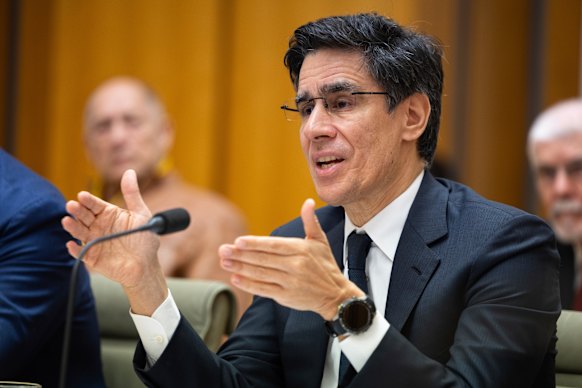
ANZ chief executive Nuno Matos said the global collapse in interest rates had contributed to higher property prices.Credit: Alex Ellinghausen
He said thermal coal would not have a place in the nation’s energy future, while nuclear was unlikely to play a role. But an abundance of cheap energy would help lift Australia’s economic performance and productivity.
“Australia should be an energy superpower. The fact that we are in a situation where we have a possible issue with demand and supply imbalance on energy is sad and shouldn’t have happened,” he said.
“As a country, we need to do a much better job of getting energy to market, both renewable and natural gas, to help decarbonise the grid, get rid of coal and become the energy superpower that we should be.
Loading
“I believe we could have one of the world’s lowest energy costs and deliver net zero and be a wonderful exhibit to the world that you can do both at the same time.”
Matos, who took over as ANZ boss six months ago, admitted that it would be hard for the globe to meet the Paris Agreement target of net zero by 2050.
He said it would be a “difficult journey to get there on time”.
“It needs agreements on how we are going to transition the economy into the future, and certainly, it’s in the best interest of the Australian economy, as it is in all economies, to reduce and contain energy costs,” he said.
Pressed on Australia’s ability to reach net zero, he urged caution.
“The medicine could kill the patient … so the transition has to be balanced,” he said.
While Irvine spoke expansively about the nation’s energy needs, he issued a grim warning about the future awaiting young Australians.
He said the cost of housing in particular was a huge problem, noting parents were admitting to each other that their children faced a fall in living standards.
“Intergenerational inequity is on the rise. Unless this is reversed, future generations may not surpass their parents’ living standards,” he said.
Loading
Irvine said a range of issues, including complex regulation, planning laws and low productivity were all contributing to the nation’s housing problems.
But Matos, who began his career in Portugal and has worked across the US, Europe and South America, noted that global factors had played a role in Australia’s expensive property market.
He said ultra-low interest rates that dominated the world between the global financial crisis in 2008 and the COVID pandemic had been a major factor in pushing up prices.
“The world ran for 15 years with [cash] rates at zero per cent. That created a lot of inflation – that’s the price to pay to rescue the global economy,” he said.
“It’s a fact of life. Globally, real estate as an asset class has spiked dramatically. This is a world problem. This is not an Australia problem.”
Cut through the noise of federal politics with news, views and expert analysis. Subscribers can sign up to our weekly Inside Politics newsletter.
Most Viewed in Politics
Loading