3 months ago
31
3 months ago
31
Extreme fire danger is expected across Sydney, the Illawarra, the Shoalhaven region, the southern ranges and slopes and the Monaro Alpine region bordering Victoria, where firefighters were battling catastrophic conditions on Friday.
Loading
An extreme fire risk rating means people should be prepared to take action to protect life and property.
Temperatures are expected to reach as high as 43 degrees in the city and its west on Saturday, before easing back to 25 degrees on Sunday.
The NSW Rural Fire Service said a large bushfire burning south of the Murray River, about 50 kilometres east of Albury, could blow into NSW when the winds change to southerly on Saturday.
Firefighters are monitoring the area between Talmalmo and Jingellic as flying embers ignite spot fires on the NSW side.
“People need to take action now and make sure they’ve got a bushfire survival plan in place,” said the RFS district manager of the southern border, Superintendent Tom McDevitt. “It’s never too late to start one and know what you’re doing.”
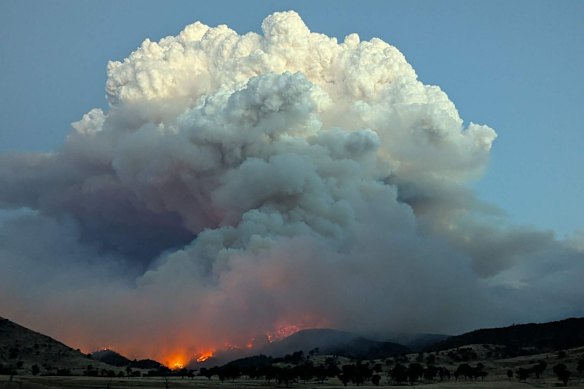
Smoke fills the sky above the Walwa bushfire, on the Victoria and NSW border.Credit: VicEmergency
Fires already burning in Victoria and new blazes possibly sparked by dry lightning later on Friday will be fast-moving and hard to control as an evening change in wind brings 90km/h gusts to Melbourne, the Bureau of Meteorology said in an update from the national emergency centre.
The winds will then move into NSW on Saturday, increasing fire risk.
“We’re expecting widespread extreme fire danger ratings across NSW and the ACT for tomorrow. No districts are currently at the catastrophic level,” a BoM spokesman said.
NSW RFS Commissioner Trent Curtin said volunteers were helping south of the border.
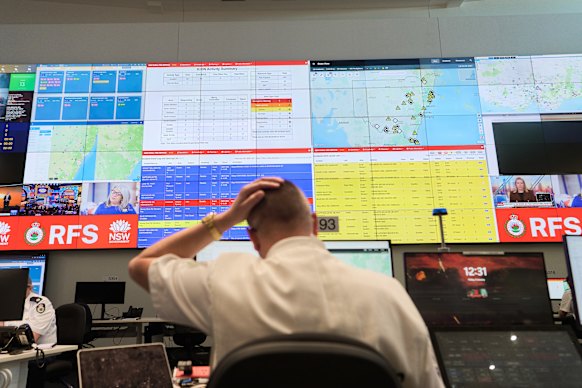
The State Operations Centre at NSW RFS headquarters on Friday.Credit: Flavio Brancaleone
“We’ve sent a lot of crews into Victoria today to support them with their catastrophic conditions,” he said. “We’ve got a lot of aircraft available to support that, so whilst we don’t expect that fire to cross the border, we are prepared in the event it might.”
The Murray River that comprises much of the border between the states does help to limit the spread.
Loading
“It’s a natural break there. That fire would have to jump quite a long way, but it is possible,” Curtin said. “Under these conditions, embers can travel quite a long way.”
Curtin encouraged those who had not already done so to download the Hazards Near Me app and to monitor conditions regularly.
“It’s really important that everyone’s prepared for extreme fire conditions,” he said.
Transport for NSW said trains in Sydney and some other parts of the state would be running at reduced speed on Saturday due to the extreme heat.
Among the trains affected on Friday and Saturday were those running on the Blue Mountains line, between Berala and Flemington, Lidcombe and Penrith, Blacktown and Richmond and around Strathfield and Olympic Park. Buses are running between Campbelltown and Moss Vale because hot weather was affecting tracks.
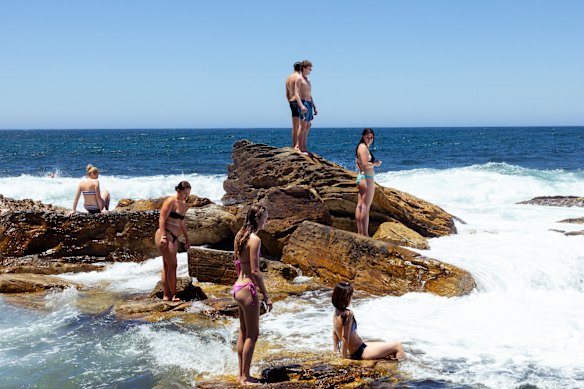
People cool off at Coogee Beach on Friday.Credit: Dominic Lorrimer
Questions about the real number of trained RFS firefighters have persisted, from inside and outside the service, for several years.
In 2024, Jindabyne Brigade captain Colin Wooden told a NSW parliamentary committee hearing that he suspected the published figure of 70,000 was misleading.
“My concern is that they keep saying that we’ve got 70,000 members, and they’ve lost sight of the actual number of people that are getting on trucks,” he told the committee.
“I just did a quick look at our brigade and 36 per cent of our members I’ve never seen on a truck and 10 per cent have gotten too old or have moved on.
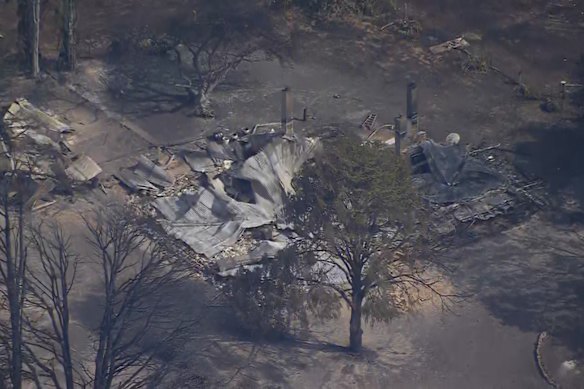
Emergency services report widespread property losses in the Victorian village of Ruffy.Credit: Nine
“Years ago, if there was a fire, bosses would let their people go and fight fires. Now they can’t because of operational requirements and all that sort of stuff.
“So, now, the only people that are available seven days a week are the old greybeards like myself. We had five people on a truck at a fire last year and no one was under 65.”
In February 2025, the Productivity Commission’s annual review on the state of emergency services across Australia found the RFS boasted a volunteer firefighting force of some 75,000.
The figure had remained consistent across multiple reports, and meant that NSW had a higher ratio of volunteers per 100,000 people in the population than any other state.
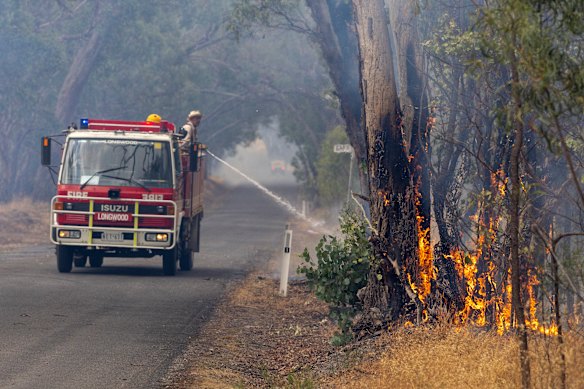
Fire crews at the Longwood fire.Credit: Jason South
But in April, former RFS commissioner Rob Rogers told a budget estimates hearing that the agency had only 45,000 “trained” firefighters, as well as additional volunteers who provided “catering and all of those other associated activities”. There were “varying levels of activity” among volunteers, he said.
“They all have their own rules of who’s active and who’s not ... I understand it’s been applied in a lot of different ways around the state,” Rogers said in the hearing.
Rogers’ comments prompted the Productivity Commission to seek further information about the actual size of the RFS force.
The RFS spokesman on Friday said its number of volunteers was determined in large part by reports provided by individual brigades.
“The oversight of membership and membership status lies within the purview of individual brigades and their executive teams,” he said. “This approach has proven effective for over a century in managing membership within the organisation.
“As of December 31, 2025, the RFS has 68,890 registered members. Of these members, 55,059 are deemed operational by brigades and units across the state.
“Our remaining members fulfil roles including operational support and administration or serve in a social or reserve capacity.”
Of the members classed as “operational”, 45,252 hold a formal bush firefighting qualification.
“Volunteering with the RFS looks different for everyone, and our members engage in ways that suit their skills, availability and personal circumstances,” the spokesman said.
“Communities across NSW rely on the combined efforts of volunteers giving what they can, when they can.”
During the 2019-20 Black Summer fire season, there were more than 186,000 shifts completed by RFS members, but the most firefighters deployed on a single day was 3739, according to a fire season overview produced by the RFS.
with Jack Gramenz, Daniel Lo Surdo and Matt O’Sullivan
Be the first to know when major news happens. Sign up for breaking news alerts on email or turn on notifications in the app.