About one third of Americans say they have skipped meals, borrowed money, or cut back on utilities to pay for health care. That's in a Gallup poll released in March. The Trump administration has lowered prices on more than 50 drugs. But it also let premiums rise — even double — in the Affordable Care marketplace and made the biggest cuts ever to Medicaid. Already, 3 million have lost insurance and it's estimated it'll be 10 million in three years. All of this reminded us of our story in 2008, about a charity called Remote Area Medical. RAM started out parachuting doctors into South American jungles. But in the 1990s, it turned to another isolated people: Americans cut off from health care by the cost. Recently, we returned to RAM at one of its free, pop-up clinics. For Americans long on pain and short on hope, RAM is a ray of mercy in the darkness.
The parking lot in Knoxville, Tennessee began to fill early. In a frigid February, many drove hundreds of miles in desperation. Nearby, Remote Area Medical would open a clinic inside an empty exhibit hall. But RAM can take only so many patients on a weekend, so they join the line days before. We met Sandra Tallent at 5 a.m.
Scott Pelley: Sandra, where'd you come from?
Sandra Tallent: Huntsville, Alabama.
Scott Pelley: And how long have you been in the parking lot here?
Sandra Tallent: Since 4:30 Wednesday night.
Scott Pelley: Wednesday night. So, Wednesday night, Thursday night, and this is Friday morning.
Two nights sleeping in her car, a 200 mile drive, all for lack of dental insurance.
Scott Pelley: If you didn't have RAM how would you get your teeth taken care of?
Sandra Tallent: I wouldn't.
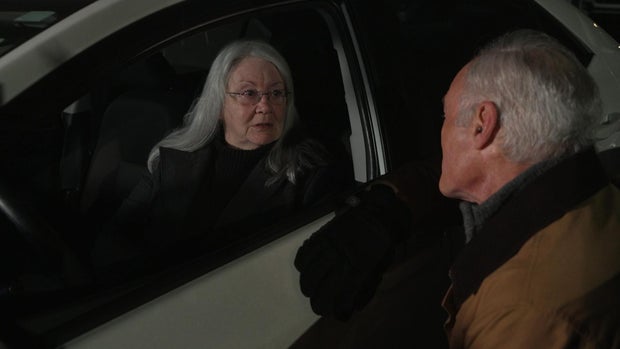 Sandra Tallent drove from Alabama and spent two nights sleeping in her car for a dental appointment with RAM.
60 Minutes
Sandra Tallent drove from Alabama and spent two nights sleeping in her car for a dental appointment with RAM.
60 Minutes
A few spaces over, Dave Burge spent the night in his truck, aching for a full set of dentures.
Scott Pelley: What happened to your teeth?
Dave Burge: Several things. I had a uninsured drunk driver run a red light doin' 80, hit me head-on, almost killed me. Two years of rehab, and three surgeries, and $140,000 later I was able to go back to work. At work one day I'm drillin' through a basement wall, and the drill hangs up on a piece of rebar, and it comes around and smacks me in the mouth, cracks my jaw, and broke 'em back out again. By then I was pretty thin on money to do much about it. So I didn't have a lotta choices. I just kept workin'.
But working was rare. Employers on construction jobs just assume he lost his teeth to meth addiction. Burge told us his only habits are nicotine and caffeine. And right now, he could use a cup. He's wrapped in four layers against 27 degrees.
Scott Pelley: If you didn't have Remote Area Medical, what would you do?
Dave Burge: Suffer. No other way around it. They're life changing.
Scott Pelley: Life changing.
Dave Burge: When they hand you your life back. That's life changing. That's what teeth mean to me. I could be a normal human again.
Scott Pelley: I sure do appreciate you.
Dave Burge: Yes, sir.
Scott Pelley: Thank you. Good Luck.
He had the luck of being near the head of the line, which stretched to 1,200 patients in Knoxville over a Friday, Saturday, and Sunday.
Brad Sands: Hold on to that, when you go up there for service, you gotta bring them that ticket…
Brad Sands, a former paramedic, is a RAM clinic coordinator.
Patient: I'm number four.
Brad Sands: Number four, head on up.
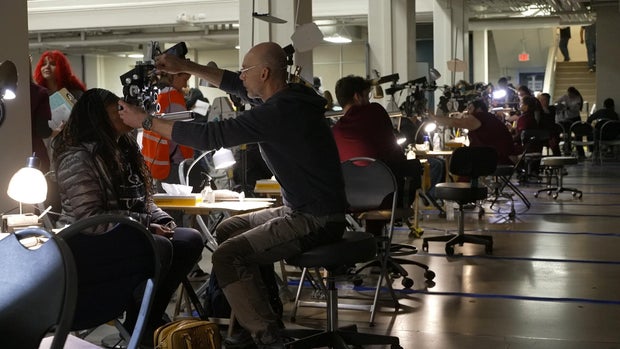 RAM eye exams
60 Minutes
RAM eye exams
60 Minutes
Scott Pelley: Who are the people in the cars?
Brad Sands: Everybody. I mean, it's your neighbors, it's your parents, it's your friends, it's the community around you. It's everybody. And it's nationwide.
Somewhere in America, Brad Sands sets up a clinic like this most every weekend.
Scott Pelley: … it's all comers, no questions asked.
Brad Sands: No insurance needed. You don't even have to give me your real name.
Scott Pelley: We met a woman at a RAM expedition who was so grateful for the help she received. But she said, "I just hate to ask."
Brad Sands: I'm not gonna judge your story. Nobody here that's working or volunteering today is gonna judge any person that comes through that door. We are here to help.
About half of the patients have no insurance. The rest have insurance they can't afford to use because of co-pays and deductibles.
Scott Pelley: And many health insurance plans have no dental.
Chris Hall: Correct.
Scott Pelley: No vision care.
Chris Hall: Correct.
Scott Pelley: No hearing care.
Chris Hall: Correct.
Chris Hall volunteered at RAM when he was 12 years old. Now, he's CEO.
Chris Hall: So when you look at the patients that come through our door, 65% of those patients are requesting dental service, 30% of those patients are requesting eye exams and glasses. Only 5% are requesting medical care. Dental and vision are two things that are isolated that people do not have access to or can't afford the access to.
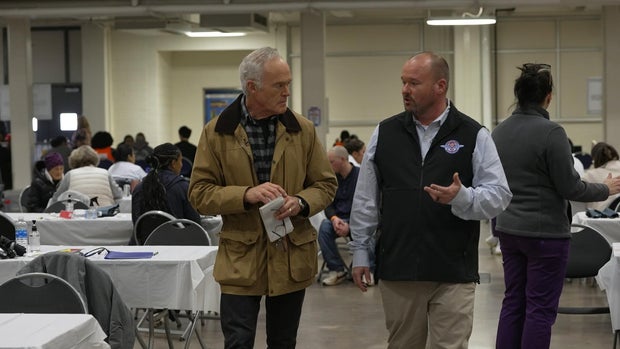 Scott Pelley and Chris Hall
60 Minutes
Scott Pelley and Chris Hall
60 Minutes
There's also screening for blood sugar, blood pressure, breast cancer, skin cancer and more. Depending on the size of the clinic, RAM will spend between 100,000 and half a million dollars over a weekend.
Scott Pelley: How do you pay for all of this?
Chris Hall: It's the generosity of the public. Over 81% of our supporters are individual donors, people that write $5, $10, $20 checks every month.
Those checks are leveraged with donated clinic space, donated supplies and volunteers: 887 volunteers on this Knoxville weekend alone.
Medical professionals paid their own way from 30 states—and brought medical students with them.
Doctor: Treat these patients with dignity, with respect, talk to them like they are human beings please.
Brad Sands: If you ever lose faith in humanity, go spend ten minutes at a RAM clinic. You're gonna see hundreds of people there that are donating their time. And they're coming out and they're donating large swaths of their own money, slash time, to help their neighbors.
Glen Goldstein: I remember there was a guy many years ago who had a broken tooth. And he told me that he tried to remove it with a screwdriver. So, if that doesn't move you to help, you know, that's the desperation.
Dentist Glen Goldstein volunteered from New Jersey. He sees patients suffering from a past without health care and no hope for the future.
Glen Goldstein: You know, I've had young people in. You know, I say, "Well, you know, some of these teeth can be saved. You know that, right?" Goes, "Yeah. I don't-- I don't care. Please-- I-- I don't have any money. I don't have any way to-- to get these fixed, so please. Please take them out."
Patient: I got a bunch of loose tooth and broke tooth bothering me and I'm ready to get them all out.
Glen Goldstein: And it's heartbreaking to take all the teeth out. It's terrible.
Scott Pelley: Patients ask you to take all of their teeth out?
Glen Goldstein: All their teeth.
Glen Goldstein: Let's see, 1, 2, 3, 4, 5, 6, 7, 8, 9, 10, 11, 12, 13, 14...16"
Scott Pelley: Because they know going forward, they will not be able to take care of them?
Glen Goldstein: 100%.
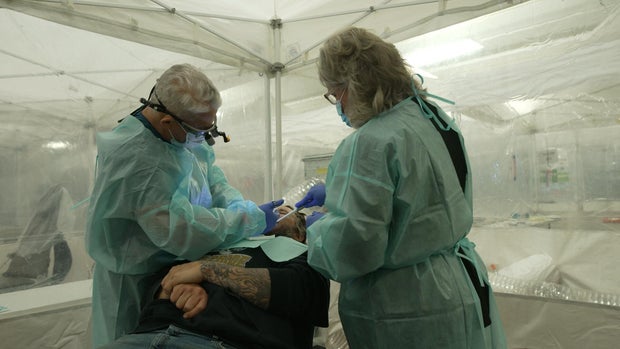 Many come to RAM for dental aid.
60 Minutes
Many come to RAM for dental aid.
60 Minutes
Relieving pain was the mission of RAM's late founder: an eccentric Englishman, daredevil pilot and Amazon cowboy.
Scott Pelley: Tell me about Stan Brock.
Chris Hall: Stan was a magnificent leader, magnificent man. Humble.
We met Stan Brock and RAM in 2008.
Stan was an adventurer who once walked 26 days in the Amazon to be treated for an injury.
So, he started his airborne medical charity with an Army surplus C-47 that flew on D-Day. When we met, he was 72, had no family, took no salary, lived in an office donated to RAM and showered with a garden hose. He died in 2018 — in the office.
Scott Pelley: He was perhaps the most dedicated person I've ever met.
Chris Hall: I agree with you completely on that. I joked around a lot when I tell people working with Stan, "It was really hard to ask for a day off when your boss hadn't had a day off in 20 years."
When we met, in 2008, Stan Brock was staging 12 clinics a year. After our broadcast, $4 million in donations poured in along with thousands more volunteers. RAM has grown from a dozen to 90 clinics a year.
Glen Goldstein: It's because of you and your story back in 2008 that bought me to almost to tears. And as soon as your segment was over, about this organization, I immediately went online, looked it up and registered down here, I'm from Jersey.
Scott Pelley: I understand that volunteering at RAM has become a family thing.
Glen Goldstein: Yes, sir. Yes, sir. So my son, who's here with me now, my wife has been here, my daughter-in-law, my daughter, my other son, we've all, they've all been here a multitude of times.
Scott Pelley: Sounds like you get as much out of this as the patients do.
Glen Goldstein: Maybe more.
Remember Sandra Tallent, the woman we met in her car, and Dave Burge, who lost his teeth in two accidents. They're here for dentures — a process that would take weeks were it not for this trailer and the 22-year-old engineer who helped build it. Connor Gibson uses computer design to make dentures with 3D printers. They can print a set in an hour or so. Gibson has slept in here to keep the printers running non-stop. He's inspired by something he calls the mirror moment.
Connor Gibson: We say it's worth a million dollars. But truly it's priceless. When you give 'em that mirror, you just see all that stress melt away. And no matter if they're 18 or 80 -- we see grown men cry sitting in the chair.
As so it was for Dave Burge, the man who told us in the parking lot that he wanted to be a normal human again.
Connor Gibson: You're a new man.
Dave Burge: Thank you.
And the mirror smiled on Sandra Tallent.
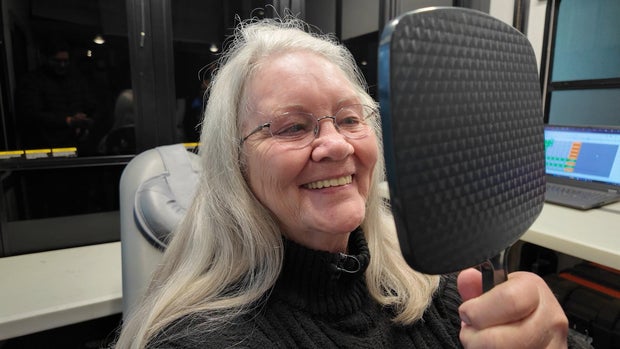 Sandra Tallent
60 Minutes
Sandra Tallent
60 Minutes
Dentist: Looks good?
Sandra Tallent: Yeah, yeah.
Dentist: Happy dear?
Sandra Tallent: Yeah.
Scott Pelley: What does this moment mean to you?
Sandra Tallent: I don't know what I'd do. You know, the Lord would make a way. But I feel like he has made a way through RAM.
Over the Knoxville weekend, RAM allowed more than 500 patients to see, 700 live without pain and restored the smiles of 24. With insurance out of reach for growing millions, RAM will hurry to another city to make health in America a little less remote.
Volunteer: You look beautiful
Sandra Tallent: Do you think I look pretty?
Volunteer: Yeah. You look gorgeous. Seriously, you look so pretty.
Sandra Tallent: Thank you again for being here, Honey.
Volunteer: Have a great day, have a great life!
Sandra Tallent: Get some sleep.
Produced by Henry Schuster and Sarah Turcotte. Broadcast associate, Michelle Karim. Edited by Joe Schanzer.
In: