
 5 months ago
81
5 months ago
81
It must be a disadvantage, given his line of work, but Warwick Thornton insists he is scared of actors. “I have an actor phobia,” he says in Berlin, where his powerful new film Wolfram screened at the annual film festival in February. “I don’t understand them, you know what I mean? These people who stood in front of a mirror at some point and said ‘yeah, this face is good enough to be in front of the camera’.” So he doesn’t talk to them about their characters. “The script should be written strong enough for us to be kind of on the same page,” he says.
It may not be, of course. Besides which, I don’t believe him; Thornton is an inveterate talker, an all-night talker – he loves to talk. Whatever, I do believe him when he says New Zealand actor Erroll Shand asked him to send not the usual kinds of notes, but a song that would sum up his character.
“He actually made me do a lot of work without having to talk to him,” says Thornton, with visible respect. “What is Casey, who’s a mongrel, misogynist, racist piece of shit? What is the right song for him? I got screwed by Erroll in such a good way, because now I think that should be part of my process in all films.”
This is the scallywag way Thornton talks: he’s a joker who veers in and out of deep seriousness, telling tales that may or may not be true, sounding nervous – he says he worries about saying the wrong thing to journalists but he can’t resist a bit of provocation – and worrying whether people will embrace his film. “That first screening is handing over your baby in its pram,” he says. Will we look after it? Will we love it? “Being in competition is scary!” He might say anything.
Of course, this was the year when all that seemed to matter at the Berlinale – always the most politically charged festival on the circuit – was where anyone stood on Gaza. Jury chairman Wim Wenders tried to head off the issue at the beginning of the festival by saying that cinema should act as a “counterweight” to politics. “We have to do the work of people, not politicians,” he said, thus starting a firestorm.
By the time Thornton and his team arrived, four days before the festival’s end, that fire was raging out of control and the festival director’s job was on the line. Thornton is a Kaytetye man from Alice Springs who has spent his life making films about the devastation of Australia’s Aborigines by white invaders. He wasn’t going to be fazed by questions about whether cinema should take a political stand. Nor was he going to toe anyone’s line.
Successive groups of international journalists sit down with him. So, Warwick, is cinema political? “Just me being here and walking around is a political statement!” he retorts. “My people were colonised. We were raped, murdered, shot, poisoned in a genocide. Smallpox vials were brought on the First Fleet to give us smallpox. I’m Aboriginal. I make films. I can stop making films, but I can’t stop being Aboriginal. So I can’t stop being a political statement, whatever happens.”
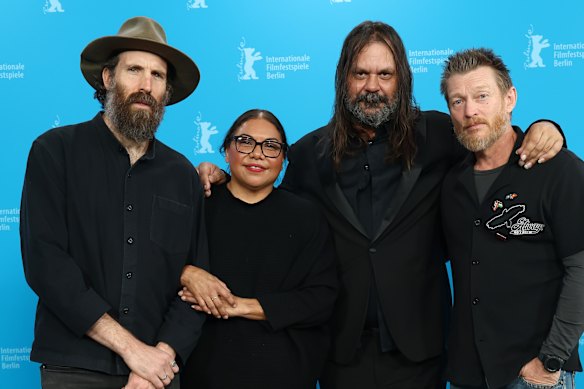
The pointlessness of the Berlinale brouhaha, especially the way it was directed at Wenders, annoys him, but he does enjoy making that riposte: that his survival is its own statement. “I love saying it in Australia to racists who wanted us gone, you know what I mean?”
As he says, his cinematic subject and purpose is clear enough. “I’m a firm believer in never making films in terraces with share houses of young university students. There are lots of those,” he says. If he ever tries to make a romcom, his wife has permission to “take me out the back”. Wolfram’s stamping ground, by contrast, is all heat and dust, with the buzzing of flies as its soundtrack; it is set in the same storied land around Alice Springs as his earlier film Sweet Country (2017).
Some characters reappear, but it isn’t a sequel. Thornton doesn’t like sequels any more than he likes romcoms. “There’s so many beautiful stories out there. And sequels are usually the death of something beautiful.” The bad sequel tarnishes the original, ruining them both. And while we’re at it, don’t call Wolfram a “meat-pie western”, a term often applied to films set in the outback. Not that he doesn’t love westerns to his very bones. It’s the meat pie that sticks in his craw. “Like spaghetti. Or there’s a ‘noodle Western’ that came out of Malaysia. You know, it’s slightly racist in a strange way.”
Thornton’s resistance to repetition meant he initially refused to consider the Wolfram script, written by Sweet Country’s Steven McGregor and David Tranter. When he did, he was convinced. Like Sweet Country, Wolfram is focused on Indigenous dispossession and exploitation; also like the earlier film, it shows people of all colours floundering to find themselves. At the same time, it pivots away decisively from the earlier film’s focus on conflicts between men.
“Sweet Country is a brutalist, male, macho, biley, spitty, B.O. kind of thing,” Thornton says. “All these blokes, dicks out there, riding horses and killing each other. The person who should have the most dignity gets shot in the head. All of which is true to the Indigenous storytelling I want to do. But because of the hardness of that film, this is an antidote, in a strange way. Because it’s about women. I am in a place now where I want to make movies about women. People I do not understand. People I’m incredibly scared of.”
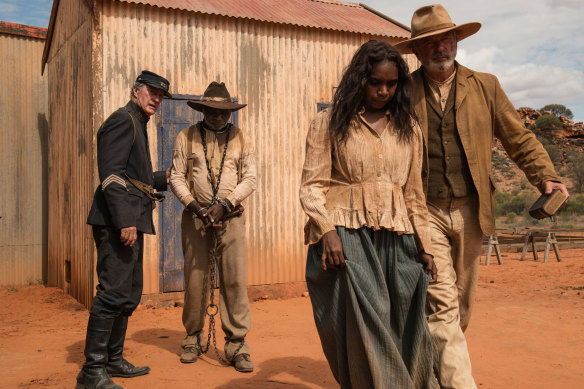
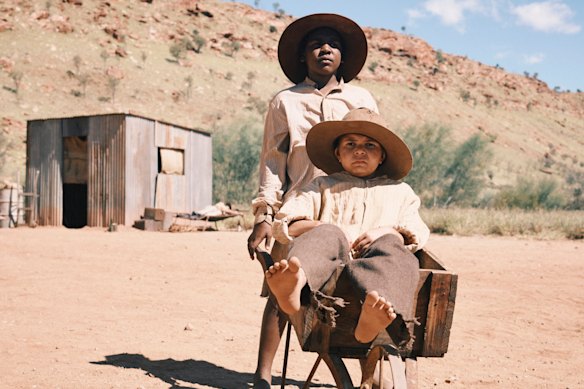
Wolfram – an old word for tungsten – opens some time in the 1930s on a dusty waste pocked with mines, where dilapidated men and ragged children swing picks at the rocks in the hope of paydirt. When their mother, Pansy, inexplicably disappeared, Max and Kid – who are barely old enough to be in school, let alone a mine – were kidnapped and traded as domestic slaves to drunken Billy. When he is bitten by a snake, they are able to escape.
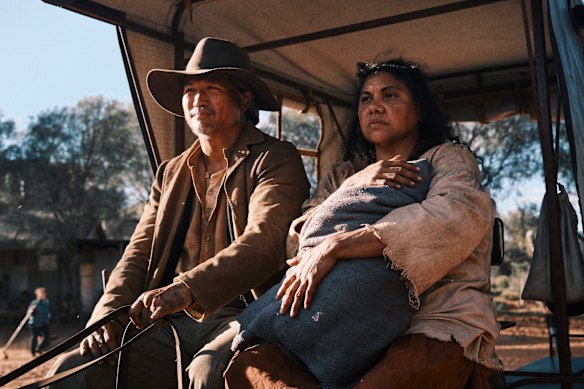
Cut to Pansy, embodied in an almost wordless performance by Deborah Mailman. Now on the road to Queensland with a Chinese goldminer Zhang (Jason Chong), she leaves small signs in the bush, hardly more substantial than the breadcrumb trails of fairy tales, that she desperately hopes will lead her children back to her. Before that can happen, Max and Kid fetch up at a bush hut where Kennedy (Thomas M. Wright) lives with his browbeaten mixed-race son Philomac (Pedrea Jackson).
Also passing through are the malevolent Casey (Shand) and his flunky Frank (Joe Bird). Casey gets a hard kind of joy from hunting and killing Aborigines. When Shand asked Thornton to find a song to inspire him, he eventually plumped for Johnny Cash’s When the Man Comes Around. “My interpretation of the song is that it’s about the apocalypse, when Jesus is going to come back and sort shit out,” Thornton told Shand. “But you think this song is about you. You’re the righteous one who is going to clean up this disgusting state of decay.” When Philomac makes off with the two children, Casey’s blood is up.
Wright, who plays Kennedy in both Sweet Country and the new film, laughs when I tell him Thornton’s line about being afraid of actors. He didn’t know Thornton at the point when he asked him to join the cast of Sweet Country; now, he says, they’re “close mates” who just don’t need to talk. Wright is also a director; his works include The Stranger (2022). “We’re both completely obsessed with and completely dedicated to cinema,” he says. “We might briefly reach out to each other and say ‘hey, what about this?’.”
Kennedy’s contempt for his son is distressing to watch but, says Wright, he didn’t feel that he was playing a villain. “In a lot of Wok’s films necessarily, you see some pretty bad white fellas. But badness and evil are not simple concepts; they spring from complex and often very conflicted places.
“Kennedy’s actually desperately lost, I think. He’s completely unreconciled to his relationship with his son and therefore his relationship to himself. This loveless, decultured, disconnected way of living is the best he can do – and that’s kind of a tragedy.” It is, moreover, a very human tragedy. “For me, counter to that sloganeering and finger-pointing that went on in Berlin, cinema has always been this big machine of empathy,” says Wright. “The thing it does best is take you to places you couldn’t go otherwise.”
Thornton has been working with many of his crew since he shot Samson & Delilah (2009), his first feature, which won the Camera d’Or at the Cannes Film Festival. He is both director and cinematographer. “Then I surround myself with the most beautiful, creative human beings, who are there to just make the film better,” he says. “The shoot is generally really easy for me because it’s almost like me and a whole lot of my best friends have gone on holiday. Except we were in central Australia and there’s 10 billion flies and we’re all eating flies.”
For the cast, his instinct is to seek out unknowns. Wright and Mailman are well known in Australia, of course, but not internationally. Sweet Country had Sam Neill and The New Boy (2023) had Cate Blanchett. “I never thought about that; I never get stuck in thinking who’s good for the poster. Who’s good for the story? I love Cate and I love Sam. They’re amazing. But when you read something and you go ‘that actor is perfect for it’ and your producers go ‘who’s that?’, I think you’re on the right track.” His favourite characters in Wolfram, he says, are the two women who run the town pub. “That’s Anni Finsterer and, actually, my daughter Luka. I’m going to make a movie about them.”
Wright says he hopes to make more films with Thornton, whatever part he plays. “I think he’s one of the most significant filmmakers that this country’s ever produced. When you look at his films, the depth of feeling and thought in those films ... As serious a thinker as he is, he’s also a complete punk who wants to shake people and entertain people and come from left field. That’s very difficult to do in Australia.”
It would be just as difficult at any studio, given the films Thornton makes. They’re not comfortable. “Yeah, they’re going to kick you up the arse and pull your hair,” the director says. “That’s what my films want to do. To tell you that you should be learning something about history, that you should know things.” Of course, he deadpans, the day may come when he makes a film about two old folk who run out of tea. Ma and Pa Kettle, craving Bushells’ best. “I’ll get there one day,” he says. “But at the moment, I’ve still got to do what I’m doing.”
Wolfram opens on April 30. Q&A screenings with Warwick Thorton and Deborah Mailman take place at Melbourne’s Classic Cinema on April 20 and Cinema Nova on April 21; HOTA Gold Coast Film Festival opening night, April 22; Dendy Newtown Sydney on April 24 and Randwick Ritz Sydney on April 25 (Thornton only).
Must-see movies, interviews and all the latest from the world of film delivered to your inbox. Sign up for our Screening Room newsletter.

















































