3 months ago
30
3 months ago
30
Four middle-aged women, members of a long-running book club, stand around a marble island bench in the kitchen of an inner-west Sydney terrace, sipping rosé while the host assembles a salad. Call it an extraordinary general meeting of the club – there’s no book on the agenda, and more serious issues are on the table.
“He wasn’t very attractive but it went for six weeks and was fantastic; I had sex again and then I said, ‘Thank you very much,’ ” says one of the guests, Sally*, who met the man she’s referring to via a friend soon after ending her marriage in 2020. Sally, 53, hadn’t dated since her early 20s. “I later learnt that that’s called a ‘palate cleanser’. The kids just thought I was at book club a lot.”
Claudia* interjects to share her expression for a rebound hook-up – “like a sniff of coffee beans”.
Sally, long, fair hair and cool glasses, resumes her story. “Then I started doing the bloody Bumble thing and I was like, ‘This is terrible!’ ” She turns to Rachel* – “like when you and I went speed dating and you came out of that and said you were going to become a lesbian”. Rachel, 59 and slender with strawberry-blonde hair pulled back, replies: “I liked the women more.”
But Sally, the head of finance for a large corporation, is a driven woman and, after two decades with “a terrible husband” who wrapped her in debt, was determined to find a new partner, a good man. She left no stone unturned. An expensive agency introduced her to an international businessman who bought her clothes, took her to restaurants and picked her up in limousines. “There was completely no substance,” Sally says. “After about four months, like when you get past that headiness, I realised my brain was inconvenient to him.” Back in the dating-app swamp, she chatted online briefly to a man who told her about his weekend and sent her a photograph of a barbecue he’d just assembled. “It’s a boy thing,” he told her, before asking what she’d been up to. “That weekend, literally, I’d been chainsawing trees in my garden. It didn’t go very far after that.” But Sally treated her search as a project. “I’d meet six different dates in three weeks, give it a break and just live for a while, and then go back in and I’d do it again.”
Lucy* the 62-year-old host, turns from the sink where she’s draining spaghetti and says to Sally: “You were really brave. You kept getting back out there, you were really corporate about it – like, ‘OK, it’s a numbers game.’ If John and I split up, that’d be it for me, I’d never go online, I’m terrified of it.”
Like Sally, Rachel is determined too. For five years she knew she wanted to leave her husband – he was “emotionally unavailable”, neglectful of her and their children, utterly focused on his IT business. Sometimes when he was working, he’d tell her that he was “in the zone” – as in don’t interrupt him. Sometimes he’d go away for weeks on end. “You did everything, you raised the kids, you pressure-hosed the driveway, you did everything,” Lucy comments. But Rachel wanted her youngest child to turn 18 before she upended the marriage. She parked her unhappiness. In early 2022, she buckled – just before her daughter’s birthday.
“It was, ‘I can’t do this marriage any more,’ I was just done.” Her husband was blindsided. “It was this anger, like, ‘How dare you inconvenience my life which is so good with you doing everything.’ ” One of his first responses to the news was to ask Rachel to hold off until he’d closed a major contract. Plating up spaghetti ragù, Lucy observes: “Women check out a long time before they actually leave, and when they do finally walk out the door the men are like, ‘What! I didn’t see this coming!’ If they’d been paying attention, they would have noticed that she hadn’t been present for years.”
Rachel was ready for adventure after her marriage ended. “I’m quite a sexual person and I needed to enjoy that aspect of my life again.” She had a year-long relationship with the first (and last) man she met via an app. He was kind and loving and the sex was great but, politically, they were a gulf apart. “And he never stopped talking about himself.” Rachel, a public servant, told the man it was over. Now she’s ambivalent about ever entering another relationship. “I’m quite happy to be single,” she says. “It’s important women aren’t afraid to be alone; it’s really disempowering to be afraid to be alone.”
This evening’s book club agenda: a new feminist movement – a revolution in how heterosexual women in midlife are thinking about love, relationships, men and living arrangements. An ever-increasing number of women of a certain age, disaffected with where they’ve found themselves after lifetimes of socialisation about women’s roles, are binning old romantic scripts that cast them as labourers and emotional moorings and reassessing what they want their lives to look like.
Sally’s and Rachel’s stories are emblematic of the shift: both are what psychologists might dub “walkaway wives”; both ditched deeply unsatisfying marriages once they felt their children were old enough to cope with upheaval. Their decisions match a broader demographic shift: while the divorce rate is at its lowest in 50 years, the share of divorces involving couples married 20 years or more – a proxy for midlife and older splits – has risen by about 30 per cent over three decades. (There is no available data to reflect the rate of de facto separations; and, as Nicole Kidman knows too well, men still leave women.) But this story is about more than marriages ending: it’s about what women are deciding to do when they are single again – regardless of whether they chose to leave the relationship or were left. Women who have the financial resources to do so are increasingly taking a stand, sometimes for the first time, about what sort of man and partnership is worth their time and energy, even if that means they end up building solo lives.
Dr Elisabeth Shaw, a clinical psychologist and CEO of Relationships Australia NSW, talks to hundreds of women every year, and has felt the changing temperature. “We’ve really seen out the phase where women feel they need a man to feel good enough,” Shaw says. “More women in midlife are willing to stand alone and take what comes.”
On the morning of the book club, Lucy, a shrewd, plugged-in identity in the Sydney entertainment world, emailed me a recent article from Oprah Daily headed, “Why the Stereotype of the Desperate Single Woman Is Becoming a Thing of the Past”. It cited 2022 Pew Research Centre data showing that 65 per cent of single American women overall (versus 50 per cent of men) were not actively seeking love or dates, while 2020 data reported this rising to 71 per cent for women aged 50-plus. The article noted: “We are living through a moment of quiet refusal, a steady unravelling of roles we never truly wanted.” Now, as Lucy herds us towards the dinner table, she mentions the article. She believes the same change is happening in Australia but is convinced the article understates its weight. “I think it’s far more consequential, a profound shift in the bedrock of the patriarchy and, as an offshoot, it translates to something of a crisis for midlife and older men, particularly in the midst of the male loneliness epidemic. They’ve always been able to rely on having a woman to take care of them; what happens if women clock off?”
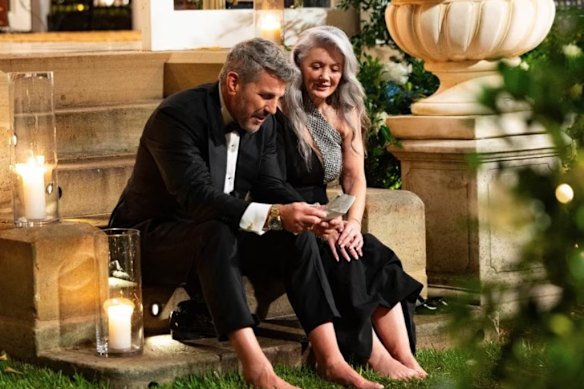
In early November last year on national television, Terri Rippon turned down a man, offering Australian women a stunning visual of what midlife female empowerment can look like. In a moment of excellent television, Rippon was steadfast. Although it’s a far less interesting detail, she was beautiful too: silver-blue Grecianesque gown, unsullied grey hair and eyes so deeply blue you could dive into them.
This is what anachronistic television looks like: on the semi-reality show The Golden Bachelor (broadcast on Nine, the owner of this masthead) a silver fox – in this instance, Barry “Bear” Myrden – is ushered through orchestrated dates with a group of middle-aged women before picking them off in a series of tense “rose ceremonies”. The women wait, helpless, as he pauses for dramatic effect before calling on them one by one to receive a rose. Those who do not get a bloom are booted.
As one of the contestants, Rippon had squirmed through a number of the ceremonies, at the end of which Myrden selected her to play on. In one episode, she watched another contestant’s anxiety build as she waited on his decision. “I couldn’t get that out of my mind: here’s this woman feeling that way over a man, waiting for this man to choose her.” By episode five, Rippon was done. “Terri, will you accept this rose?” Myrden asked. For what seemed a lifetime, she was silent. He asked her again. Finally, she stepped forward. “I thought long and hard about it,” she said, shaking her head, smiling kindly, “I’m not going to accept your rose.” Was that a how-dare-she look darting across the bachelor’s face?
Now Rippon, a 62-year-old property developer from Torquay on Victoria’s Surf Coast, tells me her answer was not premeditated or scripted. She simply realised that she had no interest in competing with other women for a man. Her thinking about men and relationships has been hard-won. In 2000, Rippon’s then-husband told her he needed to move out “to work things out”. She discovered he had started a new relationship when her young sons returned from an outing and told her they’d met “Daddy’s new girlfriend”. “I was a complete mess,” she says. “It really broke me.”
Rippon has had three long-term relationships in the years since, the last with a financially insecure man a decade younger. “It was great – probably sexually driven – but he was immature. I remember having an argument with him one day and I said, ‘My god, I’m nearly f---ing 60, I don’t need to put up with this crap.’ ” She is not interested in being either a “nurse or a purse” for a man, she says. “I’m sick of helping men. If I met somebody now, he has to be at least on the same level as me financially and I most likely would never live with them. They need to have their house, I’d have my house. Happy days.”
Rippon’s Golden Bachelor turn is not the only pop culture moment to reflect the midlife shift. Backlash against the influencer-driven, frilly-aproned trad-wife movement was in full swing by the time Lyz Lenz’s divorce memoir, This American Ex-Wife – which described marriage as “a commonplace horror” – was released in early 2024. Two months later, American writer Miranda July’s novel All Fours, the “first great perimenopause novel” according to The New York Times Magazine, quickly became a rallying point for women. “Sometimes I could hear Harris’s dick whistling impatiently like a teakettle, at higher and higher pitches until I finally couldn’t take it and so I initiated,” says July’s anti-heroine of the chore of having sex with her husband alongside “endless cleaning and cooking and caring and working”. The Yale Review described the bestseller as “a call to freedom from conventional forms of domesticity and marriage”. In the novel, a semi-famous artist seething with hormones and discontent farewells her husband and young child and, instead of driving to New York for a work event, stops at a “junky” motel where she spends weeks in a transformative, dream-like liaison with a younger stranger. After All Fours′ publication, women bombarded July, 51, with messages confessing to their own relationship disaffections. Book clubs threw themselves upon it, All Fours group chats proliferated. Inspired, some women reportedly upturned their own lives.
English singer Lily Allen’s exceptional 2025 album West End Girl added another layer. Many read the autofictional exposé of the infidelities of 41-year-old Allen’s (now ex) husband as a rejection of the expectation women should stay silent about men’s poor behaviour. It electrified women, setting off a social media storm. “For every woman who’s twisted herself into a human pretzel to keep some emotionally constipated bloke happy, this is our national anthem,” one woman commented on Allen’s Instagram.
The zeitgeist has spawned headlines (“Is having a boyfriend embarrassing now?” – UK Vogue) and new language. Terms such as “heteropessimism” and “heterofatalism” have emerged to describe, in the main, women’s weariness and cynicism about straight relationships. As Annabel Crabb identified in her 2015 book, The Wife Drought, one of the troubles hetero women face is that they don’t get to have a wife. Even while working full-time, women continue to do the greatest share of unpaid household labour – on average, 32 hours a week, nine hours more than men, according to the Australian government’s 2025 Status of Women Report Card. Studies also have found that women bear about 70 per cent of the mental load of running households – keeping tabs on school projects, medical appointments, gifts for everyone as well as his mother. And then there’s “mankeeping”, a term postdoctoral Stanford University fellow Angelica Puzio Ferrara coined in 2024 to describe the work of being a partner’s de facto counsellor, managing his emotional turmoil and buttressing what is frequently a frail social network.
Little wonder a Chicago psychotherapist’s Substack post headed “Ageing Out of F---s” went viral in late 2025. Ellen Scherr, who claims “to help women navigate midlife transitions when you suddenly can’t tolerate anyone’s bullshit” argues that neurological and hormonal shifts can strip away decades of hypervigilant, people-pleasing behaviour and emotional labour. In their place, she writes, women in midlife can gain clarity, time and authenticity. ”Welcome to what I call the Great Unf---ening,” Scherr wrote. The first comment underneath said: “Wow. This was a whole exhale I didn’t know I’d been holding.”
Back at the book club dinner table: dragging sourdough through sauce, mopping up the spillover of revolutionary discussion. There are any number of aspects of this new love landscape to address. “We’ve looked the devil in the face and gone through the fire,” says Sally, laying down her fork. “We know who we are.”
Such resolve isn’t forged in a vacuum. By midlife, adding to the strain of difficult or insufferable relationships, any number of other blows can land, often simultaneously – bereavement, redundancy, caring for ailing parents or wayward young adult children, menopause, health issues. Eleanor Mills, the 55-year-old founder and CEO of Noon, an organisation dedicated to building community for women in midlife, calls it “the midlife clusterf---“. But Mills also describes an opposing force turbo-powering a woman’s agency at this time – the realisation that, in a “hundred-year life”, they still have time. “We’re seeing lots of women voting with their feet and saying, ’I’m not prepared to settle for something shit when I’m only halfway through my life,” says Mills. “We’re approaching midlife with a different kind of agency and sense of expectation.”
There’s no manual to explain the rules of engagement after a woman decides the status quo is untenable; things can be messy, protracted or even remain unresolved. Enter “quiet divorce” – what an article late last year in New York magazine’s The Cut termed “subconsciously uncoupling”, checking out on a marriage while remaining together, the age-old condition of detaching and living in a state of weary acceptance or worse. As Rachel knows, it can take a toll. During the five years she was quietly quitting her marriage, she endured crippling perimenopause symptoms and, at one point, underwent major surgery. She thought her husband would step up when she was released from hospital but on the first day home, she cooked the family dinner.
As Lucy brings a cake to the table, Rachel says she was on antidepressants and relied heavily on the “serenity prayer” to get through – accepting what can’t be changed and finding the courage to change what can. “You switch off the taxi light,” Sally says. “You do what you have to do,” Rachel replies.
Sally’s “quiet quitting” from her husband was noisier. As fast as she paid the mortgage, her husband piled up debts secured against the house. “I worked my arse off until I had enough to buy him out.” In 2010, she negotiated a financial separation from her husband, although she elected to stay under the same roof for another 10 years for their children’s sake. “I had to give him cash but it meant I had a legal agreement that I was the primary caregiver, the owner of the assets.” Now Sally finds herself thinking about women who don’t have the financial means to engineer exits. “The real work these days is helping women build a five-year plan, because it can take that long, you’ve got to get your ducks in a row.” She has been astonished at women she knows who haven’t even had their own bank accounts when they’ve separated from their husbands. “I’m like, ‘What are you doing!’ ”
Lucy shares her experience: soon after her marriage in the mid-2000s, her husband’s behaviour switched from kind to controlling and abusive. “I realised he was a liar, scary.” Like Sally, she was the main income earner, but it took her seven years to manoeuvre her way through her husband’s coercive control and out of the massive debt he’d landed her in. “With every move I made, I massaged his ego; I had to make him think that things were his idea and would benefit him.” Finally, in 2010, Lucy was able to transfer money out of joint accounts and cancel credit cards. “He wasn’t a shouter, he was a quiet man. He said to me, ‘I just tried to use the credit card.’ I said, ‘Yep, it’s not going to be working any more because we’re splitting up.’ He said, ‘Well, what am I meant to do for money?’ I said, ‘Get a job.’ I came out of the marriage going, I will not be treated like shit ever again.”
With such a mindset, building new intimate connections can be a slow, tremulous process. “I have to protect myself,” Rachel says. One woman I speak with for this article describes the experience of being with a new lover as “terrifying”: “I’m so rigidly keeping my vulnerabilities under wrap that it’s like walking on a tightrope. The truth is, after a spectacularly dramatic end to a long and ultimately toxic 20-year marriage, I’m not sure how I would cope with rejection again and that’s what drives my choices about relationships now. Midlife men should know that midlife women don’t need them – we are independent, we’re not looking for someone to look after us … they need to add value to our life!”
Another woman tells me that, although she recently started dating a new man after rebuilding herself from a devastating relationship breakdown in mid-2023, her only priority is maintaining a calm and peaceful home for her daughters. “The relationship will only continue if it is completely incremental to my life and my peace,” she says. “If in any way it compromises this beautiful life we have now, I just wouldn’t stand for it.”
Both Sally and Lucy are now in strong, committed relationships – Lucy has been with John for 13 years, Sally with Chris for a little over two years. Both are poster women for another hallmark of this new era – LAT relationships, people “living apart together”, maintaining relationships while keeping separate households. In 2019, more than 1.5 million single Australians had an intimate partner they didn’t live with. “It’s a case of build-your-own arrangement,” says Lucy, one of many women who see a LAT arrangement as defensive architecture as much as lifestyle preference, a way to achieve intimacy without slipping into old roles. “I am a great fan of geographic separation; from my experience, I don’t think men and women living together in a heterosexual relationship full-time serves women particularly well. Men are hard work, even the lovely ones. We lose ourselves and end up as domestic servants – it’s in our DNA.” Lucy and John, who both have young adult children, are only now starting to talk about moving closer or in together. “We’re having some really intense conversations about it; we both have baggage and I’m really protective of my own space.”
Lucy has counselled Sally about the issue of cohabitation. Soon after Sally met Chris, she was overwhelmed by the sense they should have been together forever. Lucy took her for coffee. “She said, ‘Don’t try and merge your houses and your kids all at once.’ That really settled me,” Sally says. For now, she and Chris see each other three nights out of seven. “We’ve got a rhythm, I really look forward to seeing him – it’s exciting, there’s so much joy in our relationship; even if eventually we move in together I think we’ll need ways to preserve that.”
Kerri Sackville, the Sydney-based author of Out There: A Survival Guide for Dating in Midlife, offers a compelling example of how living apart together can work. Four years ago, after a decade or more of misery, a marriage breakdown, another traumatic relationship and eight years of what she describes as “almost frenetic dating”, Sackville looked at her platonic friend Michael and had an epiphany. “I swear to god, it felt like I had been hit with the love stick,” she says. “I suddenly thought, ‘I want to touch his knee!’ ” They have been together since soon after that electrifying moment but still live apart. “From the start, we talked about how you can form your own ideas about what a relationship is and what it looks like.” They see each other most days, holiday together and are close to each other’s young adult children but don’t force them together. “As much as it would be nice to one day live together, there’s no urgency,” Sackville says. “We spend a lot of time together, but can then retreat back to our own places – I’m 57, he’s 61, we need space!” Still, she says, “it’s the first time in my life I can honestly say I’ve felt emotionally safe with someone else.”
One day while I’m writing this article I visit my literary agent, Fiona Inglis, at her Paddington office. She tells me a modern love story. As with so many such stories at our time of life – Inglis is 64 – it starts with a tragedy. In 2015, the father of her two young-adult sons died six weeks after being diagnosed with oesophageal cancer. For years, her boys were her sole focus. Soon after they had both finished high school, Inglis, the managing director of Curtis Brown Australia, signed up to Bumble.
Women in midlife aren’t rejecting love or men or relationships. They’re rejecting asymmetry in relationships.
In his dating profile, the man said he loved the ebb and flow of stories. “And I thought, ‘Well, stories are my life.’ ” Inglis met him in the Sydney beachside suburb of Coogee for a coffee. She remembers the blue of the sea and the sky and the red of his T-shirt, his thick grey hair. “Handsome, Irish.” She took him a book, a collection of short stories by the Irish writer Kevin Barry. At the end of the date, the man walked her to her car. “I said, ‘Well, that was fun, that was really fun’, and I put my hand out to shake his hand. He just pulled me into a big hug – he’s really tall, about six foot three – and said, ‘Yeah, me too.’ ” Inglis and Cathal (Karl) de Burca, a semi-retired microbiologist and IT consultant, were married last year at Wylie’s ocean baths in Coogee. He wore an Irish kilt, she wore Trelise Cooper. Her two boys walked her down the boardwalk. In her wedding speech, Inglis said: “I didn’t need to be rescued, I could quite easily have gone on living on my own perfectly happily, but now I have him in my life, I know I can lean on him for absolutely anything.”
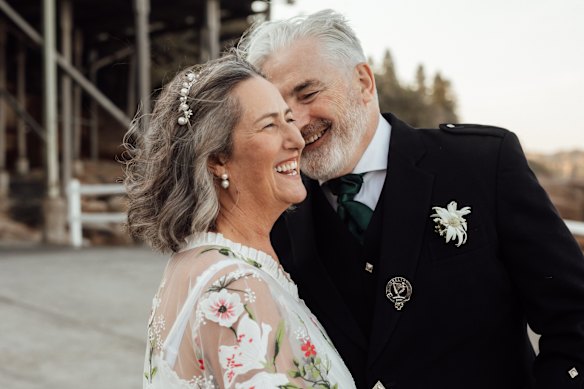
The couple have what Inglis describes as “a daggy old house” on the NSW South Coast where de Burca spends most of his time. Inglis typically is in Sydney Monday to Wednesday and on the coast Thursday to Sunday. “I get down there and if I haven’t seen him for two days, we just fall into each other’s arms, we just love seeing each other.” When they swim in the ocean, Inglis slips in behind him. “He’s got really big shoulders and the way he swims is the way he lives; he’s really steady and strong and powerful, and I can just go in his wake.” They have a binding financial agreement but money is unimportant. “He brings absolutely everything else to the table; I feel so fulfilled by having him in my life.”
Women in midlife aren’t rejecting love or men or relationships. They’re rejecting asymmetry in relationships, the cost of love as it has been structured for generations. At multiple turns through the research for this piece, I come upon middle-aged women who have, in the past couple of years, fallen freshly and deeply in love. Book club member Claudia*, for example, who has never married and does not have children. At a pub one night in 2024, out with friends, she and an acquaintance, a widower, were the last to leave. “The seats were being packed up and we were still chatting,” Claudia, a 54-year-old researcher, tells the book club members. She’d not previously had a one-on-one conversation with the man. Within four months of the conversation, they’d both sold their houses and moved in together. “I could just tell he was solid,” she says. “This person is somebody I always want to stay with; I always want to be in the same room as him.”
But if there’s no man sufficiently solid or safe or emotionally literate to hand, midlife women are standing firm, holding on to their authenticity and refusing to compromise. Noon’s Eleanor Mills sees a woman at midlife as a chrysalis. “You finally get a chance to shake off everybody else’s expectations ... all the hoops you’ve had to jump through, and finally get a chance to say, ‘Well, what do I want?’ ” And women are having love affairs of a different nature – with tight groups of girlfriends bound by deep affection, big laughter, emotional support and common interests. “I’ve got the most wonderful girlfriends,” says The Golden Bachelor’s Terri Rippon, “my heart is so filled that men just don’t cut the mustard for me any more.”
The meeting to discuss the revolution is drawing to a close now; Sally and Rachel and Claudia are carrying plates into the kitchen while Lucy stacks the dishwasher. Sally mentions a woman she knows who walked away from her marriage just before she was 65. “She got absolutely caned by the kids and their friends but she just felt the marriage was dead; there wasn’t conflict, it was more just there was nothing. She wanted to travel, to live. He didn’t. She hasn’t stopped travelling since, she’s done the most amazing things.”
Lucy stops for a moment, mid-plate, thinks, and then says: “From birth, the biggest threat society says women face if they don’t conform is that they’ll end up on their own with cats. But, when you’ve been through shit with men, you think, ‘Actually, that sounds pretty good!’ ”
* Names and some identifying details have been changed.
Get the best of Good Weekend delivered to your inbox every Saturday morning. Sign up for our newsletter.