3 months ago
23
3 months ago
23
Washington: The Trump administration’s prosecution of one of President Donald Trump’s top political enemies was dealt a major blow after a judge made a rare intervention upon finding “government misconduct” may have tainted the case.
Former FBI director James Comey, who oversaw probes into Hillary Clinton’s emails and the alleged ties between Trump associates and Russia in 2016, was indicted on criminal charges in September, days after Trump publicly instructed his attorney-general, Pam Bondi, to expedite the prosecution of several political enemies.
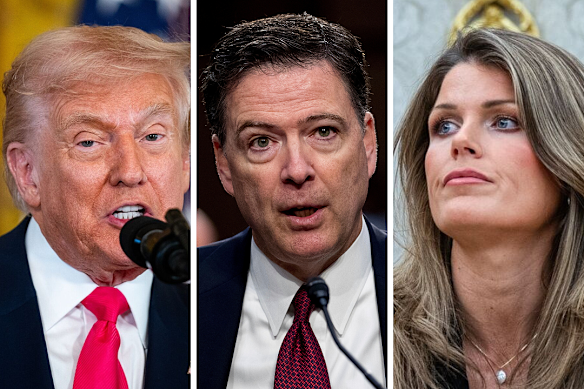
US President Donald Trump, former FBI director James Comey and US Attorney Lindsey Halligan.Credit: AP
A grand jury indicted Comey on charges of making false statements to a 2020 Senate hearing and obstructing a congressional investigation, and he faces jail time if convicted. He has pleaded not guilty.
But on Monday (Tuesday AEDT), magistrate William Fitzpatrick identified several irregularities with Comey’s indictment, and, in what Fitzpatrick himself described as a rare and extraordinary move, ordered all grand jury evidence to be unsealed and handed over to Comey.
“The record points to a disturbing pattern of profound investigative missteps – missteps that led an FBI agent and a prosecutor to potentially undermine the integrity of the grand jury proceeding,” Fitzpatrick wrote in a scathing ruling.
In particular, he questioned the actions of Trump’s former personal lawyer, Lindsey Halligan, whom Trump then installed as a prosecuting attorney to pursue Comey and other political enemies, when she presented to the grand jury.
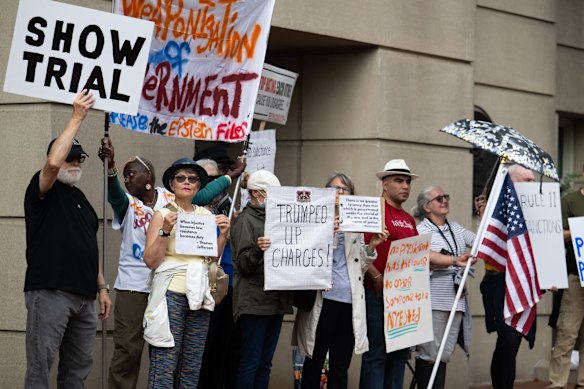
Protesters outside court when former FBI director James Comey pleaded not guilty in October.Credit: Bloomberg
Halligan – who has never been a prosecutor – had only been appointed to the job days earlier, amid Trump’s frustrations with apparent resistance from her predecessor about pursuing the prosecutions.
“The court has identified two statements by the prosecutor to the grand jurors that on their face appear to be fundamental misstatements of the law that could compromise the integrity of the grand jury process,” Fitzpatrick found.
One “highly prejudicial” statement by Halligan conflicted with the Fifth Amendment, Fitzpatrick said, and may have led the jury to believe that the burden of proof was on Comey to explain away the government’s evidence, rather than for the government to prove his guilt beyond reasonable doubt.
Another statement by Halligan suggested to the grand jury that they did not have to rely just on the evidence presented to them. Rather, it suggested “the government had more evidence – perhaps better evidence – that would be presented at trial”, Fitzpatrick said.
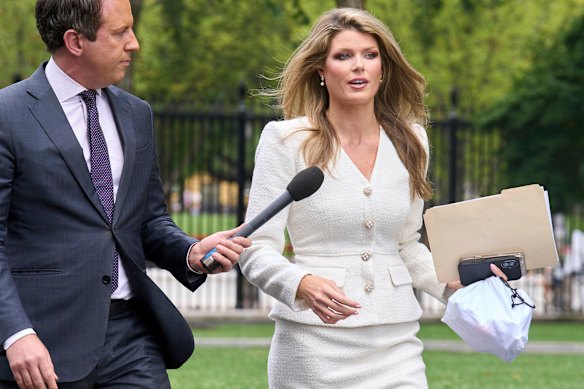
Trump promoted his former personal lawyer Lindsey Halligan to take over the Comey case.Credit: AP
Halligan’s actual statements were still under grand jury secrecy and were redacted from Fitzpatrick’s ruling. Halligan was one of only two people to address the grand jury, along with the lead case agent at the FBI.
The public elements of the Comey indictment had already been scrutinised by lawyers including those at the Brennan Centre for Justice, which found it lacked clarity and was likely vulnerable to challenge.
Loading
“All told, the indictment doesn’t look like the work of experienced prosecutors who understand the scrutiny to which any indictment, and certainly this one, will be subjected,” wrote former federal prosecutor Joyce Vance.
“Federal prosecutors use a robust review process to surface issues in an indictment before they take it to a grand jury. That doesn’t seem to have happened with this one.”
The White House has been contacted for comment.
Comey was among several of Trump’s political enemies that the president asked Bondi to target. Another, New York Attorney-General Letitia James, was indicted in October on charges of bank fraud and making false statements to a financial institution.
More to come
Most Viewed in World
Loading