3 months ago
22
3 months ago
22
Protesters will be free to conceal their identity at public demonstrations unless they are instructed by police to remove face coverings under weaker than promised mask laws to be considered by the state cabinet on Tuesday.
Under the proposed new legislation, police can only order the removal of masks if they reasonably suspect a protester is committing or about to commit a criminal offence. Even in these circumstances, exemptions can apply for health, cultural and religious reasons.
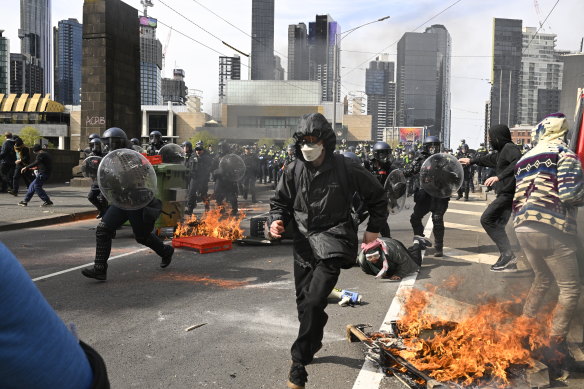
Masked protesters clash with police during a demonstration against the Land Forces expo in Melbourne in September.Credit: Chris Hopkins
However, the government was facing the prospect of possible court challenges to the constitutionality of a blanket mask ban, as well as a potential revolt from Labor Party faithful.
The details were confirmed by three sources with knowledge of the government’s plans. The bill will be introduced to parliament this week, if approved by cabinet on Tuesday, among other law and order measures.
The proposed laws fall short of what Premier Jacinta Allan pledged in the aftermath of the firebombing of the Adass Israel Synagogue and then weekly protests against Israel’s bombardment of Gaza, which she said had included “extreme, dangerous and radical conduct” and antisemitism by some of those who attended.
Speaking shortly after the synagogue was destroyed by arsonists, Allan promised to stop protesters using face masks to hide their identity and counter the use of pepper spray by police.
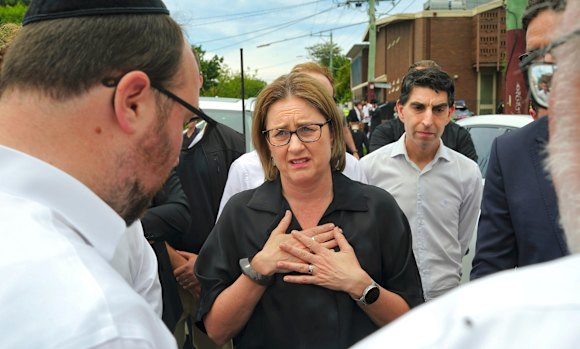
Victorian Premier Jacinta Allan outside the Adass Israel synagogue after it was destroyed in December 2024.Credit: Luis Enrique Ascui
“We’ll ban the use of face masks and balaclavas at protests,” Allan said on December 17 last year.
“We know they are being used to conceal identities to shield agitators from crowd control measures like capsicum spray. Face masks aren’t a free pass to break the law. There should be no place to hide in this state if you’re a racist stirring up hate on the streets.”
Under Victorian law, police already have the power to direct someone to remove face coverings if they are within a “designated area” – a geographic space gazetted by police for the purpose of deploying greater search powers.
If a protester refuses to comply, police can direct them to leave. Failure to comply with a direction is an offence.
Under the proposed new laws, police will no longer have to designate an area to request the removal of face masks but must comply with the reasonable suspicion provision.
The government’s attempt to strike a balance between legal concerns and its promise to crack down on extreme behaviour at public demonstrations, while likely to be cautiously welcomed by libertarian and legal advocates, will disappoint Jewish community organisations.
It is also likely to prompt heated debate around the cabinet table on Tuesday.
Opposition police spokesman David Southwick said the proposed changes were too little, too late and would frustrate people who had been waiting for the government to take strong action.
“It is simply going to provide more cover for people who want to break the law,” he said.
The opposition has already pledged that a Coalition government would ban face masks and reinstate move-on powers to help police deal with violent and disruptive protests.
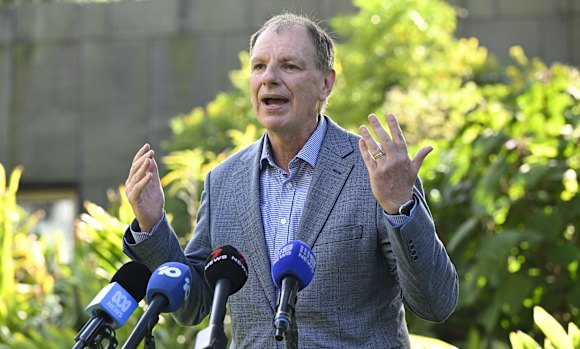
Opposition police spokesman David Southwick.Credit: Christopher Hopkins
The Allan government will deliver on a separate promise to ban the public display of symbols of proscribed terrorist groups such as Hezbollah and Hamas, and the use of glue, rope, chains, locks and other attachment devices used by protesters to resist police.
The legislation will contain provisions designed to limit protests outside synagogues, mosques and other places of worship but not impose a blanket ban. There was a general acceptance an outright prohibition would have unintended consequences, including for child sex abuse survivors who have previously protested outside churches.
When the law changes were first promised by the government, Police Minister Anthony Carbines said ski masks were for Mount Buller, not the streets of Melbourne.
“If you stand for something, you don’t get to hide behind a mask here in Victoria,” he said.
After clashes with police at the Land Forces weapons expo in 2024, then-chief commissioner Shane Patton said demonstrators had been intent on causing violence.
“They were standing there in full-face balaclavas with ski masks on. There was no snow there,” he said. “They only wore those for one reason: to avoid being subject to a [capsicum] spray when they came with intent to provoke, to attack.”
The legislation was drafted following extensive consultation with human rights advocates and Jewish, Islamic and other community groups.
The Human Rights Law Centre had raised concerns about the legal validity of a face mask ban, arguing it would criminalise people who wear them for health or cultural reasons, to maintain their privacy, or who wear mask coverings as a form of political communication or art.
The centre’s legal director, Sarah Schwartz, said on Monday that the High Court had affirmed that laws restricting peaceful protest had to be justified and proportionate.
“A blanket ban on face coverings at protests would not only be a clear overreach but would likely breach the constitution’s implied freedom of political communication,” she said. “A proposed mask ban would deter participation in peaceful protest, especially among racialised communities, religious minorities, and people with disabilities.”
Schwartz, who is also executive officer for the pro-Palestine Jewish Council of Australia, said if the government was serious about addressing extremist conduct, it must not cut across people’s right to protest peacefully.
The centre also opposed banning the use of attachment devices, the display of terrorist symbols and protests outside places of worship.
Start the day with a summary of the day’s most important and interesting stories, analysis and insights. Sign up for our Morning Edition newsletter.
Most Viewed in Politics
Loading