3 months ago
28
3 months ago
28
The nation’s peak Muslim body has defended a radical Islamist organisation as the Albanese government moves to expand its powers to ban extremist groups, a stance that has exposed internal divisions within Australia’s Islamic leadership.
The Australian Federation of Islamic Councils has signed a joint statement with stand4palestine – a protest group closely linked to Hizb ut-Tahrir – criticising proposed laws that would make it easier to designate organisations as prohibited hate groups.
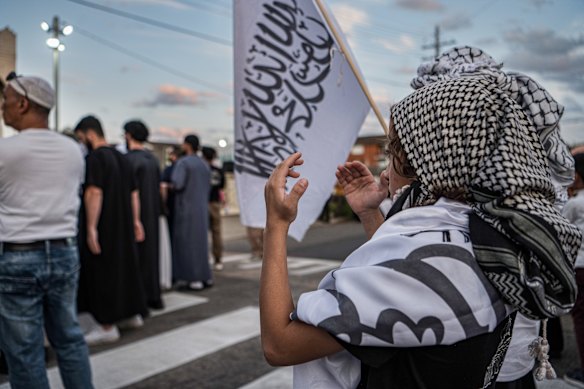
A protest linked to Hizb ut-Tahrir in Sydney in October 2024. The fundamentalist group is banned in a string of countries, including the UK, Germany and Indonesia.Credit: Flavio Brancaleone
In the statement, published to Instagram on Sunday, the community Muslim groups said the proposed regime was “part of a wider effort to hold the Muslim community collectively responsible for the Bondi attack”.
“One does not have to agree with Hizb ut-Tahrir, and can in fact be strongly critical of it, but banning Hizb ut-Tahrir under the pretext of hate is wrong and misleading,” they said.
“We cannot ignore the genocide in Gaza, which pro-Zionist advocates have spent the last two years defending.
Loading
“If hate speech is really a crime, then the words of pro-Zionist advocates, who have provided a cover for genocide, should first be prosecuted.
“Whether it is individuals or groups, we must reject any attempt to silence our voices through executive overreach.”
Hizb ut-Tahrir is regarded warily by many in the Muslim and broader community due to its hardline views, amid concerns it has stepped up its presence in mosques and youth groups.
The laws, likely to be tabled in federal parliament on Tuesday, would lower the threshold for the federal government to designate a prohibited hate group. Membership of, or support for, a listed organisation would carry penalties of up to 15 years’ imprisonment.
The Australian reported on Sunday that AFIC’s leadership signed on to the statement despite internal opposition, with a source saying the decision was not approved by all executive committee members and amounted to a “captain’s call”.
The statement, also endorsed by several other Muslim groups, including the Ahlus Sunnah Wal Jamaah Associations in Sydney and Melbourne, followed Prime Minister Anthony Albanese’s decision to abandon an omnibus extremism bill and instead split gun reform and the hate groups regime into separate legislation.
An official statement from AFIC on Sunday made no specific mention of Hizb ut-Tahrir, but said the body remained “seriously concerned” by the government’s proposed powers relating to the designation of “hate organisations”.
“When power to outlaw organisations rests on secret evidence and political discretion, it stops being about the law and becomes ideology and politics with the force of the state behind it,” Dr Rateb Jneid, president of AFIC, said. “This is not how a democratic country should define or punish hate.”
Loading
It argued that laws enabling the government to designate organisations as “hate groups” and apply consequences without clear definitions, transparent standards of evidence, or a fair mechanism for challenge, were “the opposite of sound lawmaking” and vulnerable to political misuse.
AFIC was contacted for comment.
Home Affairs Minister Tony Burke has said the laws were designed to capture organisations such as Hizb ut-Tahrir and the neo-Nazi National Socialist Network, which he argues have deliberately stayed just inside the law.
“There have been organisations which have played a game for a long time in keeping themselves just below the legal threshold … the Nazis, the National Socialist Network, and Hizb ut-Tahrir,” Burke said last week. “Two groups which, through their spreading of hate, have a direct impact on increased risk on our national security environment.”
Most Viewed in Politics
Loading