3 months ago
11
3 months ago
11
Arguing Australia has too many elected representatives has been part of the nation’s political discourse forever.
Take this short poem printed in the Cessnock Express and Mining and Farming Representative from 1905, when the author “Steele Grey” took umbrage at plans to pay the state’s politicians.
“We have politicians weighty,
And we have, them tall and small,
But perhaps we’d get along as well,
If we had none at all.”
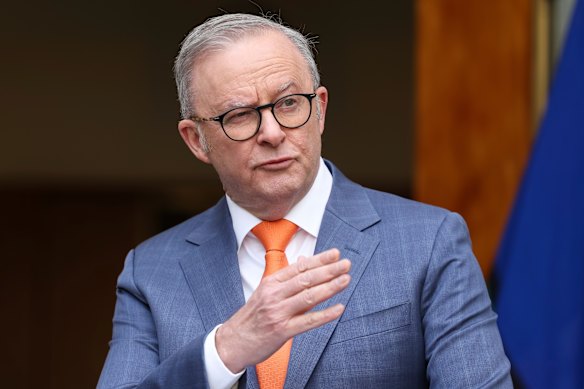
Prime Minister Anthony Albanese played down the prospect of making the parliament bigger during this term on Wednesday – but the idea has merit.Credit: Alex Ellinghausen
While US President Donald Trump has recently ruminated that American voters might be open to a dictator, it’s pretty clear most Australians still want the right to vote on those who represent them at the local, state and federal levels.
Finding the right number, however, to do that representation is much more difficult.
Special Minister of State Don Farrell has brought the issue into focus by asking the parliamentary committee charged with reviewing the 2025 election to examine the number of federal MPs and fixed four-year terms.
The knee-jerk reaction of many will be like Steele Grey – why the hell would we want more MPs?
The most obvious reason is the pressure we’re putting on the existing 150 House of Representatives members.
There are now, on average, 177,000 people in each electorate. In 1984, when the number of parliamentarians was last increased, it was just 105,000.
Loading
That’s 177,000 people with their own needs and issues that have to be addressed by the local MP and their staff. That’s the local MP who gets asked to attend every school prize night, council meeting and community gathering within their electorate every day.
That’s the same MP dealing with complex immigration or welfare payment issues (these dominate the time of elected officials), problems with the local road or pedestrian crossing, the parliamentary committee work and – if they’re a minister – their executive responsibilities.
I haven’t included the time spent on political or media engagements, while fitting in time for their own families.
At 177,000 per seat, and growing, Australia is an international outlier.
Members of Britain’s House of Commons represent, on average, 72,000 people. Canada’s 338 lower house members represent about 81,000 voters (in a country even larger than Australia) while across the ditch, Kiwi MPs answer to an average of 30,000 voters.
Only the United States, which under Trump is no democracy poster child, does far worse than Australia, with the average Congress member representing close to 800,000 people. Little wonder feelings of anger, disenchantment and conspiracy run through the American political system.
More MPs would lighten the collective load on the current crop. It would also increase the chance that communities or interest groups who feel underrepresented now find someone to listen to their concerns.

At 177,000 people per seat, Australia is an international outlier when it comes to electoral representation.Credit: Bloomberg
Don’t go thinking an enlarged parliament would give the government of the day an electoral advantage. When Ben Chifley increased the size of the parliament at the 1949 election, the influx of new MPs helped his Liberal opponent Bob Menzies.
And there’s scant evidence Bob Hawke’s parliament increase in 1984 helped him, as Andrew Peacock won an extra 16 seats compared to Hawke’s additional seven.
More MPs would, hopefully, increase competition on the government and opposition backbench. The Coalition could do with a few more foot soldiers to hold Anthony Albanese and the Labor Party to account.
There’s also a growing safety issue around the size of our electorates.
David Littleproud represents 150,000 residents of the seat of Maranoa, which sprawls across almost 730,000 square kilometres of southern and central Queensland. It’s larger than South Africa – population 64 million.
Durack in Western Australia, represented by Liberal MP Melissa Price, is the country’s largest electorate. It’s a mind-boggling 1.4 million square kilometres. If it were a nation, it would be the 19th largest.
Most regional and rural electorates are getting larger in area as their populations grow more slowly than urban and coastal areas or suffer outright falls. The people in these communities, such as Mount Isa or Armidale or Swan Hill, all deserve proper representation.
Loading
Forcing MPs to drive or fly long distances is just asking for trouble. Then Nationals’ leader Tim Fischer in 1994 famously escaped a car accident that killed two people as he drove home from his electorate office in Albury to his farm, 130 kilometres away outside the community of Boree Creek.
Other rural MPs have reported far too many near misses on long drives or flights in small planes.
Sticking with the same number of electorates, spread across the entire continent, means rural seats will only get larger.
Steele Grey may have wanted to ditch all elected officials. But democracy is built upon the concept of representation. And a key part of that representation is ensuring that voters can engage with their elected official in a timely and efficient manner.
Ultimately, that may require more MPs.
Cut through the noise of federal politics with news, views and expert analysis. Subscribers can sign up to our weekly Inside Politics newsletter.
Most Viewed in Politics
Loading