3 months ago
19
3 months ago
19
Growing up in western Sydney, where the mercury increasingly spikes hot and sweaty, Mt Druitt artist Katerina Asistin spent summer days and annual school swim carnivals at her local swimming pool.
On the city fringes, it’s such municipal baths that offer respite in high summer. The Mt Druitt Swimming Centre is a chlorinated blue oasis among patches of grass and picnicking families, the shallow end of the 50-metre Olympic-sized pool usually thickest with swimmers.
“This will be the last season before it gets renovated to become an indoor-outdoor swimming pool, which made me want to paint it,” Asistin says. “I remember times running to the bathroom and like the concrete was super hot. Even though the shaded part was on the concrete paths, people would take picnic blankets and put them on the grass and just soak up the sun.”

Western Sydney artist, Katarina Asistin, at Mt Druitt Swimming Pool, a summer destination she has been documenting in a major commission for Penrith Regional Gallery’s upcoming The Pool Show. Credit: Steven Siewert
A new exhibition showcasing public baths and backyard pools opens at Penrith Regional Gallery this weekend, fittingly timed for the hottest season of the year in a suburb holding the record for the highest temperature ever recorded in the Sydney basin (48.9°C on January 4, 2020).
The Pool Show includes loans from the Art Gallery of NSW – David Hockney’s Water pouring into swimming pool, Santa Monica (1964), four works from Tracey Moffat’s Fourth pool series (2001), Max Dupain’s Swimmers at Newport (1952) and Harold Cazneaux’s Dee Why Pool II (1934) – as well as works by several emerging western Sydney artists including Asistin’s watercolour and acrylic paintings of Mt Druitt pool.
Gallery director Toby Chapman says the swimming pool is not merely a place of leisure and relaxation. “It’s a site where the politics of our time play out; where your race, postcode, gender or sexuality can be determinants for who can swim, and how they are treated in the pool.”
Artist and writer JD Reforma rummaged through his family’s photo albums for colour-faded holiday snaps from the Philippines, which he has etched onto metal mirrors used in public pools. Marian Abboud and The Seed of Hope Collective look at migrant and refugee women’s relationship to water, including the Assyrian Women’s Swim Club, an older group of women learning to swim at Granville Pool.
“I definitely think it’s keeping up with their kids, and not missing out,” Abboud says. “The women I’m working with now are really embracing things in their life a lot more than when they were younger, and there’s this freedom in being able to float in water that we take for granted.”
Fellow artist Dennis Golding points to the divisive history of Australian pool culture in collaboration with First Nations young people from his father’s home town of Collarenebri, where it’s uncertain the local pool will open this summer due to engineering issues.
Golding’s Echoing Pathways project comprises print etchings and a string of ceramic sculptures resembling floating pool dividers, referencing the 1965 Freedom Ride, when a bus of activists travelled across regional NSW to protest Aboriginal people’s exclusion from town facilities, including pools.
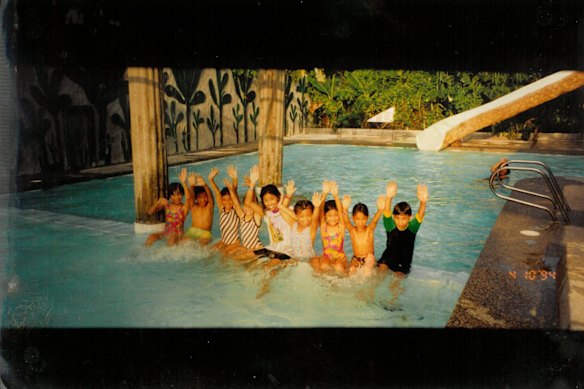
JD Reforma’s A pool is promise.
His experience of the outdoor swimming pool is more complicated than Asistin’s. “I grew up in Redfern and our closest pool was Victoria Park near Broadway, and so me and my cousins would be dropped off by our aunties or grandparents, or we’d go in community groups, and that felt good,” Golding says.
“But a lot of times, when it was just me and one other friend, we’d sometimes get interrupted by other kids who didn’t want us around and would call out bad stuff.
“There were moments where you’d feel a bit unsafe going alone so it helped going as a group.
Loading
“What I remember best about the pools was the type of games that we loved to play, like the coins where we’d dive in blindly to find them on the pool floor. We always used to hang around the deep end because we loved diving off.”
Mt Druitt pool closes for renovations on January 26, but not before Asistin introduced her two nieces to its kids’ pool.
“I find swimming pools hold so much memory,” she says. “I also grew up going to the beach and still do as an adult, but I feel like with swimming centres they have their own nostalgia because of its architecture and commonality and accessibility.
“The community is very different, and the environment itself. To me, the swimming pool is more welcoming in a way. I vividly remember my last school swim carnival in 2020 and all the seniors didn’t compete and went to the novelty event, and big groups of Samoan and Tongan friends. I remember everyone having fun in the shallow end. It was chaotic but always fun together just forgetting our dramas and differences.”
The Pool Show at Penrith Regional Gallery from November 8 to February 15.
Most Viewed in Culture
Loading