3 months ago
19
3 months ago
19
When Taran Pahwa bought his first home in outer-suburban Donnybrook last year, he chose a property with the biggest backyard he could find within his budget.
Pahwa and his family live in Olivine, a fledgling housing estate 50 kilometres north of the city centre.
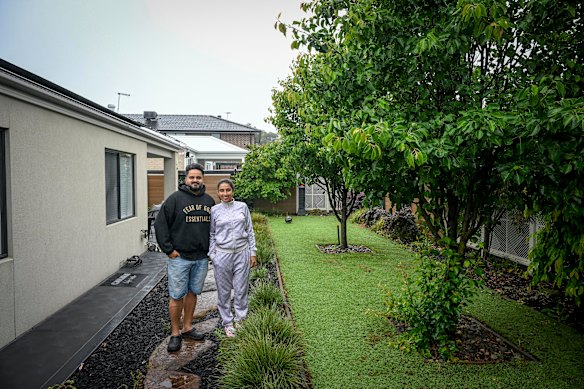
Taran Pahwa and his wife, Annupreet, enjoy spending time in their backyard in Donnybrook.Credit: Eddie Jim
The family put a premium on owning somewhere with a yard generous enough to be a private sanctuary and social gathering place.
“It’s more psychological,” Pahwa said. “If you’re staying in the suburbs, I think that’s the perk. You should have a bigger garden and backyard for sure.”
Olivine’s developers have built an impressive communal playground called the Gumnut to lure young families, constructed around towering river red gums.
But elsewhere in the estate, mature trees are more scarce.
Most of Pahwa’s neighbours’ houses have been built close to the property boundary, and his family’s spacious, shady yard has become a rare commodity.
“I’m surprised because a lot of people who are building their houses, they are not left with much backyard – they just want to fill up whatever is allowed,” Pahwa said.
It’s not that houses in Donnybrook are getting bigger. Rather, blocks of land are getting progressively smaller, leaving less room for a traditional backyard, in a trend that is being replicated throughout Melbourne’s fastest growing suburbs.
A 10-year analysis of lot sales in Melbourne’s outer-suburban growth corridors reveals the median block of land has shrunk just over 20 per cent, from 441 square metres in 2015 to 352 this year.
The suburban shrinkage means Melbourne’s greenfields have laid claim to having Australia’s smallest median lot size for four years in a row, according to data compiled by the Urban Development Institute of Australia.
A standard new block in the greenfields is no bigger than a modest-sized property in inner-city Northcote.
Rob Burgess, a property industry researcher with Quantify Strategic Insights, said: “Relative to most of suburban Melbourne, the lots in the growth areas where people are buying house and land are considerably smaller than the average suburban lot in an established area.”
The trend is being driven both by urban planning rules that mandate greater housing density and by worsening affordability that has led developers to reduce lots to sizes that keep a three- to four-bedroom house within reach of first home buyers.
Andrew Raponi, senior research manager with RPM Group, said rising interest rates had reduced first home buyers’ borrowing capacity and forced them to settle for smaller blocks than they could have afforded five years ago.
But buyers have been less willing to compromise on house size.
“If people have got a family of four, they need three to four bedrooms,” Raponi said. “It’s a lot harder to negotiate on house size. Whereas with the land, you can go a bit smaller.”
Many buyers would still like a big backyard. Since COVID times, they also wanted an extra room to work from home, Raponi said.
Gaurika Kohli, a real estate agent who specialises in Melbourne’s outer north, said many buyers were time poor and not interested in maintaining a yard, and would rather convert outdoor space into a covered al fresco sitting area.
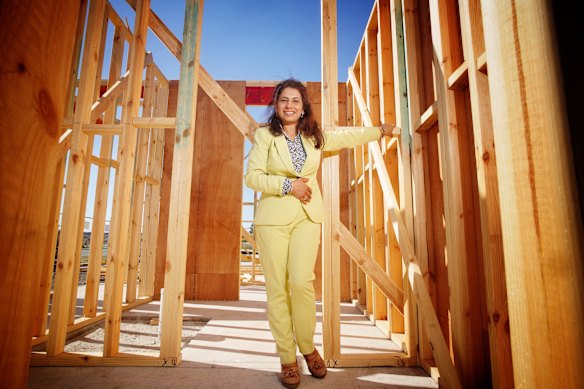
Many first-home buyers aren’t interested in maintaining a backyard, says real estate agent Gaurika Kohli.Credit: Luis Enrique Ascui
State government planning guidelines for new precincts in Melbourne’s growth corridors had also increased housing density expectations, in the push towards so-called 20-minute neighbourhoods.
In 2013, the former Growth Areas Authority planned new suburbs with a target of 15 homes per hectare. By 2021, the Victorian Planning Authority had increased density targets to 20 to 25 homes per hectare, rising to 30 dwellings in a town centre.
Loading
This increased housing density on the fringe is helping Melbourne hold its status as Australia’s fastest-growing city. Its population grew by 142,637 people in 2023-24, according to Australian Bureau of Statistics data, and growth was fastest in affordable outer suburbs including Fraser Rise, Rockbank and Clyde North, where a 350 square metre block of land sells for about $400,000.
These suburbs are forecast by the state government to accommodate an extra 350,000 homes by 2050, but Wingate research director Andrew Perkins said that based on current trends, Melbourne’s greenfields could squeeze in an extra 420,000 homes within the current urban growth boundary.
“The government will set a minimum density per hectare, and you’ll see that’s prescribed in a number of the structure plan documents,” Perkins said. “But then you’ll see developers that are exceeding those densities as they are introduced.”
RMIT University urban planner Dr Thami Croeser said the push towards more compact suburbs made sense in tackling car dependency, but not at the expense of tree cover.
“You need tree canopy close to homes to protect neighbourhoods from heat,” Croeser said, explaining that street trees and public parks will not keep homes cooler in a heat wave.
“If you look at green suburbs in places like Brisbane or even here in Melbourne, the street trees aren’t doing the heavy lifting – it’s the backyard trees.”
Start the day with a summary of the day’s most important and interesting stories, analysis and insights. Sign up for our Morning Edition newsletter.
Most Viewed in National
Loading