3 months ago
5
3 months ago
5
Many of us may have fond memories of homes filled with vases adorned with koalas and kangaroos, all taking centre stage on the gingham tablecloth. And truly, what could be more Australian than a shelf lined with ceramics encrusted with such motifs?
While some still see these distinctive designs as kitsch, others see the value both in a monetary and cultural sense. What might have once cost a few shillings in the 1920s, ’30s and ’40s is now worth serious dosh – even for the mass-produced ceramics.
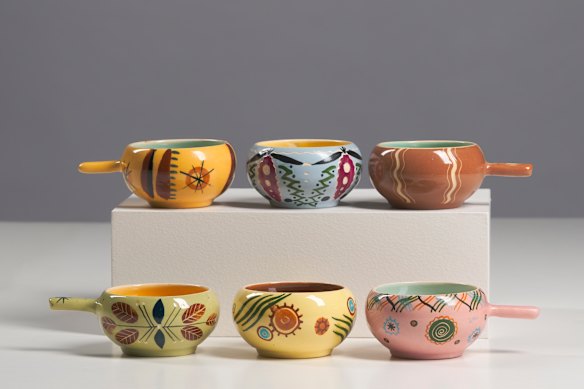
Six ramekins by potter Martin Boyd, whose productions can be highly valued.Credit: Leon Schoots
Some names such as Arthur Merric Bloomfield Boyd and his father Merric Boyd are highly collectable. A large bowl by Arthur, circa 1952, sold at Gibson’s for $7000 (plus buyer’s premium). It features a larrikin-like figure hastily riding a bike.
Other less well-known ceramicists, such as Marguerite Mahood, who was once collected by the late art dealer Marvin Hurnall, also attract significant money. Many of her ceramics from the 1930s include the sugar glider and can fetch upwards of $5000.
“The more one-offs by art potters rather than mass-produced by ceramic studios are obviously going to be worth significantly more,” says Jennifer Gibson, managing director of Gibson’s.
Brushtail possums and the Australian echidna, or spiny anteater, were also used to adorn Mahood’s tableware, be they vases, candleholders or simply whimsical statues on ebonised plinths.
‘These designs capture the distinct Australian humour and celebrate the everyday creatures that are part of our lives.’
Emma Busowsky, curator at the Bendigo Art Gallery“Marguerite’s sugar gliders are iconic with many selling upwards of $5000,” adds Gibson, who singles out other artists such as Grace Seccombe for her Australiana motifs, from kookaburras to various native birdlife.
Even mass-produced pottery by Remued, a pottery company based in Melbourne, is worth looking at, with a bowl adorned with a koala fetching $3200 (plus buyer’s premium) at Gibson’s.
Those who aren’t in the market at these prices can certainly start their Australiana collection by looking at the distinctive glazed ceramics produced by Melrose.
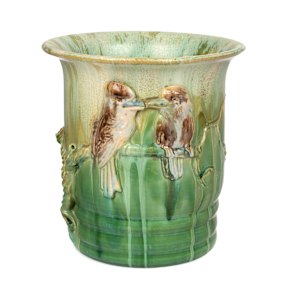
A rare glazed earthenware vase by Remued Pottery.
“These pieces generally start at around $100 and tend to stop at the $1500 mark,” says Graham Lancaster, owner of Graham Lancaster Auctions in Brisbane.
Green glazed bowls embossed with possums and bookends adorned with gum leaves may have been dismissed as simply “cheap and cheery” (read “kitsch”) once upon a time but are now looked at by a younger audience in a new light.
“The prices for Melrose tend to go in waves. There was a recent auction in Melbourne selling a huge amount of Melrose that affected the market, with some prices falling by as much as 50 per cent. It’s certainly a good time to buy,” adds Lancaster.
Emma Busowsky, curator at the Bendigo Art Gallery, has been involved with a number of ceramic exhibitions, some of which have been collaborations with the National Gallery of Victoria (NGV).
Loading
One of these exhibitions was of the ceramicist Klytie Pate. One of the first ceramicists to be acquired by the NGV, her fine filigree-like designs include local flora such as banksias, along with kangaroos and other native creatures.
“Ceramics are a more affordable art form than say, traditional painting and sculpture,” says Busowsky, who only occasionally sees ceramics by the Boyds in second-hand stores or markets.
However, those depicting Australian motifs certainly appeal to a wider audience. “There is value in ‘kitsch’. These designs capture the distinct Australian humour and celebrate the everyday creatures that are part of our lives,” she adds.
While these Australian fauna and flora are generally produced by Australians, either by studio art potters or companies such as Remued pottery, there are numerous examples of others, such as British company Royal Doulton, interpreting the Aussie culture.
Rosemary Caldwell, who works at the Camberwell Antique Centre in Camberwell, still delights in showing a dinner plate depicting two kookaburras by artist I.A Crisp from the 1930s and selling for $375.
Titled Two’s Company, there’s a distinct chirp to these birds sitting on the branch of a tea tree.
Expert tips on how to save, invest and make the most of your money delivered to your inbox every Sunday. Sign up for our Real Money newsletter.
Most Viewed in Money
Loading