3 months ago
5
3 months ago
5
Opinion
November 12, 2025 — 3.30pm
November 12, 2025 — 3.30pm
The “killing season” headlines are not new. Nor is speculation about a woman’s ability to survive a high-pressure role, while the (mostly male) sharks smell blood.
But as Australia’s political class and media focus on whether Sussan Ley can survive beyond Christmas as the Liberal Party’s first female leader, Australia’s democracy and track record for helping women get into politics is being lauded internationally.
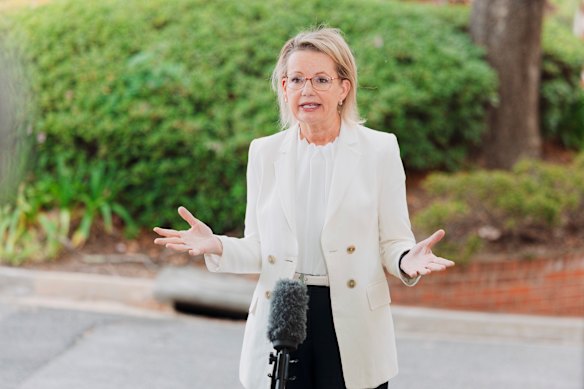
When Sussan Ley stepped into one of the toughest jobs in politics, she also contributed to Australia’s highest-ever ranking for gender equality in politics in this year’s World Economic Forum’s Global Gender Gap Report.Credit: David Beach
The irony is: while we often fixate on the fragility of women’s leadership at home, the rest of the world sees Australia as a success story.
This week, I am attending an international gathering of changemakers, innovators and reform leaders who are advancing democracy around the world. The Better Politics Foundation wants the gathering in Berlin not only to celebrate democratic leadership but to champion bold political ideas for the 21st century.
What few people in Australia can possibly know is that Australia is being lauded as a country that has made genuine, measurable progress – not only in the number of women elected, but in the systems that support them to run, win and lead. One delegate even told me that Europeans want to “rub up against” Australia in the hope that some of our successes will be transferred.
Australia achieved its highest-ever ranking for gender equality, climbing to 13th globally … This didn’t happen accidentally.
The World Economic Forum’s Global Gender Gap Report 2025 noted Australia achieved its highest-ever ranking for gender equality, climbing to 13th globally. The improvement was driven by across-the-board gains: on the Political Empowerment sub-index, Australia ranked 19th this year, up from 28th in 2024. We have more women in parliament and ministerial roles than ever – 49 per cent of federal parliamentarians, 37 per cent in the states and territories, and 40 per cent in councils.
This didn’t happen accidentally. It follows years of cultural change, structural reform and a growing ecosystem of organisations committed to building a stronger democracy – one that reflects the people it serves. Among them is Women for Election, where we work to inspire and equip women of all backgrounds to stand for public office. Through candidate training and leadership programs, it has helped thousands of women – from every political stripe, and from local councils to federal politics – to leap from community leadership to elected office. Recent federal alumni include Nicolette Boele, the member for Bradfield, Jess Teesdale, the member for Bass, and Trish Cook, member for the new seat of Bullwinkel.
Internationally, Australia is being viewed as a leading example of how to build the pipeline – the infrastructure that helps women not only enter politics, but succeed there. In countries where progress has stalled, that approach is seen as a model to emulate.
Loading
Of course, recognition abroad doesn’t mean the work stops. Representation remains uneven, especially in regional Australia. While our federal parliament is looking more balanced, state and territory governments have the lowest female representation of the government levels.
Women in politics also face entrenched cultural and structural barriers. One of the most significant and troubling recent barriers is the fear many women face of harassment and intimidation, both online and in person, during campaigns and after election. This was illustrated when federal member for Wentworth Allegra Spender and NSW MP Kellie Sloane reported rape and death threats after they condemned a neo-Nazi rally in Sydney at the weekend.
Also troubling is the high attrition rate of women from local government ranks that, unless curbed, will have knock-on effects for the candidate pipeline at state and federal levels. More than 20 per cent of current federal MPs began their political journey in local government. While 40 per cent of councillors across the country are now women, there are still too many male-only councils in regional Australia. And the proportion of female mayors hovers at about 30 per cent.
It’s the state and territory level that needs most focus. Indeed, in the recent Tasmanian and NT elections, female representation went backwards.
But amid these challenges, there’s reason for pride. Australia’s progress shows what’s possible when commitment to equality outlasts the news cycle.
We see firsthand how change begins long before an election – in community halls, at school gates and kitchen tables, in conversations where women say for the first time: “I could do that.” Each woman who steps forward expands what’s imaginable for the next.
Loading
Countries that have struggled to break through political inertia, see in Australia an encouraging truth – that steady, practical investment in training, political support structures and civic culture, works. If we want that recognition to mean something, the next step is clear: we must keep building systems that support women to run, get elected and lead.
Because every time a woman steps into public life, our democracy grows stronger, fairer and more representative of the nation we truly are. That – far more than the latest leadership speculation – is the story worth noticing.
Licia Heath is chief executive of Women for Election, a non-partisan group committed to increasing the number of women in public office at local, state and federal levels.
Get a weekly wrap of views that will challenge, champion and inform your own. Sign up for our Opinion newsletter.
Most Viewed in National
Loading