3 months ago
14
3 months ago
14
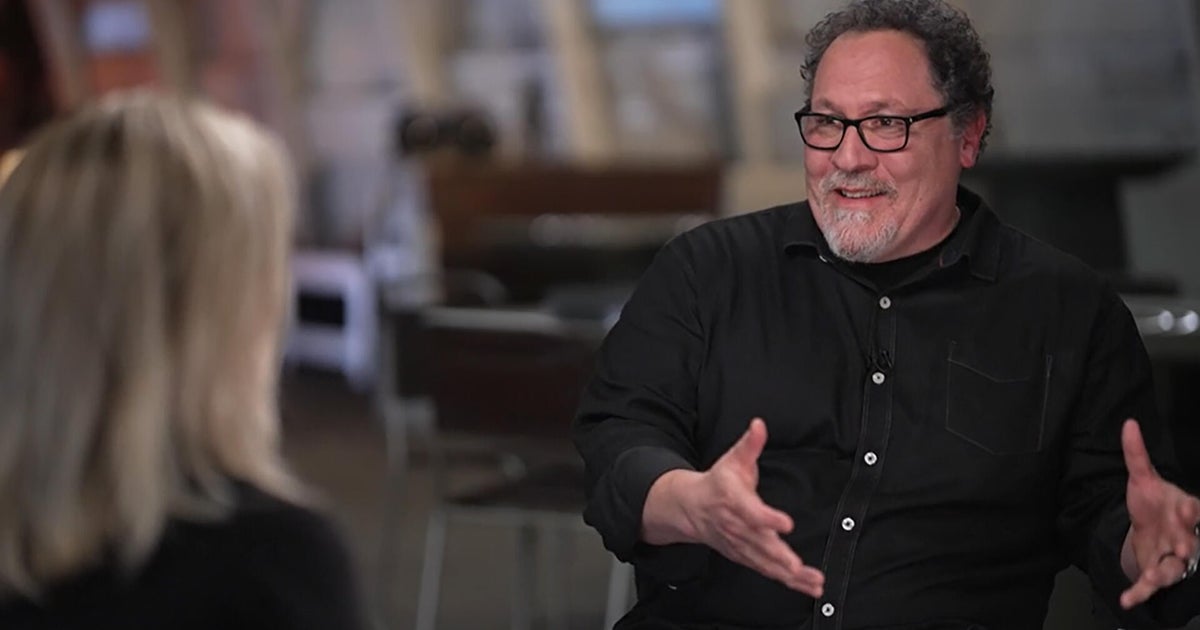
“It’s a learning curve; I’m finding what my limitations are,” says Matthew Mitcham. “But I find that it nourishes my soul. Nothing makes me happier.”
The former diver and Australian Olympic gold medallist is not talking about his new career as an actor, or his role as a counsellor for people addicted to chemsex (the pursuit of having sex on hard drugs).
He’s talking about the doggy daycare he semi-accidentally started at his home in London. What began as casual dog-minding to fill the void left by his lack of a permanent pet has snowballed into a daily procession of toy poodles, cockapoos, staffies, whippets, French bulldogs and Australian cobberdogs.
“I look after an average of six to eight dogs a day,” he says. “I now have one or two people helping me to keep up with demand – it’s kind of exploded and turned into a business.”
It’s becoming clear why Mitcham may have chosen the enthusiastically dog-friendly La Bottega cafe in Leichhardt for our rendezvous. A portrait of a resident small brown dog named Pongo (for the protagonist in 101 Dalmatians) features on the front of the menu. Pongo himself lazes in the sunlight next to our table like a bronzed nonno on a cigarette break in his local piazza.
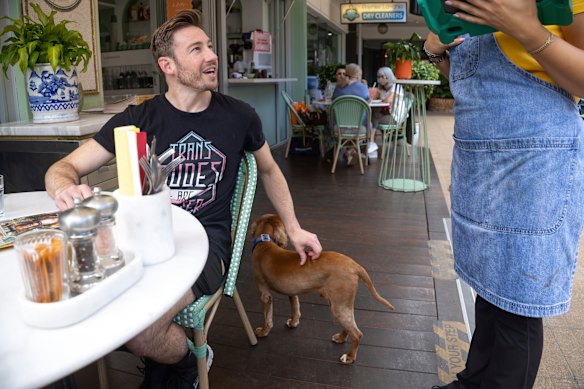
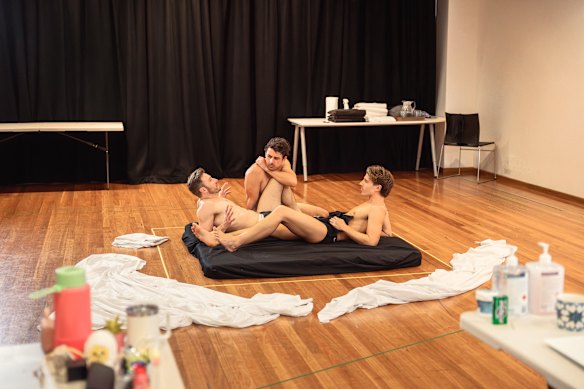
This spot is also a skip away from the Italian Forum, where Mitcham is rehearsing his latest show in a run of theatre productions he describes as “queer plays that address sensitive, difficult topics that include a lot of flesh”. It’s a thespian life made possible by his flexible dog-minding side gig.
The show, Afterglow, follows a married couple who invite a third man into their bed. Cue fireworks and fallout.
“I never really knew how polyamory worked. Not that I’ve necessarily partaken. But in the last few years, I went from an 11-year relationship to a six-year relationship, which were extremely different relationship styles. And so I had to learn about how to navigate those different dynamics. And I still didn’t necessarily get it right the last time,” says Mitcham, who plays one of the married men.
“I just happened to have learnt a lot of the lessons that the character learns in the play, in the last few years … That’s why I was so thrilled to get to play the part.”
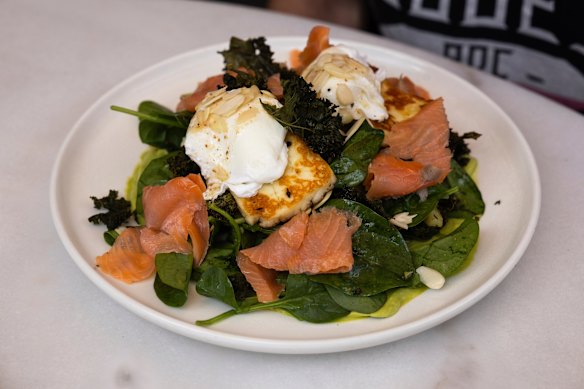
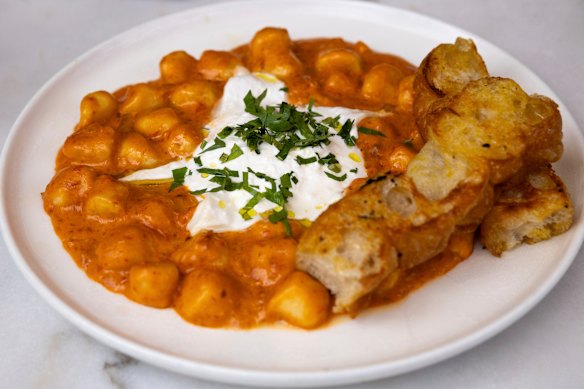
There is a parallel between acting and diving, Mitcham says, after he orders a summer breakfast bowl of chargrilled broccoli, crispy kale, halloumi, whipped avocado and slivers of smoked salmon. I order a plate marketed as “Mumma’s ricotta gnocchi rosa and burrata”.
In both the 90-minute sprint of a stage performance and the second-long plunge of a dive, Mitcham strives for a flow state; an in-the-zone zen rush where thoughts, anxieties and memorised lines vanish, and there is only action.
“That’s kind of the dream. And you only get there from preparation. It was exactly the same with diving. The only times I wasn’t nervous were when I felt prepared.”
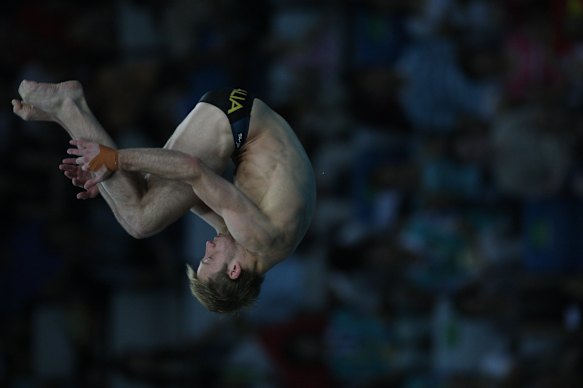
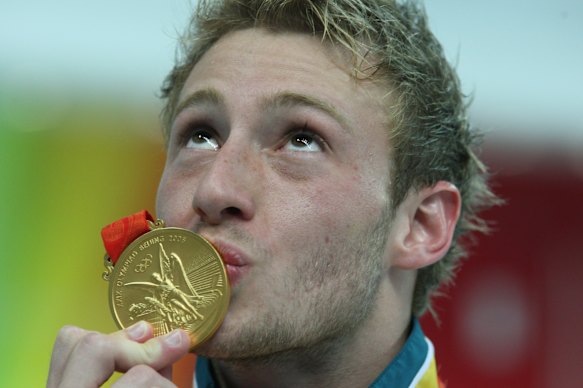
Mitcham’s mastery of that zone at the 2008 Beijing Olympics didn’t just bag Australia’s first gold medal in diving since 1924. His final dive made global history.
It started with Mitcham, then 20, perched backwards on the edge of the 10-metre platform, golden-haired and statuesque. A final breath. Then a rapid and clinical back two-and-a-half somersault with two-and-a-half twists, punctuated by a splash so puny after the explosion of movement it looked almost slapstick. It was the highest-scoring dive in Olympic history.
Then came the moment that snatched more headlines. In the euphoria after the win, Mitcham kissed his boyfriend at the time, Lachlan – only on the cheek, but it was enough to delight most and scandalise some. It was like episode five of Heated Rivalry, 17 years before it aired. (If you know, you know). TV cameras broadcast the moment globally, although it was reportedly censored by US network NBC.
“If that’s one of the most homophobic things that have happened in my career – then I’m incredibly lucky,” says Mitcham.
He’s recalling the moment with a teaspoon half-dunked in a vat of chilli oil sent to spice up the poached eggs atop his bowl of green goodness. I’m mopping up Mamma’s rosa sauce off my plate with garlic focaccia (I can tell you, Mamma knows what she’s doing) and feeling only mildly guilty about asking Mitcham to reflect on this story, presumably for the umpteenth time. I was one of those quiet boys in the suburbs, oddly drawn to Olympic diving for reasons that have nothing to do with appreciating a precise pike, who watched Mitcham win gold on TV. For many, it marked the first time we’d seen a publicly gay man feted as an Australian hero.
Before Beijing, Mitcham had already come out in the pages of this newspaper. A sports reporter, Jessica Halloran, was interviewing him before the Games when he mentioned living with his boyfriend. To Mitcham, it was a mundanity. To Halloran, it was big news; if Mitcham agreed for her to report his sexuality (which he did), he’d be the only out gay man at the Olympics.
“There were 11 LGBTQI athletes in Beijing,” he says. “Ten lesbians, and me.”
Since then, there’s been an exponential climb in the number of publicly queer Olympians, Mitcham says. “There were 24 by the next Olympics in London,” he says. The number more than doubled by Rio, reached at least 172 in Tokyo, and almost surpassed 200 in Paris.
But if Mitcham took his status as Australia’s first openly gay Olympian in his stride, he was contending with a raft of other thorns behind the scenes: years of harsh training and strict coaches, chronic low self-esteem, depression, pain from injuries, and nights on end chasing highs in clubs away from the “straightjacket” of diving. He’d dabbled in smoking ice in Brisbane before quitting in 2007 – when he went to Sydney to refocus on diving ahead of Beijing – but took it back up in late 2009. He was still “knocking himself around” in the years afterwards, while getting the best diving results of his life amid a rivalry with British diver Tom Daley, Mitcham recalled in his memoir Twists and Turns. (He only ever took recreational narcotics, never performance-enhancing drugs, he wrote, and painfully detoxed from drugs before competing.)
“I’m 10 years clean and sober now, so it’s really not a part of my thinking any more,” Mitcham says. “It’s the beginning of recovery that is the absolutely hardest, which you’re not medicating any more, so you’re in withdrawal, but then you also have to deal with everything you were medicating for.
“I hang out with people all the time who are drinking. I love dancing and dance parties. There’ll be people doing drugs all around me, and it doesn’t bother me because I’ve really severed the connection between drugs being any kind of solution. ”
“Yes, [taking drugs] is incredibly effective at changing the way you feel, but it’s also a very crude tool that comes with a lot of consequences and a severe crash afterwards. But when you’re in the addiction, you only see the positive part of it. I had to remove every positive association with the drug and re-associate all of the negative. And that really helps me see addiction and drugs for what they are.”
Mitcham is now a counsellor and ambassador for Controlling Chemsex, a UK charity that helps people battling an addiction to having sex under the influence of drugs such as crystal meth and GHB. It’s an insidious addiction, he says, like treating three dependencies at once.
“Meth, for example, has the most intense spike of neurotransmitters; your serotonin, your dopamine, your norepinephrine, all those really yummy feel-good chemicals in your brain spike more than anything else. That feels like you’ll never get that feeling again, unless you use that drug again.
“But sex is also a very powerful way to spike those. So when you’re putting them together, nothing compares. Nothing will ever match those feelings.”
And going cold turkey is not necessarily the go: sex is part of a healthy life, so it’s not as easy as compelling someone to be abstinent.
“Sometimes I wish it could be like a formula,” Mitcham says of counselling clients. “You do this module, and this module, and this module, and then, ‘Thank you’, ‘you’re welcome, you’re healthy, you’re fixed!’ But life doesn’t work that way.”
Two men appear at our table: Mitcham’s castmates Will Lonsdale and Julian Curtis. They swear they’ve come for the cheap coffee and not to spy. That claim grows more doubtful when Afterglow’s director, S. Asher Gelman, with a blue-dyed fringe and silver reflective aviators, also crops up for a chat. Prompting Mitcham to stick his fingers in his ears and start singing, I ask Gelman how he’s finding Mitcham as an actor.
“He doesn’t come from the same training as the rest of them,” Gelman says. “But there’s something that’s really unvarnished about the way he approaches it, and when he drops in, it hits, and today especially it was really, like, real.”
Mitcham never trained as an actor; he fell into performance after picking up a $24 ukulele to help pass the time while on bed rest for diving-induced stress fractures in his back. That musical dabbling led to a cabaret show in 2014 based on his own life, featuring a drag queen named Spanky who played the addictive devil on Mitcham’s shoulder. He made his UK stage debut in 2023 in the Australian play Strangers in Between and featured in an off-West End production of Jock Night last year.
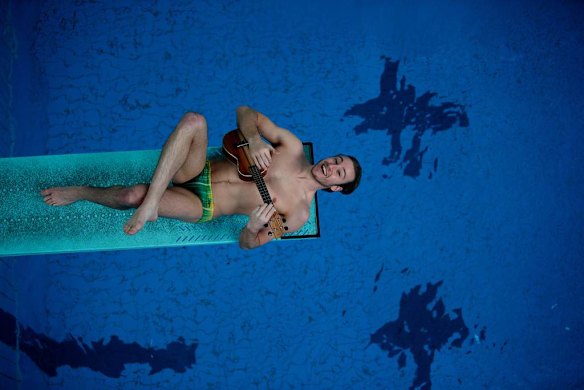
There’s one last thing I want to ask before Mitcham finishes his oat flat white and follows Gelman back to the rehearsal room: How do divers stay orientated once they hurtle off the platform?
“Dancers, gymnasts, divers, trampolinists and aerialists will usually do something called spotting,” he says. “When you’re spinning, turning, whichever axis you’re rotating on, you’ll normally pick one spot [and] every time you do a revolution or a pirouette, you will bring your head back to that spot.”
At risk of torturing the metaphor, is there a spot Mitcham has used to orientate himself in life?
“The driving force for the first half of my life, now that I’m nearly 40, was this desperate need to be special, which I harnessed to do some incredible things. But because I also had quite an unhealthy relationship with that … it didn’t end up being very fulfilling.
“It’s difficult to get the balance right of trying to not feel the need to be special, but to also not be stagnant and to push myself to do things … Oh my god, this sounds really midlife crisis-y,” he laughs.
“I guess now the thing that’s pushing me forward in life, the thing that I’m working towards and that I keep coming back to, is that I just want to be happy.”
With a show about to hit the road and a dog’s life waiting back in London, are we there?
“Oh yeah,” he says. “I’m the best I’ve been in a long time.”
Afterglow plays at the Chapel Off Chapel in Melbourne from January 30 as part of Midsumma Festival, and at the Eternity Playhouse in Sydney from February 26.
Find out the next TV, streaming series and movies to add to your must-sees. Get The Watchlist delivered every Thursday.