3 months ago
21
3 months ago
21
“The decision of the Liberal Party to dump the 2050 net zero target is not in line with Australia’s obligations under the Paris Agreement,” she said.
Australia’s former chief climate diplomat, Professor Howard Bamsey, said judgement should be reserved until the Liberals had detailed their full suite of policy measures to cut emissions, but noted that dropping net zero would imperil Australia’s Paris goal.
“It will have an immediate impact, through policy uncertainty, of increasing the cost of and access to capital for net zero oriented actions such as building renewables. The pace of the transition will already be slowed. So it already begins to put any realistic Paris commitments out of reach,” he said.
Political clash
The Liberal Party has not only by dropped the party’s commitment to reach net zero emissions by 2050, but backed one of the oldest forms of electricity generation in the grid, setting up a clash with the government over coal-fired power.
The party’s energy policy contains a significant departure from its recent plans by offering funding to keep existing coal plants running for longer and to support the construction of new ones.
Ley criticised the Albanese government over its broken promise to cut power bills $275 by 2025.
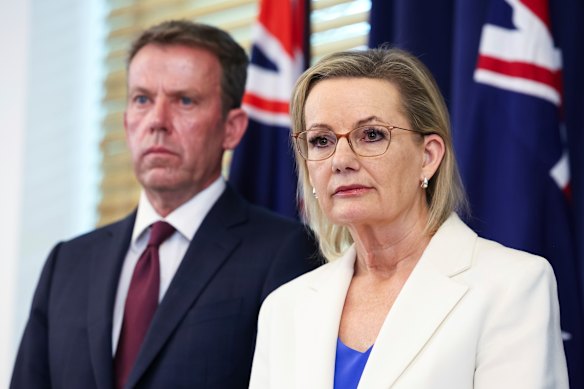
Shadow spokesman for energy and emissions reduction Dan Tehan and Opposition leader Sussan Ley during a press conference at Parliament House.Credit: Alex Ellinghausen
Former Liberal prime minister Scott Morrison announced his gas-fuelled recovery in 2020, and former opposition leader Peter Dutton went all in on nuclear in 2024. The Liberals’ policy released on Thursday said it supports “both new and existing generation with modest, targeted underwriting”.
Ley said her plan to drop Australia’s commitment to net zero emissions and support all forms of energy generation would lower bills, but declined to answer repeated questions about when prices would fall under a Liberal government.
“I can say prices will always be more affordable under us,” she said.
Loading
The Albanese government says coal is the biggest driver of bill rises and has set a goal to cut emissions at least 62 per cent by 2035, with the bulk of the cuts to come from replacing coal power plants with renewables, under its goal to boost the share of clean energy in the grid to 82 per cent by 2030.
“Ageing coal-fired power stations are the biggest threat to reliable and affordable energy because they’re shutting down, they are breaking down, they are going offline,” Prime Minister Anthony Albanese said on ABC radio.
Is coal cheaper than renewables?
CSIRO’s annual energy cost report card, known as GenCost, found in August that a new coal plant, using the most modern technology to keep emissions down as much as possible, would produce electricity for between $111 to $178 a megawatt hour – at a midpoint of $145.
Electricity produced from renewable energy, CSIRO found, would cost between $116 and $165 a megawatt hour – at a midpoint of $141. That costs include an estimated $40 billion in rollout costs to pay for the large batteries and fast-start gas turbines needed to back up wind and solar farms, and the extra transmission links to connect far-flung renewable energy zones to major cities.
“You can have brand-new coal which comes with carbon capture and storage, and that can actually be zero emissions,” Tehan told the ABC.
CSIRO found a coal plant with carbon capture and storage would produce electricity for a cost between $217 and $342 a megwatt hour - at a midpoint of $280.
These costs were calculated in today’s dollars and assumed the current price of construction.
The Liberal’s plan adopts much of the energy policy released last week by their Coalition colleagues, the Nationals, which commissioned a review of net zero by the party’s think tank the Page Research Centre. Citing figures from a report by Arche Energy consultancy it said a modern coal plant could supply power to the grid at $84 a megawatt hour, assuming lower construction and real estate costs than CSIRO.
Sweating the coal assets
Opposition climate change and energy spokesman Dan Tehan has said “sweating the coal assets” was a goal of the energy plan.
While coal has been Australia’s main electricity source for decades, its years of powering the grid are numbered, as utilities face spiralling costs to maintain ageing power stations and intense competition from cleaner and cheaper renewables.
At least half of eastern Australia’s coal-fired plants are due to shut down within 10 years, while the market operator expects coal to leave the grid entirely by 2040.
State governments in NSW and Victoria have made offers to coal plant operators to keep them running beyond their current closure dates amid worries that not enough new renewable energy and power lines are being built fast enough to compensate for their exit.
Loading
The Coalition is proposing plans to force more coal to stay in the grid for longer, arguing the 24/7 power the fossil fuel can provide will remain crucial until it can be replaced one day by nuclear power. How we, it’s push to “sweat” more assets to prolong their operations will face resistance from plants’ operators, who warn the equipment at many stations cannot continue operating for years to come without posing grave threats to reliability and power prices.
The average age of a coal plant in Australia is 38 years old, close to the average historical retirement age of 42 years.
Ley on Friday did not rule out government support for new coal plants when she was asked, twice in her morning TV appearances, if her party would support their construction but noted there were no current proposals in the planning system.
“Anything that comes to the market with a proposal in a technologically agnostic way, under our policy, is considered,” she said.
Investors are unlikely to greenlight the construction of new coal plants to replace them. In Australia and around the world, a growing number of banks and insurers have been withdrawing from coal lending, while shareholders in publicly traded power utilities, such as AGL, have meanwhile been ratcheting up pressure for their boards to commit to stronger decarbonisation plans.
Cut through the noise of federal politics with news, views and expert analysis. Subscribers can sign up to our weekly Inside Politics newsletter.