3 months ago
16
3 months ago
16
What in the World, a free weekly newsletter from our foreign correspondents, is sent every Thursday. Below is an excerpt. Sign up to get the whole newsletter delivered to your inbox.
Washington: One thing about living and working in the United States is that artificial intelligence, and its ramifications, are a major part of public life. The US is at the forefront of this new technological realm, and it is determined to stay there.
It’s safe to say I’ve been on the other end of the spectrum. I don’t use chatbots, I don’t get AI to write my emails. My exposure is pretty much limited to the AI overview at the top of Google search results.
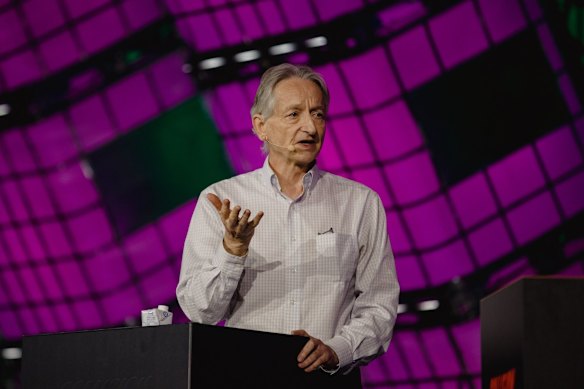
British-Canadian computer scientist and cognitive psychologist Geoffrey Hinton helped create the technology used by AI. Now he warns about its dangers.Credit: Bloomberg
Apparently, I’m not alone. I’m reliably informed that, until recently, putting “AI” in a headline was the fastest way to ensure a story was read by precisely nobody. But times are changing.
So, on a recent Tuesday night, I headed to Georgetown University to hear from the so-called Godfather of AI, British-Canadian computer scientist and cognitive psychologist Geoffrey Hinton.
Loading
Hinton and his graduate students at the University of Toronto created some of the foundational technology used by AI. He then spent a decade in the trenches at Google, before resigning in 2023 to speak publicly about what he came to see as the dangers of the technology he helped unleash.
“Back then,” says Hinton, which is an alarming way to talk about two years ago, “a lot of people, particularly linguists, said these AI language models aren’t really smart, they’re just statistics. Less people say that now.
“They also said this idea of them getting smarter than us is just crazy, we don’t need to worry about that.”
But it’s not science fiction, Hinton says now. “It’s going to happen. They’re already much more knowledgeable than us. They’re already very good at reasoning in limited domains like mathematics. Almost all the experts believe it is inevitable that ... they’re going to get smarter than us.”
For example, AI machines have already learned to develop “sub-goals” – things they need to do to reach the goals humans have set for them. One of those is to stay in existence. “We’ve seen AIs that want to keep existing and will actually try to deceive people who are trying to turn them off.”
The AIs will also seek more control, like a human. “My belief about a lot of politicians is that they start off wanting to achieve good things for people,” Hinton says, “pretty soon to realise [that] to do that they need more control, and then they end up focusing on getting more and more control. The AIs will do the same.”
Although he arrived in Canada in the 1980s, Hinton speaks with a quiet, calm British accent that cushions the blow from the alarming things he’s telling you. He is also gifted at phrasing complicated matters in simple terms, such as how little we know about what AI is going to become.
“It’s a bit like when you drive in fog,” he says. “You can see clearly for 100 yards, and at 200 yards you can see nothing. Well, we can see clearly for a year or two, but 10 years out, we have no idea what’s going to happen.”
Loading
One thing that’s widely tipped to happen is job losses. The day after I heard Hinton speak, the world’s richest man, Elon Musk, spoke at the US-Saudi Investment Forum in Washington, and optimistically predicted that in 10 to 20 years – which he called “long-term” – working would be optional.
“It’ll be like playing sports or a video game,” Musk said. You do it because you want to. Money, he said, “will stop being relevant at some point in the future”.
Hinton also believes AI is likely to lead to mass unemployment. He says trillions of dollars are being spent developing this technology, and one of the main ways big tech companies could recoup that investment is by selling AI to firms that will do the work of employees for less. ”These guys are really betting on AI replacing a lot of workers,” he says.
I like that Hinton is not a doomsayer. He’s not on an apology tour, repenting for unleashing Frankenstein. He ably explains AI’s many positive uses – how it will vastly improve healthcare and education, revolutionise the science of prediction and transform productivity. That’s how it differs from nuclear weapons, which are “only good for destroying things”, he says.
Loading
In Georgetown, an enthusiastic student asked him why we shouldn’t just invest all our money and energy into developing AIs that could solve our problems and absolve us of the need to work. Hinton said that was exactly what we should do – if our political systems could be trusted to use it to benefit the masses.
That was when Hinton’s interlocutor, democratic socialist senator Bernie Sanders, piped up.
“Do you think that is what Mr Musk and Mr [Jeff] Bezos have in mind?” he asked the young questioner. “Do you think that’s why they’re spending hundreds of billions of dollars, to say: isn’t this great, we could lower the work week, we can guarantee high-quality healthcare to everybody, we can expand life expectancy, we can solve global warming … do you think that’s what these guys have in mind?”
The young man responded drily: “Probably not.”
It’s a good reminder of that technology truism: the problem is never the tool, it’s always the user.
Get a note directly from our foreign correspondents on what’s making headlines around the world. Sign up for our weekly What in the World newsletter.
Most Viewed in World
Loading