3 months ago
27
3 months ago
27
The day my father almost died, he was 18 years old. It was the summer of 1963 when he marched into a car dealership in downtown Adelaide, handing over $80 for a second-hand two-stroke BSA Bantam bike. He wanted to commute from his family home on the city’s fringe to the Adelaide Law School. No matter he’d never ridden a motorbike before. “The folly of youth,” he tells me now, with a shrug and a smile.
The bike was small, but he could tell it had power. He drove cautiously, at first, from the dealership to a factory where he worked. When his shift finished at 5pm, the sun was still firmly in the sky. He mounted the bike but this time tore down Hutt Street at great speed, wind in his hair, life just beginning, when he approached a T-section. In that split-second he made a terrible mistake. Instead of pulling the handle towards him to brake, he accidentally pushed it forward. The bike accelerated underneath him, like a rollercoaster carriage taking a surprise turn. He lost control and smashed into the side of a parked truck. The 180-kilogram bike collided with the truck’s steel rear footstep, which cut into his flesh, crushing his bones.
Dad was hurled onto the bitumen. Everything seemed upside-down. Blood was everywhere. He screamed in agony but no one was around. He couldn’t get up and desperately called out for help. Slowly, his panic turned to peace. As blood poured from his body, he approached death in a state of calm. He wasn’t afraid. Luckily, a young boy spotted him and used a payphone to call the ambulance.
As sirens blared and morphine pumped into his veins, the paramedics told Dad that one minute longer, he’d have been gone. The limb had been severed almost entirely, the arteries and veins sliced. As he was being rushed into surgery, doctors said they would do everything they could but there was a 50-50 chance he would lose the leg. When he woke, he lurched forward in the hospital bed – something was off. His centre of gravity had shifted. He looked down and saw white bandages and bloodied stitches. His leg was gone from below the left knee.
“That was the most horrific night of my life,” he said. “I had no real understanding of what happened, until dawn broke and I saw half my leg was cut off. The psychological reality of that was almost incomprehensible.”
It was more than five decades later that he met Dr Munjed Al Muderis for the first time in a fleeting encounter that became something more – and later led inexorably to a high-profile $20 million defamation case, the first successful application of the public interest defence, and what is believed to be the longest cross-examination of any Australian journalist (me). All of which became the inspiration for my first book, Duty to Warn.
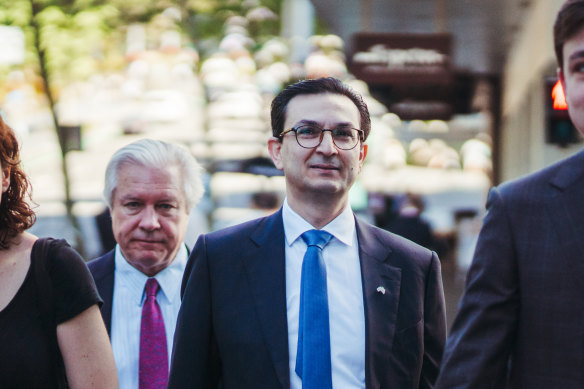
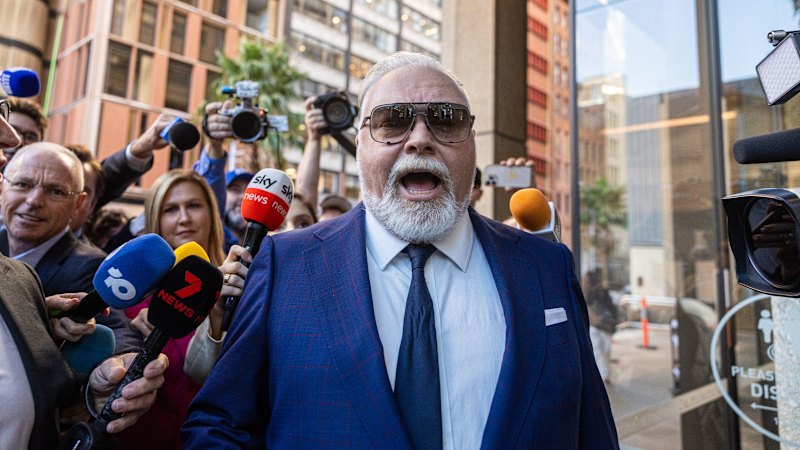
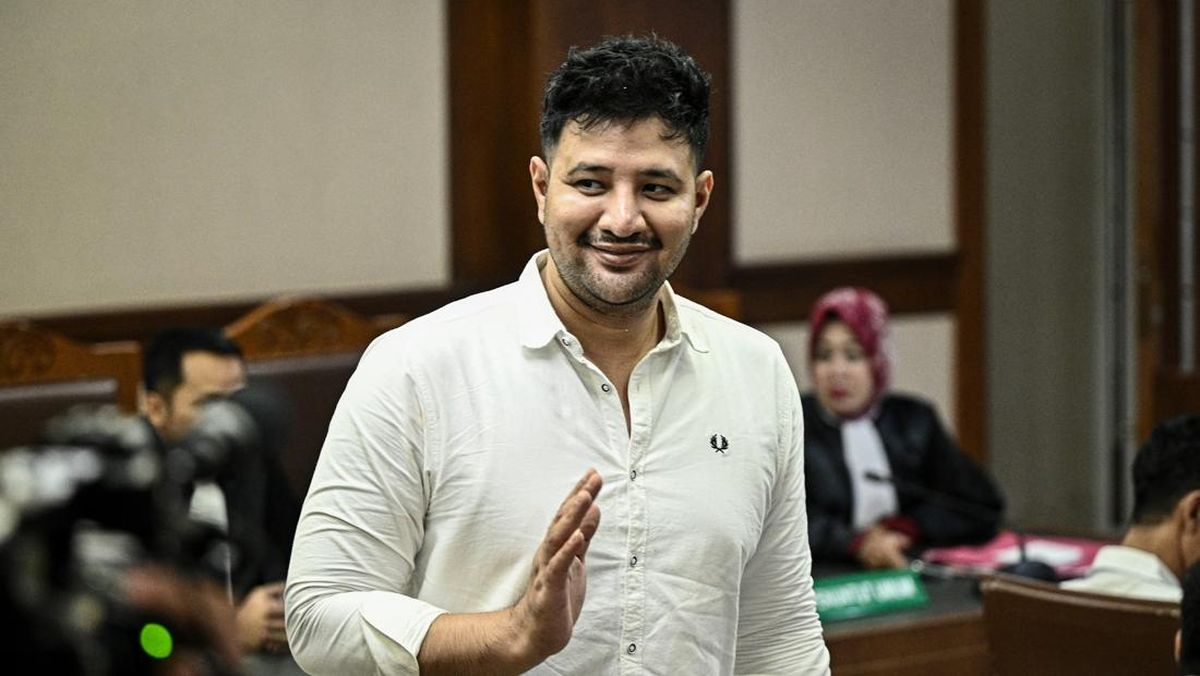
Munjed Al Muderis on his way to court.Credit: Dion Georgopoulos
My father’s accident is not something we really speak about as a family. Like a wound that failed to heal, it’s a topic that always felt painful to touch. The collective story we’ve told ourselves is that he is fine, a lucky amputee – which is in many ways true. But it’s not the full story.
The life of an amputee is a full-time job, from scanning the pavement to constant tinkering with the socket prosthesis to avoid blisters and pain. He’s done this all quietly, without complaint, and in many respects there’s been no limit to what he’s been able to achieve. He’s built houses, hiked the Himalayas, run a small cattle property. He forged a successful career as a barrister, opening Blackstone Chambers back in 1982 with his friend John Garnsey and defamation legend David Levine and took silk the following year.
The 62nd floor office in Sydney’s MLC Centre had wraparound Sydney harbour views and would become the place my father met my mother, Dixie Coulton, and the backdrop to many of my childhood memories. It was also home to a suite of high-flying barristers, from former attorney-general Tom Hughes QC to an ambitious young lawyer, Sue Chrysanthou, who joined in the early 2000s. Even back then she was equal parts loved and loathed by her colleagues as she learnt the ropes in the law of defamation, on her way to becoming one of the most famous (infamous?) QCs in the country. Her acceptance of Al Muderis’s brief decades later would be just another strand in my personal connection to this case.
Despite my father’s achievements, there is no denying that losing a limb is life-changing. It’s a permanent, irreversible alteration of your body, life and identity. There are limitations on what you can do, and parts of you that disappear. My father played soccer growing up, for instance, but I’ve never even seen him run. He suffers bouts of phantom pain, too – a difficult-to-treat condition unique to amputees, which feels to Dad like electric shocks radiating from his missing limb. When the pain arrives – unannounced and unwelcome – he sharply inhales, curses under his breath, jolts forward and grabs at his knee. At its worst, this pain became so severe that my mother had to drive him to the hospital.
Despite all this, my father made peace with his reality long ago. He knows there is no going back, no matter how much he might wish he had pulled that handle in the other direction.
And it’s this very vulnerability, I came to learn, that Al Muderis taps into. Through brochures, speeches, one-on-one consultations and the media, the famous doctor presented osseointegration – inserting a titanium implant into the bone – as the closest thing to having your limb back. He glossed over the risks and potential complications, the rates of which remain unknown, while promoting the surgery as a “pain-free” experience to a cohort of people living with chronic pain. In his carrot-and-stick pitch to amputees, not only would your life be improved with osseointegration, but without it, you could go backwards.
My father first met Al Muderis in June 2018, when the doctor delivered a speech at the Australian Club, detailing his journey fleeing Iraq to become one of the country’s most celebrated orthopaedic surgeons. He charmed the room with his inspiring tale, from surviving a leaky boat to pioneering revolutionary surgery, transforming the world one amputee at a time. By this point, this story had been told by every mainstream media outlet in the country and would eventually see him crowned NSW Australian of the Year, as he transcended from doctor to an almost god-like figure. As the room cleared out that evening, my father approached the doctor, curious to learn more about his life-changing surgery.
“Does osseointegration help with phantom pain?” he asked.
“You betcha,” Al Muderis replied. “Come and see me.”
Soon after, my father was sitting in Al Muderis’s clinic in Macquarie University Hospital, surrounded by a gaggle of men in scrubs. The surgeon talked about the benefits of his miracle procedure before he took one look at his stump, and declared he would be an excellent candidate. My father asked what happens if it fails, and the doctor said he’d simply amputate the leg above the knee and try again.
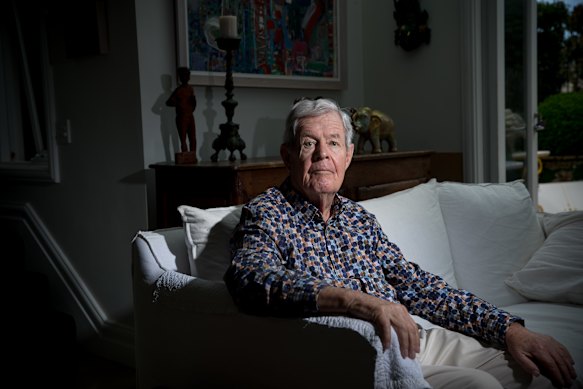
Donald Grieve first met Al Muderis in June 2018 at the Australian Club.Credit: Brent Lewin
Sensing some hesitation, Al Muderis grabbed the large parcel containing my father’s X-rays, and started drawing lines pointing in separate directions. One shot diagonally upwards to show that with the surgery, my father would return to his pre-accident levels of mobility – almost the same as when he was 18 years old. Without the surgery, another line plummeted downwards, depicting his mobility falling off a cliff. Al Muderis said my father would be in a wheelchair by the time he was 80 years old if he continued to walk with a socket prosthesis.
Dad turned 75 that year. The disturbing prognosis gnawed at him on the drive home. That night, he announced he was getting the surgery. “He was fixated,” my mother said. “Something had changed in him. He was hell-bent on getting this surgery.”
She encouraged my father to get a second opinion, which quickly brought him back to reality. He was warned that Al Muderis has an underclass of patients for whom the surgery did not go well. These people have not been filmed by television crews, but have been left depressed, addicted to heavy pain medications or worse. My father had lived his whole life without a wheelchair, he was reminded, and there was no reason to believe that might change soon. The benefits, particularly at his age, simply did not outweigh the risks.
He snapped out of the fixation and didn’t proceed with surgery. But our family conversations seeded a thought – if my father, a lucky amputee, could become so entranced by these promises and warnings, what hope did more vulnerable people have? Was this doctor really the hero painted by the media? Or was there another side to him?
I never forgot those questions. Years later, I had the opportunity to investigate and eventually got some answers. In a months-long multi-platform investigation, we revealed a pattern of false promises, minimised risks, and overstated benefits. There really was an underclass of the famed doctor’s patients. Through the pages of The Age and The Sydney Morning Herald and the screens of 60 Minutes, we told the stories of only a few of these people. Like Mark Urquhart, a paraplegic that Al Muderis made a double amputee, then left to rot with maggots in his wounds and pain like a welder’s torch burning into his legs. Like Brennan Smith, a veteran who dealt with pain so severe he cried into his pillow each night. Like Carol Todd, an elderly woman who valued her independence and needed to care for a sick husband, only to be turned into the one needing help. And Chris Bruha, a bilateral amputee who borrowed more than he could afford for osseointegration, only to suffer a bone infection and have both implants removed. Patients told us of how they felt pressured into surgery, then abandoned when things went wrong. Each story was more shocking and more heart-breaking than the last.
Loading
But like the old saying goes, the cover-up is always worse than the crime. At that point, Al Muderis could have and should have apologised to the people he failed and pledged to learn from his mistakes. Instead, he invited Chrysanthou and crisis communicator Peter Wilkinson to his harbourside luxury apartment on a Sunday evening after the stories broke. For hours over dinner they strategised the best way to rehabilitate the doctor’s reputation – undermining the claims in the media, or prosecuting the case in court. Later, I would learn, they went with both.
The trial ran for 65 sitting days, making it the third-longest in Australian history. The judge allowed hearings to start early and finish late, to accommodate the gigantic pile of evidence she needed to hear. The witness list included 35 patients (my father among them) and their family members, dozens of healthcare practitioners, experts and whistleblowers.
Al Muderis sued Nine, The Age, the Herald, me and my colleagues Tom Steinfort and Natalie Clancy for defamation in the Federal Court of Australia. Matt Collins KC opened our case in September 2023 by declaring that we did not contend that Al Muderis was some sort of monster. There was no denying he had helped many people and at no point should those experiences be diminished, Collins said. But somewhere along the way the doctor had lost track of his mission and put profits before people.
Under the leadership of Collins, solicitors John-Paul Cashen and Marlia Saunders, this dedicated legal team worked to handle each witness with care and prove what we always knew – the truth. At times, our representatives from Thomson Geer resembled a travel agency more than a law firm, organising witnesses to testify from around the world – from the US, Cambodia, Türkiye and all over Australia. It was chaotic, exhausting, stressful, but also rewarding. Amid the endless meetings, and restless nights, we set important precedents for investigative journalism, from strengthening source protection to proving the new public interest defence can work.
I watched on with gritted teeth, furious that innocent people could be treated with such disrespect.
I watched every single day of evidence, either from inside the courtroom or streamed into The Age office in Melbourne. As each day passed I only became more certain of the truth, but also disturbed by the depths the doctor would pursue to conceal it. I know all cross-examination is rigorous by design, but Chrysanthou was ruthless in ways that felt wrong. She prodded and probed at the most traumatic details of people’s lives, even chastising one patient for taking a moment to collect his thoughts. The questioning went round and round in circles, and for some witnesses stretched on for days, as Chrysanthou kept seeking different answers to the same questions. My niggling concerns were validated as Justice Abraham was forced to intervene over and over, reminding Chrysanthou the witness had already answered her question or slamming a particularly loaded question as “totally inappropriate”, prompting withdrawal. In her judgment, Abraham described Chrysanthou’s cross-examination as “very aggressive”, “lengthy” and, in one instance, “gratuitously disrespectful”.
I watched on with gritted teeth, furious that innocent people could be treated with such disrespect, all for daring to say what happened to them in the hope it might help others. All the while, this bluster and fury seemed to achieve little for her client. The more Chrysanthou pushed, the more devastating details poured onto the court record. As for my own cross-examination, in total it stretched for six days – setting a record I never wanted to hold.
I felt compelled in part to write Duty to Warn because any conversation I had or story I wrote about the years-long saga felt that it never properly scratched the surface. A question from a friend or colleague about the trial would turn into an elongated retelling of only the top two most dramatic things that had happened that week. But this trial was one of the most challenging experiences of my life – an uncomfortable collision between professional and personal, that saw my every move torn to shreds by lawyers, and the very core of my being interrogated and savaged. I was branded as a deliberate, malicious liar who had manipulated vulnerable people into tearing down a national hero. Even seasoned court watchers told me it was more hostile, more aggressive and more personal than they had seen before.
Many of my sources got the same treatment, accused by Chrysanthou of participating in an elaborate, concocted scheme involving fraud and deception – an allegation that, teased out in court over many months, sounded more like something a conspiracist might devise in front of a cork board, tugging on pieces of string tethered to nothing and leading nowhere.
Loading
As the days dragged on, I saw this barrister berate and belittle vulnerable people so severely that they were reduced to tears and extreme mental distress. I saw a mother in the witness box with tears rolling down her face, begging Chrysanthou for answers about why Al Muderis treated her son so badly. I saw the man himself, in one final moment of intimidation, stare down an elderly patient as she walked up to the stand to give evidence. I saw the doctor lie, on oath, over and over. I started to wonder if he really was a monster. Ultimately, the judgment found Al Muderis was dishonest, callous, cruel, unethical, negligent, profit-driven and fame-obsessed.
In writing the book, I re-read almost all of the 6508 pages of the trial transcript. Reliving these moments through the black-and-white written record, stripped of the emotion and tension, somehow made all that transpired even more shocking. The first version of the manuscript was 50,000 words over the limit, as I tried to cram much of the ordeal into the pages. The book is a series of stories within stories, following the lives of the patients who had the courage to speak out. They had nothing to gain, as Justice Abraham eventually found, other than telling their stories.
Most people have heard of the doctor’s duty of care, but perhaps slightly less familiar is the duty to warn. It’s enshrined in law, a key principle that binds medical professionals to warn patients of all risks so they can obtain informed consent. Journalists, too, have a duty to warn. While our trade doesn’t deal with life or death, the media is trusted to warn the public about society’s greatest failures. There is a duty to warn in the legal system too, with barristers obliged to warn clients if their case is not strong.
I want readers to finish Duty to Warn seeing what I saw, and knowing what I know, even if it’s still only a fraction of what actually happened, because the book puts on the record the abuse of power I saw and my desire to see change. Change in our healthcare system, so the public can know about dangerous doctors before it’s too late. Change in the media, so journalists don’t build up celebrity surgeons and miracle procedures without asking about the risks. Change in the law, so that people who do the wrong thing aren’t advised to use the courts to bury the truth.
As for the prediction that my father would be wheelchair-bound by 80? Well, he turns 82 in August, and is gearing up for a year of travel abroad. In between my mother’s busy practice as a barrister, they will explore the pyramids of Egypt, take safaris in South Africa and swim the beaches of Malta. Safe to say he’s certainly walking fine. Al Muderis’s dire warning, like those he had given to so many other patients, turned out to be entirely false.
Get the best of Good Weekend delivered to your inbox every Saturday morning. Sign up for our newsletter.