1 month ago
19
1 month ago
19
Opinion
October 24, 2025 — 5.01am
October 24, 2025 — 5.01am
I work in public health. My shifts are split into half patient clinical contact and half non-clinical privileges. With the latter, I avoid our shared office, instead using a quiet place nearby because much of this work requires deep concentration. I find the shared office socialising interruptive. It disrupts the sustained concentration required to do the non-clinical part of my job. The quiet also helps the migraines I suffer from.
However, a higher-up has now mandated that all non-clinical shifts are to be spent in the communal workspace so that we can be monitored for not turning up on time or leaving early. I am considering obtaining a health exemption from an occupational doctor, but this risks me being seen by colleagues as demanding special privileges. What are your thoughts?
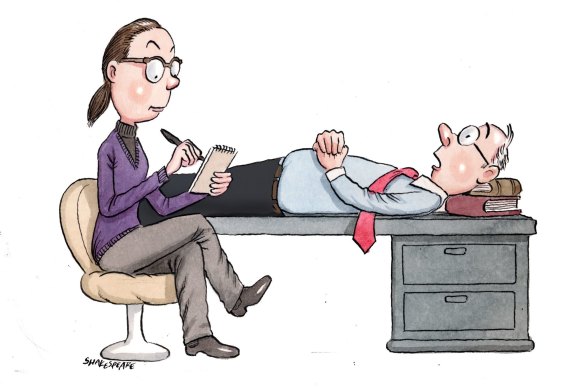
Get a health concession if you need one, but don’t feel as though you’re shirking a responsibility or taking an “easy option” if you do.Credit: John Shakespeare
I’m annoyed on your behalf. In the main, I have little time for managers being prescriptive about where work is done. Yes, there are certain jobs where being in a certain place at a certain time is important, even essential.
But there are many jobs where your location and even your hours have little or no bearing on the quality of your work. In fact, as your email (and many written to me previously) demonstrate, there are many jobs for which the typical hive-of-activity office has outworn its utility and is no longer the best place to get stuff done.
But even if your job did lend itself to a communal space, I still have problems with your manager’s rationale. Monitoring “late” coming or “early” going is a terrible reason to mandate office attendance.
This infantilises professionals, turning work into a “grown up” version of school, replete with finger-waving teachers: “If you don’t get to class before the bell you’ll need to see the principal.”
To me, this isn’t a ‘special privilege’, but a sensible work decision.
The counterargument to this, I assume, is that strict rules keep irresponsible or “un-invested” workers in check. In workplaces where enthusiasm is unavoidably low or where employees are for one reason or another unmotivated, rigidity is, if we follow this logic, a sad necessity.
But even if this is true, why does it apply to you? I find it difficult to think of a higher responsibility job than a medical professional working in public health. If a manager feels it necessary to precisely order the day of a person whose job is to save lives they have their priorities entirely wrong.
Let’s take your manager’s point of view for a moment and assume they see you as responsible and trustworthy. We’ll pretend, just for the sake of steel-manning their position, that they never talked about monitoring arrivals and departures as if they’re air traffic controllers and their charges are aeroplanes.
Loading
Let’s assume, instead, that they value your expertise and want you to share it with others. That’s fair. Their supposition, though, is that the best place for you to do this is in the open-plan office. But your non-clinical work (the specifics of which we’ve removed from your original question for reasons of anonymity) is all about sharing your knowledge – just not verbally.
And if this is something you enjoy, are good at, and which is valuable to public health, why would a boss want to make it harder for you? If it ticks none of those boxes, why are you being asked to do it in the first place?
As is often the case in Work Therapy, I think what we’re talking about here is a kind of one-track managerial thinking that works only in the abstract. In practice, setting unbendable rules that apply to everyone may seem nondiscriminatory.
And it’s a strategy that may have worked well when manufacturing was the heart of our economy (and more workers were doing arduous, repetitive and sometimes unsafe, manual labour).
But today it breaks down the moment it comes into contact with the reality of a post-industrial economy – a complex reality made messy by the sheer multiplicity of human experiences.
It makes total sense to me that, as someone affected by migraines, you would work better in a quiet place (perhaps with a certain kind of lighting that big open offices generally don’t provide). It only makes more sense when you consider the nature of your work. To me, this isn’t a “special privilege”, but a sensible work decision.
Yes, get a health concession if you need one, but don’t feel as though you’re shirking a responsibility or taking an “easy option” if you do. I see this as your attempt to bring legitimacy to a way of working that, in a more trusting workplace, would be considered entirely unexceptional.
Send your Work Therapy questions to [email protected]
Most Viewed in Business
Loading