3 months ago
28
3 months ago
28
Opinion
December 11, 2025 — 3.40pm
December 11, 2025 — 3.40pm
Conceptually, it is difficult to fathom which of these notions is more difficult to get your head around. The first is Elon Musk adding more than half a trillion dollars to his incredible wealth, and the second is how he plans to reach this goal – by building data centres in space.
Even in the world of Silicon Valley’s bold claims, moonshot ideas and blue-sky values, this one feels next level. It’s making Musk look increasingly like the poster boy for extreme universal capitalism.
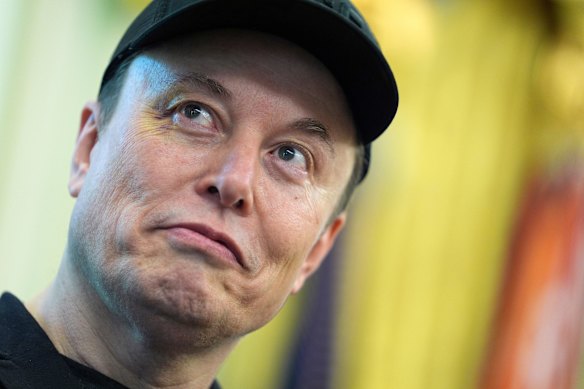
Elon Musk has proven to be the world’s greatest salesman. Will he make that the best salesman in the universe?Credit: AP
But in a world experiencing data centre fever thanks to the booming artificial intelligence race, even the notion of populating space with this infrastructure will get an investment case hearing.
Down here on Earth, the appetite for these data centres’ processing power seems bottomless, while the immense energy and water resources needed to operate them are limited. Here in Australia, where the data boom is in its nascent stage, it has already outgrown the energy grid.
It might sound like Alien’s evil corporation Weyland Yutani scouring outer space in interstellar cruiser Nostromo to mine ore, but data processing power is an increasingly rare resource.
And before one writes off the Musk idea as sci-fi fantasy, the genesis of his latest tale comes from a Wall Street Journal article citing Bret Johnsen, finance chief of Musk’s satellite communications company SpaceX. The report said SpaceX’s value had doubled since July – and now stood at US$800 billion ($1.2 trillion).
It is nowhere big enough to justify a market value in the trillions.
Hours after this report, there was a deluge of additional news reports suggesting SpaceX would undertake a public listing to even further raise its value.
Remember, Musk owns 42 per cent of SpaceX, in addition to his 13 per cent stake in Tesla – which he is hoping to grow to 25 per cent if he jumps over a mountain of performance hurdles the board has set.
Even at $US800 million, SpaceX would have become the most valuable private company in the world – surpassing OpenAI, according to analysts from investment bank Morgan Stanley, who took these media reports seriously enough to warrant their own investor report.
SpaceX would attain 13th place on Wall Street’s S&P 500.
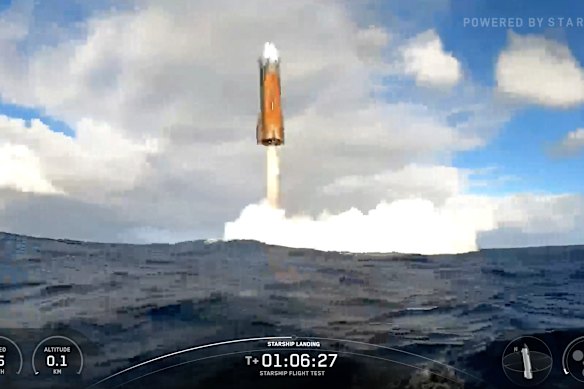
This image from a SpaceX livestream in August shows the 10th Starship mission splashing down in the Indian Ocean.Credit: AP
Whether this valuation is justified is another matter entirely.
SpaceX has a good revenue-generating business called Starlink, which uses a constellation of satellites that provide internet connectivity for consumers and telecommunications companies including Telstra.
But it is nowhere big enough to justify a market value in the trillions.
Musk, who has not yet managed to commercialise Tesla’s plans for self-driving cars or the creation of an army of robots, has moonshot ambitions for SpaceX to deliver space data centres.
Using his social media platform X, Musk commented on SpaceX’s planned future entry into orbital data centres, describing them as “by far the fastest way to scale [compute] within 4 years because easy sources of electrical power are already challenging to find on Earth”.
He has a point.
Morgan Stanley notes that “while space-based data centres face a number of challenges (orbital debris, data governance, etc), at-scale orbital compute clouds also have a number of benefits vs traditional data centres ranging from power (receive full solar constant in space), to cooling (space is -270°C), and reduced latency for the growing [total adressable market] of edge-devices vs long-haul terrestrial paths”.
Loading
Musk isn’t alone in these lofty ambitions – there’s a number of tech companies including Google, whose Project Suncatcher aims to build constellations of solar-powered satellites carrying its custom TPU [AI chip] hardware to serve as space-based AI/computing data centres.
Nvidia is positioning itself for the orbital data centre frontier by supplying high-performance GPUs [graphics processing units] and other critical infrastructure.
But there are plenty of giant ideas that fall to Earth when practicalities collide with them.
Musk has proven to be the world’s greatest salesman. Let’s see if he can better that by expanding that title to best salesman in the universe.
Most Viewed in Business
Loading