3 months ago
28
3 months ago
28
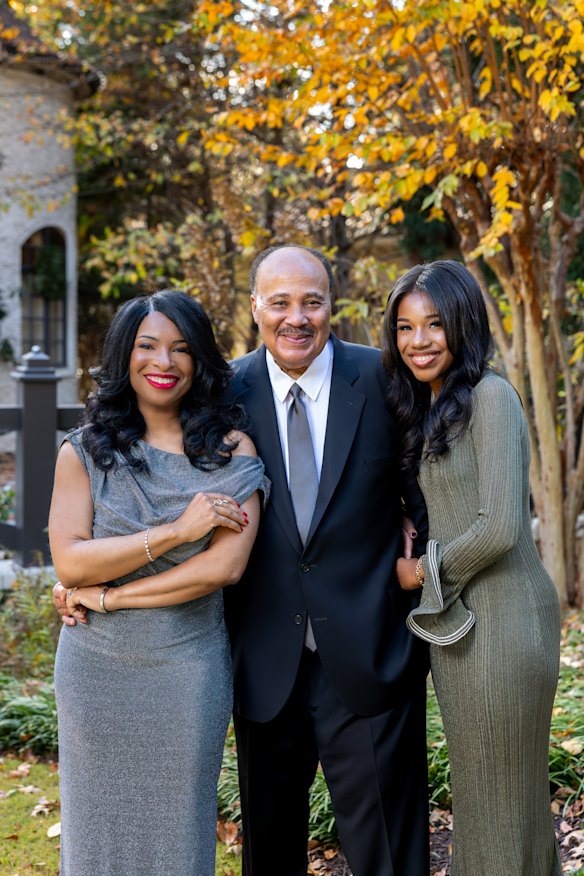
Martin Luther King III is the second child and oldest son of American pastor Dr Martin Luther King jnr, the internationally celebrated civil rights activist, who was assassinated in Memphis on April 4, 1968. King III – known as Marty as a child – was 10 years old when his father died. Following in his footsteps, he served as president of civil rights group the Southern Christian Leadership Conference (SCLC, co-founded by his father) from 1997 to 2004, and is currently chairman of advocacy organisation the Drum Major institute. He has also served in local government in his home state of Georgia, spoken before the UN and written two books, including the recent What Is My Legacy? with his wife, Arndrea Waters King. He has a 17-year-old daughter, Yolanda. King III is in Australia this summer to support CareerTrackers, a non-profit organisation that facilitates corporate internships for First Nations university students.
Australians know Martin Luther King as one of the most famous public figures of the 20th century. But he and your mother, activist Coretta Scott King, also had four children: your sister Yolanda, you, your brother Dexter, and your sister Bernice … What was Dr King like as a father?
Well, first of all, I’ll have to contextualise it by saying that at 10 years old, that’s all I knew: Dad. I had no real idea about the movement he was part of leading, or what it meant. Dad was playful. Dad was as much engaged as he could be. He travelled, it felt like, pretty much every day, so we were always happy to be with him. Sometimes we would play baseball in the front yard, or ride our bicycles, or go swimming together at the YMCA. He taught my brother and I how to swim.
We also travelled with him sometimes – so that’s where I did see him in the context of the work he was doing. [I remember in] 1964 going with him to St Augustine, Florida – a very turbulent and frightening time. St Augustine was a very segregated community. For instance, they didn’t want black people to swim. In the pools, when blacks were swimming, they would pour acid or lye [caustic soda] into the pool. And at the beaches, policemen would ride up with their billy clubs, beating people out of the ocean. So that’s the tragic kind of hate and hostility that existed. Dad and his team were working to desegregate that city – and many other cities in the South.
Speaking of that segregation, your father wrote about an amusement park near your home in Atlanta called Funtown, from which you were barred. Can you recount that story from your perspective?
Absolutely. The backstory is that every week we would take Dad to the airport, and we had to pass by this amazing amusement park. It had every ride you can think of: a ferris wheel, bumper cars, all types of rides. And we’d see children, hundreds of children, just having the best fun that you could think of, eating candied apples and cotton candy and hot dogs. It felt like we went by hundreds of times – and we could not go. But Mum would always say, “Your dad is working to create the opportunity for you to go.” And then the day came when we were able to go. And I tell you, that was the most incredible experience. Dad was just kind of a big child – he went on all the rides too. It was the most … I mean, I can remember it as if it was yesterday and it was over 60 years ago.
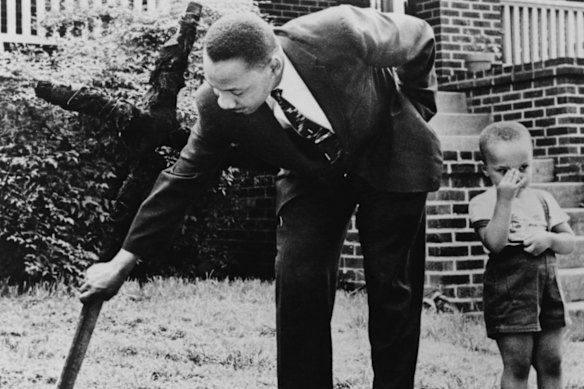
[During King III’s childhood, the King family home was bombed, and King received several death threats.] Your parents seem to have done a great job shielding you from the dangers they faced. Were you ever worried for your father’s safety? Did you think something terrible might happen?
I was certainly subconsciously aware, because our phone would ring from time to time, and one of us would answer, and the voices were just ugly and hate-filled and they would threaten our family. But it kind of just rolled over our backs. It was not something we chose to ingest. I think we were raised with a strong faith and spiritual foundation, and we believed that God was going to take care of us even though there was the prospect of something happening. And until it happened, I don’t think any of us were … we opted not to live in fear. And Mom and Dad really did try to shield us as much as possible.
‘When they were seeking the death penalty for the man who killed our grandma, the family said no.’
Martin Luther King III[King was assassinated in 1968, aged 39, as he stood on the second-floor balcony of the Lorraine Motel in Memphis, Tennessee, during a visit to support striking African-American sanitation workers.] In your recent book, What Is My Legacy?, you describe trying to consciously lay down the bitterness and hatred you still feel as part of your grief about your father’s death.
Yes. Dad would say, “We must learn non-violence or we may face non-existence.” Now, the way I chose to process that … I tell you, I was 10 years old when my father was killed. I was 11 years old when my uncle mysteriously drowned. I was 16 years old when my father’s mother was assassinated in the church while playing the Lord’s prayer [on the organ]. But I was raised in an environment that taught love and taught forgiveness. Dad would say, “Hate cannot stomp out hate. Only love can do that. Darkness can never put out darkness. Only light can do that.” When my grandfather lost his sons and his wife, he used to say, “I refuse to allow any man to reduce me to hatred. I love every man. I am every man’s brother.”
So I wake up every day, and first of all, I’m thankful to God, and I ask for forgiveness for things that I’ve done wrong and understanding so that I can be a positive conduit in society. I do that every day. Not some days, not like, ‘OK, I’m going to try this today and then I’ll try something else tomorrow.’ No, it’s consistency. And choice. I chose this [path]; my family chose this path. When they were seeking the death penalty for the man who killed our grandma, the family said, “No. We don’t want the death penalty. We don’t believe in that. We believe in love and forgiveness even to those who hurt you.”
That’s the message I have for kids: there is redemption. There is forgiveness. It doesn’t mean you forget. It doesn’t mean it’s not painful. Some days I wake up and see something in the world and I want to talk to my dad. Well, that option I don’t have, at least in the physical sense. Sometimes I get signs. I have dreams where he comes to me and shares a path.
You’re in Australia to speak to young Indigenous Australians for an organisation called CareerTrackers, which supports First Nations university students and young professionals. It was founded on the model of a similar group in the US, Inroads. Inroads was established after your father’s extraordinarily famous “I Have a Dream” speech in Washington. What are you hoping to say to these young Australians?
I start with an apology, because of how the Indigenous populations, not just in Australia but around the world, have been treated. Then, under normal circumstances, I’d talk about the ways in which, during the modern civil rights movement, people retained hope, retained the capacity to dream. And ultimately freedom did come. We seem to be in a bit of a tailspin, a spiral backwards, at this moment, but I still do believe a better day is coming. So my wish is to share a perspective that provides hope for Indigenous communities. And to say that even though I’m not Australian, if there’s anything I can do to partner, to help in that mission, I’m honoured to have the opportunity.
You’ve just come back from Oslo, where your daughter Yolanda, who is Martin Luther King jnr’s only grandchild, has just given a speech before the Nobel Peace Prize Forum. Your father received the Nobel Peace Prize for his non-violent struggle for civil rights for African Americans. Yet you’ve also talked about how – due to changes in reproductive, gender, diversity, equity and inclusion laws under the Trump administration – Yolanda has fewer rights today than she did when she was born. How are you feeling about the legacy we’re creating for young people today?
Well, while I am frustrated, legitimately frustrated about what is happening in our nation and world, what I feel is great hope and inspiration from the young people all over the globe. And it is the young people. My father was only 39 when he was killed. When he led in Montgomery [during the Montgomery Bus Boycott, begun when African-American woman Rosa Parks refused to give up her “coloured” bus seat to a white passenger] in 1955, he was in his late 20s. Movements may be the vision of older folks, but it’s the energy of the young people that sustain them. Great progress was made in the ’60s by young people.
[At this point in the interview, King III suddenly looks up from his computer screen and begins to smile and nod.] Mr King, are you OK? Do you need to leave the screen?
My daughter just got notice that she’s accepted at Columbia!
Oh my goodness. Just now?
Just now.
[Yolanda King appears on screen beside her father, holding a letter. She has dark, curling hair and an enormous smile. She and her father hug.]
Hello! That is magnificent news. Congratulations!
[Yolanda King]: Thank you!
Why don’t we stop our recording for a moment, so you can congratulate her. [The interview resumes a few minutes later: King III is discussing Yolanda’s college plans. She will be studying pre-law arts at Columbia, one of America’s most famous Ivy League universities.]
She wants to change the system in a positive way, and believes she can do that through human rights law.
She must have done brilliantly well in her exams: congratulations. So let’s return to the question of your visit to Australia and your work with young First Nations people here. Do you see similarities between what Indigenous kids are facing and what African-American kids are facing?
Well, first I would say that I don’t presume to take any ethnic group’s situation and compare. My sense is that the Indigenous population [in Australia] still has a monumental level of inclusion that must happen. But the connection [between African Americans and Indigenous Australians] is that people are being mistreated just because of the colour of their skin. That’s where maybe it begins: it goes far beyond that, but that’s where it begins. And that should never be the case. [In the case of First Peoples in any nation, we should] want to understand what is it that we can learn from those culturally who’ve been here long before we arrived. And also to ask what can we learn together.
[What Is My Legacy? presents the idea that an individual’s legacy should not revolve around money or reputation after death, but something everyone can try to embody and work towards each day.]
I’m very taken by this idea of “living legacy” that you write about in your book. Tell me a bit about your work for the Fulton County Board of Commissioners. You did that for several years, and then you worked for your father’s organisation, the SCLC. How do those kinds of roles build your legacy?
Well, when I was much younger – although I don’t consider myself old! – but I am very close to 70 now [he is 68], but in my 20s, I wanted to give something back to the community that nourished my growth and development. So I ran for public office in Fulton [the most populous county of Georgia, encompassing its capital city, Atlanta]. I served for seven years, and represented over a million residents. In fact, one of the most traumatic experiences I had was that I was vice chairman of that seven-member board, and I ran for chair in 1993 and I lost. I ran a very poor campaign. It was one of those experiences that created growth because if you win everything your whole life and never lose, you don’t learn. My learning did take me a while, I admit, because in my mind I’m saying, “How does Martin Luther King’s son lose an election!?” I had to acknowledge to myself: “You ran for a campaign and you did not exhibit leadership on a few issues, and that’s why people chose someone else.” Ironically, that person who was chosen ended up going to jail for corruption.
‘In my mind, I dreamed that one day I was going to be a United States senator. And then I lost at county level!’
Martin Luther King IIIOh, goodness. So he wasn’t a perfect candidate either.
No! But I had to make a decision. It’s not that you were knocked down: we’re all going to be knocked down in life. But how do you respond to that which could destroy you? For six or eight months, I was just not actionable, just overcoming my own …
It’s such a blow to the ego, isn’t it? And so public …
Look, in my mind, I dreamed that one day I was going to be a United States senator! I planned to run for secretary of state, and then one day run for the senate. And then I lost at the county level! Interestingly enough, Raphael Warnock, the man who is the pastor of Ebenezer Baptist Church – where Dad and my grandfather preached – is now one of our United States senators. And that is wonderful. But for myself, my decision was that I decided to continue trying to make a contribution, but in other fields.
For me, and my family, the mission has always been to try to eradicate from our nation and world what Dad defined as the triple evils: the evil of poverty, the evil of racism and the evil of violence. And while there have been some strides made, they have been nowhere near enough. In our own country, we have nearly a hundred million people who are living at the poverty line, and that is not acceptable in a nation that has a multitrillion-dollar economy. Racism should be something that we can look back and say, “Oh yeah, we used to be that way, but today we’re so much better.” Now racism is popping its ugly head up and some of our political leaders are most responsible.
[During President Trump’s first impeachment trial, a member of his legal team, Kenneth Starr, used King’s words to defend Donald Trump. King, said Starr, “referred to ‘the long moral arc of the universe [that] points towards justice’ “. King III denounced this use of his father’s words. “What mockery, what hypocrisy and rank opportunism to equate my father’s views about 246 years of enslavement and almost 100 years of segregation and [President Trump’s] intent to undermine constitutional governance,” he said.] What impact has the current administration had on your work?
I think they’re having what I call “temporary success” in rolling back progress on those triple evils. Temporarily, [that progress] is gone, but we must bring it back. That is our task.
How?
If humanity is going to survive, we have to engage in civil dialogue. That is how we navigate through complex issues. And it can’t be done effectively as a segregated society.
Tell me about the Realize the Dream initiative you’ve developed with your wife and Marc and Craig Kielburger [Canadian social entrepeneurs and founders of the international WE Charity].
Our goal is to get people to donate 100 million hours of [community] service by 2029, when Dad would have been 100 years old. We want people to engage with service opportunities that speak to their heart. If you are concerned about homelessness, if you are concerned about mental illness, if you’re concerned about creating better schools, that’s what speaks to you and that’s where you should offer service. We’ve mobilised the NFL; the NBA; two million teachers have signed up to encourage students to do an hour of service. And we believe that serving in a project that you have an interest in is going to help to transform our nation. And ultimately, maybe, even transform the world.
And also transform you as an individual, don’t you think?
No question. It leads to fulfilment. If you engage in service, you get a dopamine rush. It works not just the spirit, but on the whole human being. When there’s a tsunami or fire or hurricane, people come rolling their sleeves up. They don’t ask you, “Well, what colour are you?” They don’t ask you, “What do you believe?” They come ready to create whatever, do whatever they need to do to help. When you’re serving, you’re not looking at somebody’s ethnicity, you’re not looking at someone’s sexual orientation, you’re not looking at someone’s religious belief.
Or their political beliefs.
Yeah. You’re working together to make things better. And that’s when people are turning to each other instead of turning on each other. You could argue that around the globe right now, we are in crisis. But we see the best of who we are, as nations and also as a world community, when we’re in crisis. I really do believe that there’s no task that we cannot accomplish if we work together.
This interview has been edited for length and clarity.
Get the best of Good Weekend delivered to your inbox every Saturday morning. Sign up for our newsletter.