3 months ago
23
3 months ago
23
It is difficult to understand why a work of art lodges inside you. It might be encountered at a pivotal moment when you’re unusually amenable to influence. Or it might be that it triggers in you the buzz – that inexplicable and welcome thrum that suggests something you cannot define, a kind of inspiration, that must be followed and understood.
Many years ago, I saw Jean-Frédéric Schnyder’s Wartsaal (Waiting Room) series of paintings at the Hamburger Bahnhof, a contemporary art museum in Berlin. The 92 small, rectangular canvases depict train station waiting rooms all across Switzerland, completed over several months in 1988-1989, each of them dated and labelled with its particular location.
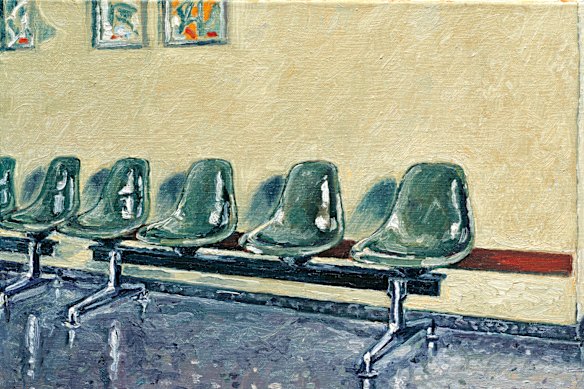
I instantly loved them. I loved their quiet pause. I loved their expectation and possibility. I loved their small interiorities in a country so defined by its looming landscape. I looked at the rows of them on the walls of the museum, and I looked at them again, and again. I was saddened there were no postcards or catalogue of the show that I could take home with me so I could keep looking at the rooms.
I thought I was in Berlin with a particular beloved when I saw those paintings, and I was surprised to learn when I later searched through my diaries that it was actually years later that I went to Berlin with a different person. That second person was someone I was with for a long time but whose presence in my life left little impression on me.

It is a shocking truth about getting older that you learn that longevity does not equate with impact. There is no balance or proportion to what changes you. Someone you are close to for a few weeks might leave a stronger mark than someone you are with for a decade. A work of art you encountered for a few minutes might captivate you for years.
All this is to say, I may as well have seen Wartsaal alone. I felt them as mine. I never told anyone about them. They were lodged in me, solitary and unshared. I was young and insecure, and did not want to risk someone cooler or more knowledgeable being dismissive of the pictures. I did not know if they were the right kind of thing to be captivated by.
But I kept thinking about them. Maybe I could write a series of short stories, starting in each room? I once wrote a poem about them, expressing the long sequence of their similar-but-different images as akin to a comic strip – a row of pictures of equal size – without a punchline. I occasionally looked them up online, but did not find any criticism or images.
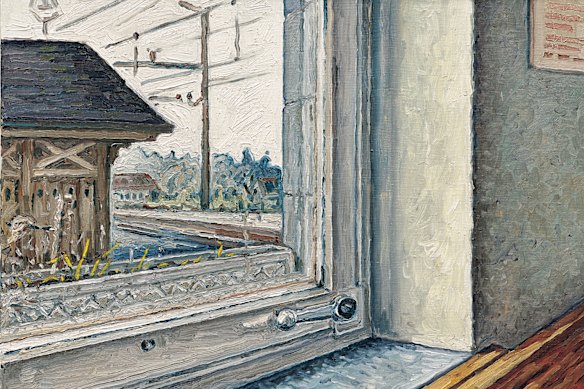
Recently, I was developing a novel idea with various characters who, I soon recognised, shared a connection with Switzerland. And I thought of those Swiss waiting room paintings again. When I researched them this time, I learned so much more and found excellent reproductions. They were not exactly as I remembered them – they were even more interesting, each one more uniquely itself – but I still loved them. And I hoped that they would be a part of my burgeoning novel.
In 2023, I was a grateful recipient of a three-week residency at the Fondation Jan Michalski in Switzerland, where I worked on my novel and wandered around the local trails. The Fondation is an extraordinary place – inspiring and beautiful, with the deeply uncompromised quality that comes from significant philanthropic vision. It is situated in Montricher, which also happens to be the final location of the 92 train station waiting rooms in Schnyder’s series of paintings.
The woman at the residency who took me to the station one day almost drove off the road when I told her about the coincidence. Montricher is a small village in the foothills of the Jura, with few attractions but a cheese factory and an exemplary literary institution that did not exist when Schnyder painted its train station in 1989.
I did not realise the connection until I was there, in situ, in that dreamy place in the north-west of Switzerland, trying to unfurl a novel. Sometimes, the universe gives you a small message that you are on the right track, that the odd things you’re interested in might actually coalesce into a legible whole.
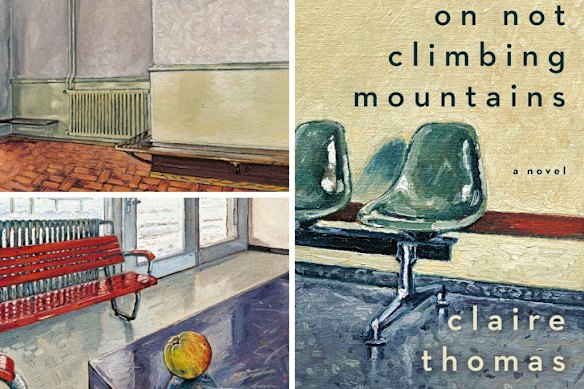
I finished my novel and sent it to my publisher. Various cover designs were considered, but none of them felt quite right. I was told that it’s often tricky and expensive to get permission to use an artwork on a book cover, but I thought I would try. I sent an email to Schnyder’s gallery in Zurich, which was forwarded to the private collector who owned the Wartsaal series. The response was unequivocally generous – yes, you can use the paintings! Here they are in hi-res! No fee required! One of the waiting room paintings is now on the cover of On Not Climbing Mountains.
My novel does not include, precisely, the ways in which I obsessed over those paintings. But it does include a character who saw them years ago, thought about them often, and who experiences a serendipity – different to mine – with the final location depicted in the series. It was very satisfying to be able to make Wartsaal work in On Not Climbing Mountains, to slot that particular fascination into my novel. It is the only thing an artist can do when they get the buzz from another work of art – reconfigure it, honour it (I hope) and let it resonate somehow in their own work. So that someone else, decades later, might also discover the thing they loved, and maybe love it too.
On Not Climbing Mountains is published by Hachette on February 24.