3 months ago
23
3 months ago
23
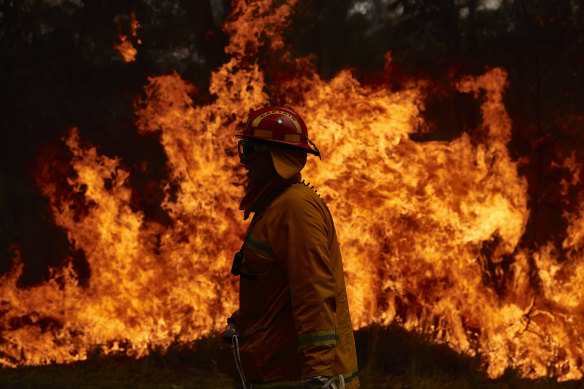
Generations of accepted wisdom tells us that hazard reduction burns – reducing undergrowth, or “fuel loads” through targeted burning – reduces the severity of bushfires. But an increasing number of scientists are casting doubt on the practice, arguing the climate has become too hot and the areas of risk too vast for safe and effective hazard reduction.
Before bushfires ignited into firestorms last week, scorching through more than 404,000 hectares of Victoria and counting, an alliance of farmers and firefighters issued a stark warning about a “critical lack of firefighting capability” across the state.

The Walwa bushfire in northeast Victoria grew from the Mount Lawson State Park last week.Credit: VicEmergency Hume
The groups, headed by United Firefighters Union secretary Peter Marshall, CFA Volunteers Group president John Houston and Across Victoria Alliance’s Andrew Weidemann (who plans to field One Nation candidates at the next election), wrote to Premier Jacinta Allan threatening legal action if any firefighters lost their lives in the looming fires.
Amid warnings of catastrophic fire conditions, the groups wrote: “Premier, collectively we place you on notice that we do not have the resources or equipment to confront such a scenario”.
“Firefighters, both career and volunteer, will again be asked to risk their lives to protect Victorian communities,” they wrote. “However, they will be doing so under conditions that your government has allowed to become dangerously unacceptable.”
Predictions of catastrophic conditions were realised when a raging fire north-west of Corryong grew so fierce it developed its own weather pattern: a pyrocumulonimbus cloud producing its own lightening and thunder.
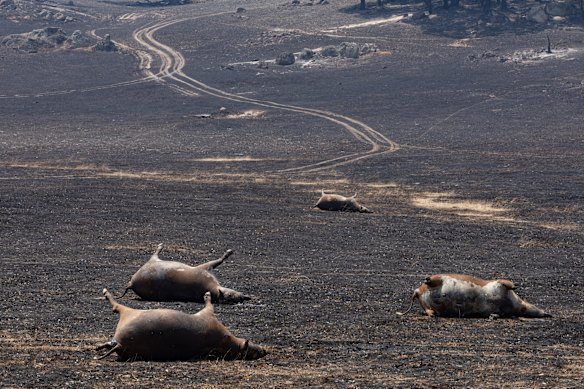
Cattle killed by bushfire near Terip Terip in central Victoria.Credit: Jason South
Climate change is making such clouds, first recorded in 1998, increasingly common. It is also making fighting the bushfires that produce them a far more vexed task.
Writing to the premier last week, the farming and firefighting groups identified ageing fleets and equipment – and the “alarming decline” in fuel-reduction burns across Victoria – as contributors to tinderbox conditions that would enable any spark to explode into raging fires.
Prescribed burns have been a feature of Australian firefighting since the 1950s, while First Nations groups have used targeted cultural burns for tens of thousands of years.
But the question of how the burns are conducted in modern Australia – particularly as climate change dries the continent and produces shorter periods in which burns can safely take place, as well as longer fire seasons and more ferocious and frequent fires – is one that is increasingly urgent.

A controlled burn near Bendigo in 2023.Credit: Jason South
Forest ecology expert Associate Professor Grant Wardell-Johnson said fuel reduction philosophies were scientifically outdated and “must be redressed as a matter of urgency”
“The policy and management around fire stems from the 1950s when prescribed burning was being developed [and] in the early ’60s in particular,” he said.
“And that was all fine, but we’ve had 2 degrees of global warming since then.”
When mainstream prescribed burning practices were developed, higher soil moisture levels and longer windows of mild conditions in autumn and spring made burns more feasible, he said.
“Now, with an extra 2 degrees, the window of opportunity is narrowed incredibly. And not only has the window narrowed for when you could conduct the burn safely, but also the time between mild or moderate conditions.”
Writing in The Conversation last month, research associate Philip Zylstra and Distinguished Professor David Lindenmayer argued that First Nations people conducted highly precise targeted burns in small areas, while leaving vast areas deliberately unburnt.
By contrast, they said, colonists burnt great swaths of the landscape to promote pasture for cattle and sheep – a practice recommended by the royal commission following the 1939 Black Friday bushfires.
Loading
Wardell-Johnson, Zylstra and Lindenmayer argue burning forests actually increases their flammability for many years, by stimulating fresh undergrowth, thinning the mid-story of growth (which allows fires to pass through more quickly), and drying the forest. They have concluded in multiple papers that this increased flammability lasts for decades.
“It’s deeply culturally ingrained for us,” Zylstra told this masthead.
“There is a perception that forests are dangerous unless we interfere with them, unless we take control somehow; whether it’s by burning them or logging them, or grazing them … and that is a cultural thing where we’re scared of the idea of something that’s genuinely wild.”
Of the more than 404,000 hectares of Victorian land burnt by 4.30pm on Wednesday in the latest fires, just over half is public land, including national parks and state forests. The rest was agricultural and private land.
The Department of Energy, Environment and Climate Action says Forest Fire Management Victoria conducted planned burns and other measures to reduce “fuel-driven bushfire risk” across more than 109,000 hectares of public land in 2024-25.
Chief Fire Officer Chris Hardman says planned burns are a key part of Victoria’s bushfire response.Credit: Getty
The department’s annual report says the autumn planned burning operation was delayed in some regions due to dry conditions in much of the state, particularly in western regions. Had it proceeded, it risked creating large bushfires.
For its part, Forestry Australia rejects Zylstra and Lindenmayer’s argument that forests should be left to age naturally, to increase moisture levels and create higher canopies that can better withstand strong winds.
“The notion that fire can be excluded from most Australian forests for more than 40 years is fanciful, given the increased frequency and extent of wildfires over the past 20 years under changing climatic conditions,” wrote Dr Tony Bartlett in an article reproduced by the organisation.
Chief Fire Officer Chris Hardman said crews had responded to more 350 bushfires since December 1, and controlled burns were a key part of Victoria’s response.
“We’ve kept more than 85 per cent of them under five hectares and the way we do that is through early detection of fires from our fire towers and reconnaissance flights, aggressive first attack by aircraft, rappel firefighters and ground crews to keep fires small.
“Planned burns over several years, our network of strategic fuel breaks and various response activities – including backburning – have also helped to reduce the impact of several of the recent large fires in Walwa, Longwood, Carlisle River, Kennedys Creek, Ravenswood, Wonnangatta and Mallacoota.”
Start the day with a summary of the day’s most important and interesting stories, analysis and insights. Sign up for our Morning Edition newsletter.
Most Viewed in National
Loading