3 months ago
18
3 months ago
18
A piece of red tape that has blocked electricians from working seamlessly across state borders for a century and driven up prices for their customers may finally come to an end.
State and federal treasurers on Friday will meet with an overhaul of the patchwork of electricians’ occupational licensing – the starting point for what proponents hope will be the start of a string of changes that let key workers to move easily around the nation’s worksites.
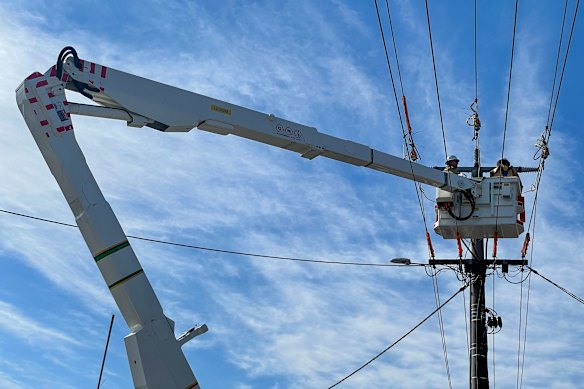
A single licence allowing electricians to work across state borders would help lift the nation’s productivity levels.Credit: Paul Rovere
Treasurer Jim Chalmers is heading the meeting that he has said will focus on federation reform, national competition policy and the government’s $900 million National Productivity Fund.
The fund provides incentive payments for the states and territories to take on policy reforms that are expected to boost productivity, which has flatlined nationally over the past decade.
State treasurers are expected to agree to make electricians’ licensing part of national competition policy, paving the way for payments out of the productivity fund that will cover the cost of aligning their various licensing regulations.
Loading
Soon after the election, Chalmers identified occupational licences – used by states to police a wide range of occupations – as a key area that needed to be streamlined. A Productivity Commission report this year found that if states recognised all electricians’ licences it would deliver benefits of between $51 million and $62 million a year.
Across all so-called “high-risk” occupations that require a licence, the annual benefit approaches $1 billion.
Ahead of Friday’s meeting, the Electrical Trades Union, the National Electrical and Communications Association and Master Electricians Australia have written to state and territory treasurers to urge them to finally put in place a single, national electricians’ licence.
ETU national secretary Michael Wright said substantial productivity gains could be unleashed for the economy if electricians and other trades were able to work across the country with a single licence.
At its 1921 national conference, the Electrical Trades Union passed a motion calling on the federal government to create a national licensing system for all electricians.
Wright said a high-quality national licence would enable electricians to seamlessly cross state borders to carry out necessary work.
He said while there appeared to be broad political support for the single licence, there was a fear state bureaucracies may put the issue on the backburner.
“There is a risk of it being slow-walked to death,” he said.
“We’re not trying to change anyone’s mind, but we do want to bump this up to the top of their email to make it a priority.
Loading
“This is a common-sense change that will boost productivity, safeguard quality, protect safety and start unlocking a projected $10 billion in gains for the nation. It’s about a century overdue.“
A single licence for electricians is expected to be used as a template for other sectors, starting with the nation’s patchwork of licences for engineers.
Demand for both occupations is growing, with figures released on Thursday showing a huge lift in work on data centres.
The Australian Bureau of Statistics reported that business capital expenditure on information media and technology equipment jumped by 91.5 per cent in the three months to September to a record $2.8 billion.
The sector is dominated by the rollout of data centres. Over the past year, capital spending has jumped by 147 per cent with the sector now the third largest for investment, eclipsing manufacturing for the first time and only behind mining and transport.
The large lift in spending helped push up overall capital spending to almost $49 billion, the stronger quarterly result in a decade. It is expected to help push up the September quarter GDP result that will be released next week.
Chalmers said the stronger-than-expected lift in business investment was a positive sign for the economy.
“These figures show not only is investment in priority areas like data centres and cleaner and cheaper energy growing, it’s growing even faster than anticipated,” he said.
“This investment will help make our economy stronger, more resilient and more productive over time.”
Cut through the noise of federal politics with news, views and expert analysis. Subscribers can sign up to our weekly Inside Politics newsletter.
Most Viewed in Politics
Loading