2 months ago
15
2 months ago
15
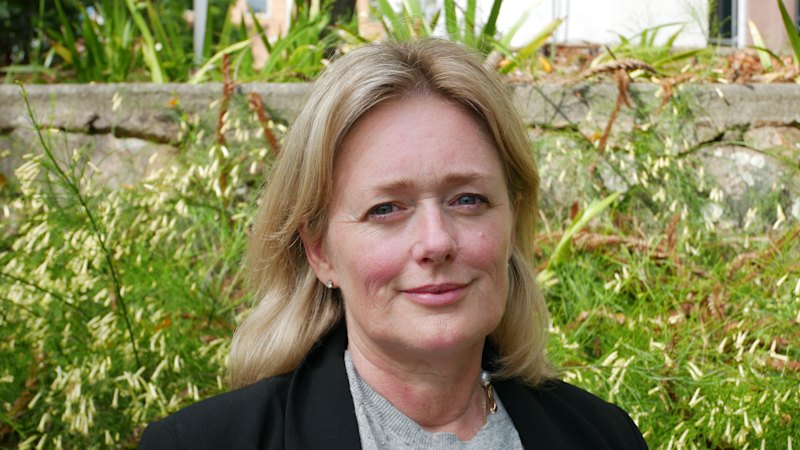
Chantelle Geissler has shot 800 feral cats since moving to Kangaroo Island five years ago, which she admits is quite a lot for someone who doesn’t eat meat.
As part of her job with the island’s cat eradication program, Geissler is alerted when there is an animal in one of 750 traps throughout the eastern end of the island.
Native animals are released. Pet cats are taken home. Feral cats are dispatched as quickly and painlessly as possible.
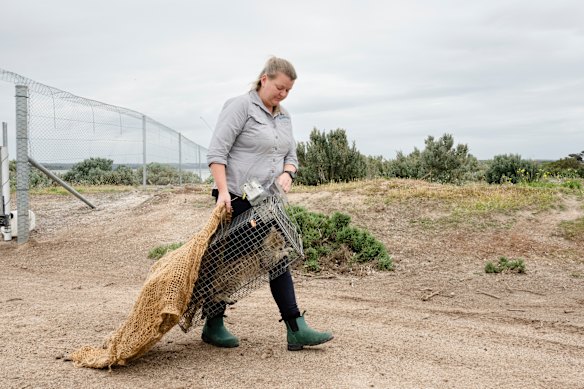
Chantelle Geissler with a cat that was caught in one of the many traps as part of the Feral Cat Eradication Program on Kangaroo Island.Credit: Janie Barrett
As the cat hisses and bristles, Geissler calmly points her rifle through the cage and expertly shoots it in the head. Then she dissects it on the back of the work ute to see what it has been eating.
It is grisly work for the 32-year-old former Sydneysider, but essential.
“It’s definitely confronting and definitely not glamorous but, as a team, we all understand the damage the cats do … so I try to focus on the lives I am saving rather than the one I am taking,” says Geissler.
“When you open them up and look inside their stomachs and see a native species – for me it’s the beautiful, iconic blue feathers of superb fairy wrens – it really hits home and makes you understand why you do what you do.”
Her colleague at the Kangaroo Island Landscape Board, Josh Mulvaney, says removing feral cats is one of the best things an animal lover can do.
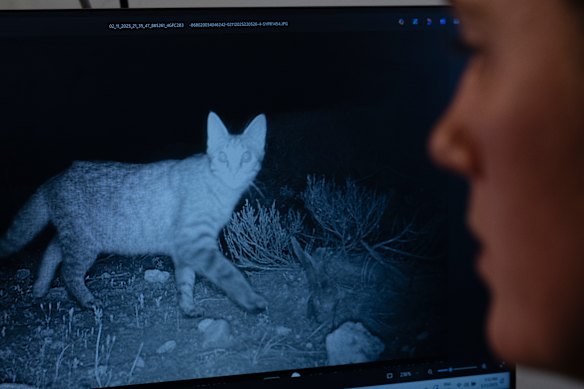
Anais Bond, field officer for the feral cat eradication program on Kangaroo Island, looks at an image of a feral cat captured by a 4G camera.Credit: Janie Barrett
“Our beautiful native species don’t want you to come and cuddle them and hold them, they want you to remove a threat,” Mulvaney says.
Their efforts on Kangaroo Island are part of a broader strategy of eradicating feral animals as a core plank of island conservation efforts around Australia and the world.
Kangaroo Island, off the South Australian coast, is Australia’s third biggest after Tasmania and the Northern Territory’s Melville Island. It was declared free of feral goats and deer several years ago. After the 2019-20 bushfires, there was aerial shooting to wipe out feral pigs as well.
Now feral cats are in the crosshairs, both because of their devastating effect on native wildlife on the island, and also because of the economic and social cost of the diseases they spread to sheep.
The landscape board, a branch of the South Australian government, has erected an electric cat fence at the narrowest point of the island, isolating the Dudley Peninsula, and has systematically removed 1700 cats from it since 2020.
The goal is to eradicate the pests from the peninsula; the dream is to tackle the whole island. They are down to the last 150 cats in the enclosed area, but the easy wins are gone.
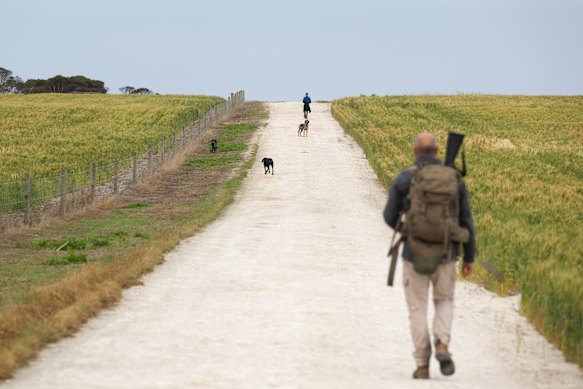
Teams of dogs track cats, which are then shot.Credit: Janie Barrett
Islands of possibility
Islands are precious but also vulnerable because of their high concentration of unique biodiversity. In less than 0.5 per cent of Australia’s landmass, islands contain more than 11.5 per cent of species listed as nationally threatened under federal environmental laws. Globally, most species extinctions have occurred on islands.
Yet they also have an advantage over mainlands, as Invasive Species Council chief executive Jack Gough explains.
“When it comes to island eradication, you’ve got this incredible opportunity to deal with a legacy of pest animals and also weeds in a confined environment,” Gough says.
“When we put the effort in to eradicate these things, the eradication is done. There’s a great big body of water around them, which means that you don’t have the potential for catastrophic failure like you do on the mainland.”
Gough says there is “example after example of the wildlife revival that takes place” after the removal of feral animals from an island.
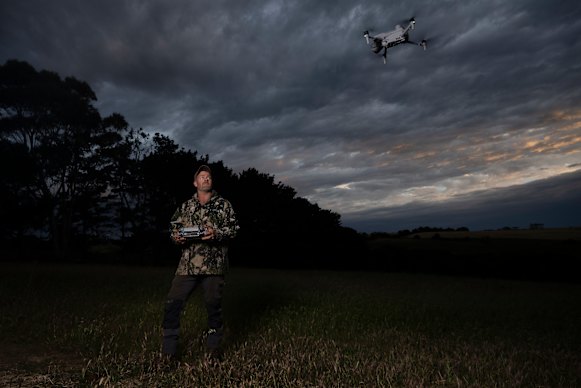
Brenny Florance, a feral animal control officer, uses a drone and thermal technology to detect feral cats.Credit: Janie Barrett
Australian examples are plentiful. Take the removal of rats and mice (and earlier pigs, goats and cats) from Lord Howe Island, which has allowed the endangered native woodhens to flourish and the successful reintroduction of endemic species such as native snails. Or the boon for nesting seabirds after the removal of rabbits, rats and mice from Macquarie Island in the Southern Ocean.
Australia is a world leader in feral eradications on islands, the Invasive Species Council says. Over 220 eradications of invasive vertebrates have been undertaken on Australian islands. At least 170 Australian islands have had invasive vertebrates successfully eradicated, and 96 islands have had two or more invasive vertebrate species successfully eradicated.
Our close neighbour New Zealand is also thinking big. The Predator Free 2050 movement, led by the Department of Conservation, aims to rid the island nation of key introduced predators – mustelids (stoats, weasels and ferrets), rats and possums – by 2050.
New Zealand has no native land mammals besides bats, and introduced predators kill about 25 million native birds each year. Some 4000 native species are threatened or at risk of extinction, the department says.
Saving the Galapagos
From Guam to the Galapagos, the islands of the vast Pacific Ocean are leading the global movement to conserve island ecology by removing invasive species. There are projects all over the world, but the Pacific is a nexus because of geography and history.
From as early as the 1600s, European explorers had a strategy to drop breeding pairs of livestock – goats, pigs and other animals – on islands to ensure a future food supply.
We know from his journals and ship logbooks that Captain James Cook, for example, was responsible for introducing goats and other livestock everywhere from New Zealand to Hawaii.
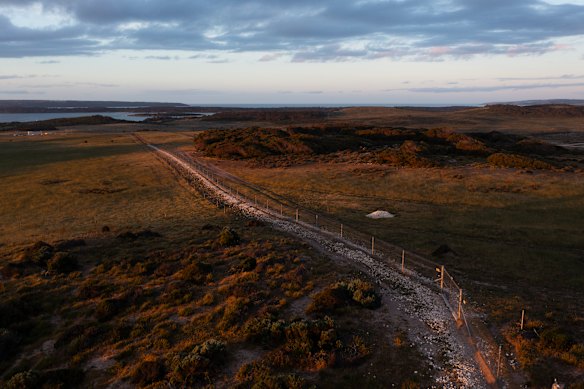
The catproof electric fence that separates Dudley Peninsula from the west on Kangaroo Island.Credit: Janie Barrett
This practice ravaged island ecosystems – goats are particularly bad because they are notorious for overgrazing, their hard hooves damage soil, and a population of feral goats can double every year-and-a-half.
One of the earliest successful island conservation programs was the project to remove goats from the Galapagos Islands in Ecuador.
Pirates, whalers and fisherman started to leave goats in the archipelago from the 1800s. Goats were eventually released onto 13 islands, and they were already present in low numbers when Charles Darwin visited in 1835.
By the late 20th century, goats had overrun the Galapagos. This was most devastating in the northern part of Isabela Island, where the rim of Alcedo Volcano was a vital gathering place for giant tortoises. The area was covered in dense rainforest dotted with shaded pools fed by thick mists from the volcano.
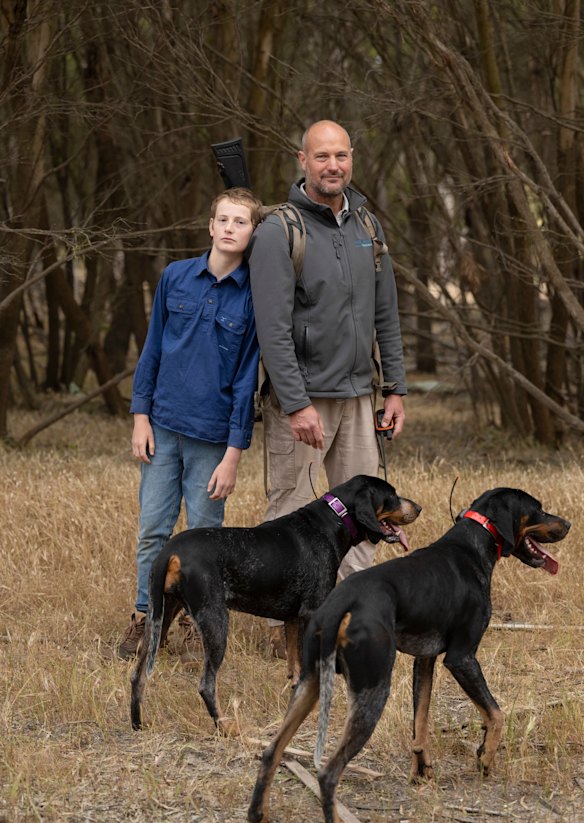
Paul Jennings, his son Finn, and his bluetick coonhounds, who have been trained to track cat scent on Kangaroo Island. Credit: Janie Barrett
After a century in southern Isabela Island, goats managed to cross the hostile terrain of the Perry Isthmus – 12 kilometres of rough lava – into the northern part of the island in the 1970s.
Finding that the grass really was greener on the other side, the population of goats exploded, massively degrading the ecosystem. By the early 1990s, they had destroyed the forest, eliminating the shade and water supply needed by the giant tortoises and other animals.
Enter Project Isabela, an ambitious project that ran from 1997 to 2006 to eradicate goats, pigs and donkeys from the Galapagos Islands.
A team of park rangers started hunting goats on Pinta Island. On the bigger Santiago Island, they had multiple teams sweeping segments of the island daily, and supplementing the hunting with aerial shooting from helicopters. A 2011 peer-reviewed article in PLOS One states that 79,579 goats were removed from Santiago over 4.5 years for a cost of $US6.1 million. The last 1000 goats took a year and a half at a cost of $US2 million.
Goat hunting began on northern Isabela in 2004, using both ground and aerial shooting, but also “Judas goats”, a technique that exploits goats’ social nature. The hunters would capture a goat, sterilise it, and fit it with a radio collar with GIS tracking before releasing it. The goat would seek out the group and inadvertently lead the hunters there. This proved very successful – a total of 62,818 goats were removed over two years for a cost of $US4.1 million.
The same techniques were then used on three uninhabited islands: Floreana, San Cristobal and Santa Cruz, while efforts continued in southern Isabela.
The Galapagos Conservancy describes how the vegetation recovered as goat populations declined. Small trees began regenerating from the stumps and many rare species of plants and birds became abundant.
Nature recovers
In 1994 two graduate students from the University of California Santa Cruz, Don Croll and Bernie Tershy, were studying seabirds on Mexico’s islands. They saw the damage caused by invasive rats and the recovery once removed.
They used it as a blueprint and founded Island Conservation, which today is involved in dozens of projects, including removing goats from the Robinson Crusoe Islands in Chile to give the critically endangered firecrown hummingbird a chance of survival.
A recent effort to remove of pigs, rats and monitor lizards from Loosiep Island in the Federated States of Micronesia has increased the survival rate of endangered green turtles, and allowed the inhabitants to grow food such as bananas, sweet potatoes, okra, and breadfruit.
The group’s chief conservation officer, Cameron Diver, says as well as feral eradication, island conservation also involves restoring habitats and reintroducing locally extinct species, also known as “rewilding”.
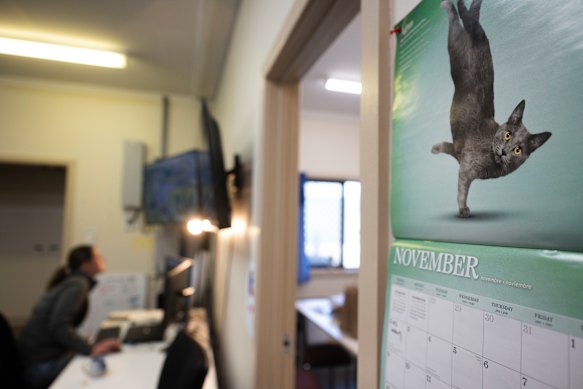
The office of the feral cat eradication program on Kangaroo Island.Credit: Janie Barrett
Sometimes species come back spontaneously. In 2024, feral pigs and rats were removed from the uninhabited island of Kelefesia in Tonga. Soon ground-nesting birds returned, including herald petrels never before been recorded there.
Rat control in the Galapagos led to the re-emergence of the Rabida leaf-toed gecko, a species only known from the fossil record.
Hawadax Island in Alaska, once dubbed Rat Island, is once again flourishing as a nesting ground for seabirds, including the tufted puffin, which had not been seen there for two centuries.
“What you’re seeing there is a direct and immediate correlation between control of invasive species, regeneration of natural habitat, and the capacity of the natural world to survive and to thrive,” Diver says.
Island Conservation has found impacts on the ocean itself too. Around restored islands, coral reefs grow three to four times faster, are two times more resilient to bleaching events, and have 15 per cent more fish biomass on reefs.
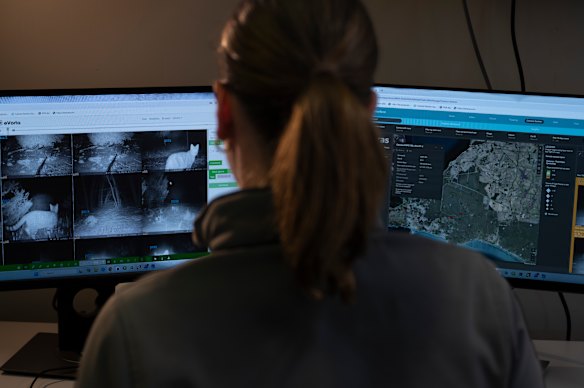
Anais Bond, field officer for the feral cat eradication program.Credit: Janie Barrett
Dogs and drones
On Kangaroo Island, the landscape board has embraced technology. The 750 traps are part of a network with 280 4G cameras, with cloud-based AI-enabled software analysing the 35,000 images taken every night. Program manager Paul Jennings says this replaced the need for all footage and traps to be checked manually, allowing an expansion in the number of traps and cameras.
A legal change has also enabled the landscape board to set traps within one kilometre of a residence with landholder permission. Before that more than half of Dudley Peninsula was off limits
Other methods in use include “felixers”, which can detect the presence of a cat and spray a toxic gel that the cat will ingest when grooming.
Jennings works with a team of dogs to track cats. The bluetick coonhounds are fitted with GPS collars, so Jennings can track their location through a handheld device, and play sounds to recall them.
Loading
The dogs work as a team. If they find a hot scent, they vocalise to alert each other and collectively back the cat into a tree where Jennings can shoot it with his rifle.
Night hunter Brenny Florance uses a thermal drone to spot cats prowling at night. A veteran of previous Kangaroo Island eradications, Florance has learned to exploit animals’ weaknesses. With goats, it was the Judas goats as used in the Galapagos. With deer, it was hunting on foot and outsmarting the animals.
“Cats don’t have much of a weakness – they’re a pain in the arse, but curiosity does kill the cat,” Florance says.
“I use Bluetooth speakers and play audio lures such as distress calls of birds, mice, rabbits, and scent lures to try and draw them out. I’ll also use devices that move around on the ground electronically so it looks like a mouse or a snake in the grass.”
A sixth-generation islander, Florance says support for cat eradication is extremely high, whereas recreational hunters opposed the deer eradication.
Sheep farmer Jayne Bates, the former mayor, believes there is 100 per cent support in the community. Her biggest fear is that the funding will run out before the landscape board can finish the job, allowing the cats to replenish.
“If that happens, it will all have been wasted and you may as well have burnt the money,” Bates says.
Bates has not seen a cat at her place in two years and has noticed the return of birds and geckos.
At the Penneshaw Penguin Centre, owner Renee Daniell has seen a huge increase in the number of little penguin chicks fledging from her local colony every season – from 22 in 2019-20 to 82 in 2024-25.
In total, Jennings says the cats prey on 50 native species on Kangaroo Island, including the island’s own sub-species of echidnas and endangered southern brown bandicoots.
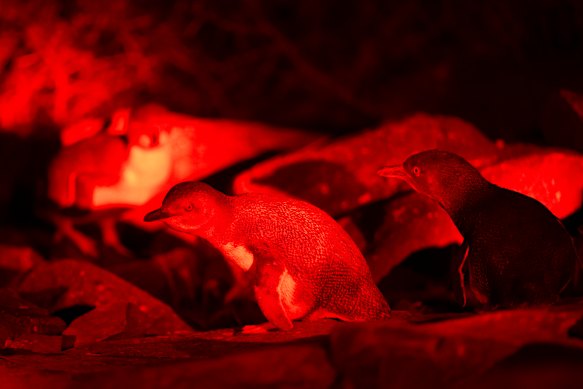
The little penguin colony in Penneshaw has increased since the start of the feral cat eradication program.Credit: Janie Barrett
Kangaroo Island is one of 20 priority places recognised in the government’s threatened species plan, and the federal government has provided $3.1 million to the Dudley Peninsula cat eradication program since 2023.
In a feasibility study last year, the landscape board estimated it would need $1.9 million in further funding to achieve a 95 per cent knockdown or $6.2 million to eradicate the cats fully from the peninsula.
“If it becomes a multiyear program, it will end up costing more,” Jennings warns. “The other worry is that the social licence might wane.”
The hoped-for funding failed to materialise before winter, the season when the trapping is most effective because of the scarcity of food, and the landscape board has spent most of this year maintaining gains rather than making further progress. This week brought a much-needed lifeline – the Albanese government says it will provide another $1.61 million through the threatened species commissioner.
Loading
The support sits alongside programs to eradicate cats, rats and pigs and other invasive pests on six other islands, the government says.
The Invasive Species Council has proposed the government set aside $400 million over 10 years for a national island eradication fund.
“This is the best bang for buck conservation interventions that we can make, and at the moment, it’s pretty ad hoc and underfunded compared to the scale of opportunity,” Gough says.
The Invasive Species Council and Kangaroo Island Landscapes Board contributed to the costs of the mastheads’ travel to South Australia.
Get to the heart of what’s happening with climate change and the environment. Sign up for our fortnightly Environment newsletter.