3 months ago
39
3 months ago
39
On paper, Insight should be the Jerry Springer of Australian television. Divisive topics – death, divorce, racism, menopause, guilt, sex and more – are covered, family secrets are revealed and unpopular and controversial opinions are shared. Heck, they even had a guest last year whose wild story about a crocodile attack went viral.
But instead of chairs being thrown, as was popular on the US chat show whenever anyone disagreed about something, on Insight, everyone just nods their head and does the most radical thing of all: they listen.
“You can actually ask questions that are uncomfortable, and that’s OK,” says Kumi Taguchi, who has hosted the show for the past five of its 30 years. “You’re not a bad person.”

Taguchi is talking the day after she recorded an episode titled Death of Debate? It’s particularly timely given that Sydney was rocked just days earlier by protests against Israeli President Isaac Herzog’s visit. And this was just after Adelaide Writers’ Week organisers cancelled their festival after authors vowed to boycott it when the festival cancelled a talk by Palestinian-Australian academic Dr Randa Abdel-Fattah.
The temperature has been hot, to say the least. But in this age of outrage, Insight has quietly carved a path through the noise. It debates topics that annoy the left, right and the middle, which is remarkable given how discourse has become so polarised.
How do they do it? And without any chairs being thrown? Trust, is the short answer.
“Everyone in the room has a real motivation for being there,” says Taguchi. “They understand why they’re there, and they understand what we’re doing. Nothing’s hidden, there’s no kind of, ‘Let’s ask that person that question, and there’ll be a bit of tension and controversy’.
“We want every guest to come out of that room feeling that they were looked after, they were valued, they weren’t blindsided by anything.
“The secret sauce, I really think, is the trust in that brand of Insight and what we do, but also the amount of work the producers do with the talent leading up [to each show]. There’s nothing that’s not discussed. Every person can say, ‘Look, I don’t want to talk about that bit, but I do want to talk about that.’ We will help them talk about difficult things.”
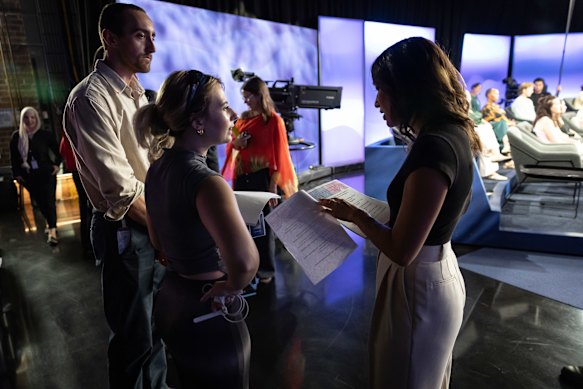
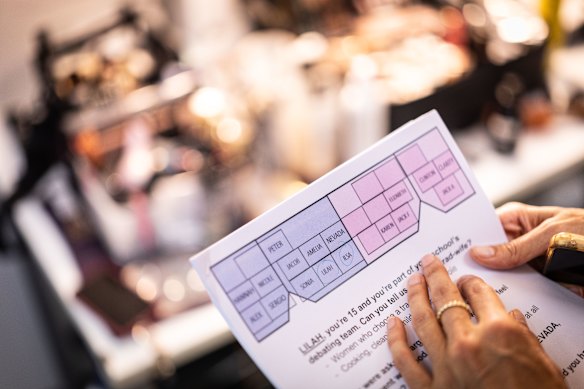
For the Death of Debate? episode, the idea evolved out of a news story from South Australia, where a year 9 debating competition became embroiled in controversy when it asked students to debate the merits of being a “trad-wife”.
“The trad-wife topic is a bit controversial at the moment, right?” says Ross Scheepers, who has been executive producer on the show since late 2018. “We workshopped doing an entire show on trad-wives, but it’s incredibly difficult to find trad-wives in Australia to come on and talk because there’s a lot of backlash around people who promote themselves as living that lifestyle. So we actually weren’t able to find a cast to do the show.
“But when I heard about the backlash against the topic that the schoolgirls [debating team] faced, I just thought with online outrage, it’s become incredibly difficult to do things that push boundaries or make people think outside of the box.”
Connor Webster, producer on Death of Debate?, said: “It’s something topical, that the really quick, 24-hour news cycle can’t cover. It’s something that we can delve into for six weeks and get to the core of what Australia thinks, like a bit of a Petri dish of the Australian psyche.”
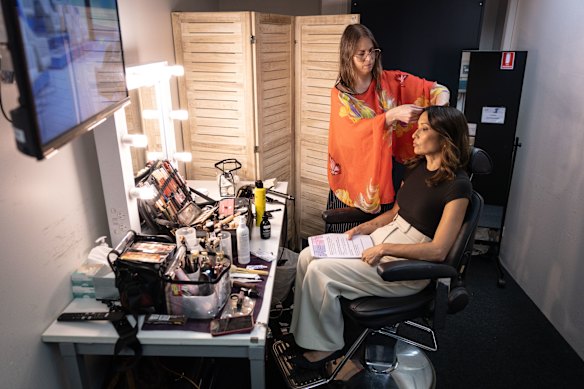
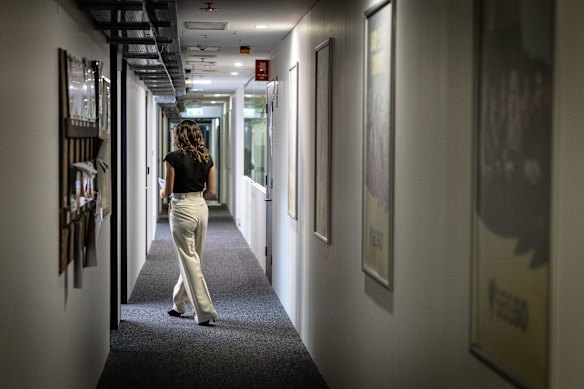
Once a topic is settled on, each episode takes about six weeks to put together. Producers raid their contact books, scour news stories and social media groups for people who might be interested in taking part.
“We do Facebook-specific shout-outs,” says Webster. “We’ll post a question, and that can get a little bit wild, but we use a whole bunch of different online methods. There’s casting agent groups and there’s Reddit. There’s no stone unturned, really, in terms of finding the people who think like our audience is going to think, and will share their views, that people are going to go, ‘I do that.’”
For the Death of Debate?, the wide range of guests include the year 9 debating team who had to argue the trad-wife topic, aspiring Labor politician Jack Ayoub, who was attacked last year after writing an opinion piece in The Australian that was headlined “Gay men have little in common with the trans movement”, philosopher Nicole Vincent, who was accused of being a “TERF” over a lecture she delivered at Melbourne University in 2019; and artist Sergio Redegalli, who infamously painted a “ban the burqa” mural in Sydney’s inner west in 2010.

Also in the audience is a woman, with the support of her adult son, happily narking on her husband for not sharing her political views. “He watches Fox News,” she says. (That woman, says Webster, was found in a northern beaches mums group on Facebook. “These people come back and say, ‘I’ll talk about my husband on television’,” he says, laughing.)
On any other show, that combination and variety of guests would be a febrile mix, but because each guest has been thoroughly prepped before going on air, the producers – and Taguchi – generally have a good idea of what the guests answers will be.
“That speaks to the trust that we build with these people in our six weeks [of prep],” says Webster. “That’s the beauty of that cycle – we get the opportunity to have several conversations, to get to know these people, so that by the time they’re actually coming to the studio, I say things like, ‘I’m actually going to get to see you in person now’, which is very strange. We’ve had a phone or online relationship for more than a month.
“We’re very transparent about how they’re going to be presented and the questions they’re going to be facing. So they know they’re just sharing their story and they’re doing it in a moderated, respectful environment where ideas can be thrown around.”
About 10 to 15 guests appear on each episode, with producers having sometimes spoken up to 75 people to find the right person who is happy to share their story, which can sometimes be quite traumatic. It’s one thing to tell a producer over the phone, quite another to do it under lights in a studio with five cameras moving around.
“Sometimes we might get to a point where they’re just not comfortable sharing a certain amount, and then there wouldn’t be space for them on the show,” says Scheepers. “Because we’d want them to talk about that. It’s just that rapport, that genuineness, that level of trust.”

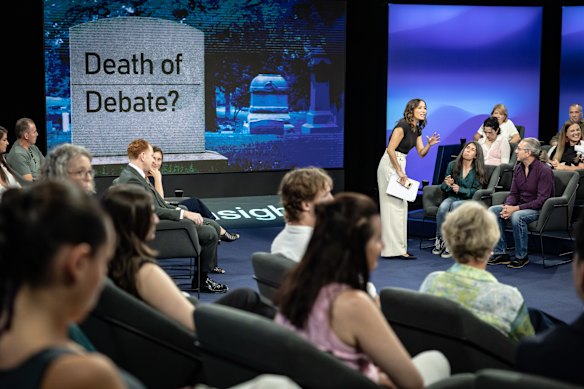
Once the guests are locked in, they arrive at SBS’s studios in Artarmon in Sydney’s inner north for a Wednesday night record. Each episode takes up to 80 minutes to shoot, and content is edited to about 52 minutes for broadcast.
On the evening I visit, Taguchi is running through the choreography of the show – practising her line delivery and positioning to basically make sure the flow of movement between each guest is seamless. “It’s a big turn,” says one of the camera operators, so Taguchi changes her footing.
Thought is also put into where each guest sits – sometimes to create connection, sometimes to maximise tension.
“I feel like there’s me, as the host, there’s all these guests, and there’s the topic. But there’s a magic that happens with the studio,” says Taguchi. “The way in which we place everyone around the room, I want that to then create this extra personality. So, let’s say the topic is, ‘Been trying to have children forever and can’t’. So you’ve got a couple sitting opposite another couple who have been through similar things, that way they look at each other and go, ‘You get me’.”
As the guests come in for the record, Taguchi says hello. One woman is nervous, not sure that she will speak, so Taguchi checks in with her before – and during – the recording, asking if she feels comfortable to go ahead.
Even though she has been involved in the preparation of each episode, Taguchi is sometimes surprised by what unfolds when the cameras start rolling. Again, there is no chair-throwing, just a polite level of conversation that you wouldn’t find on social media, in parliament or at your weird uncle’s house. What is the trick?
“There’s something about that space where you have to be holding your own views accountable in front of other people that’s much more difficult,” says Taguchi. “It’s so hard to do, and it takes a different level of courage, I think, and a really lovely level of maturity to do that.”
Guests are also challenged about their opinions.
“We want people to come in and be faced with their own ideas and to have to defend them a little bit,” says Scheepers. “So even if someone does believe one thing, or the few people who do, they’ll often be asked, ‘You have to consider the other sides of this as well’. We’re not just providing a speaking platform for someone to come and just express. Often they’re asked, ’Could that be contradictory? Or do you think twice about something.”
I won’t give away any spoilers, but it’s safe to say that the Death of Debate? episode ends with polite disagreement, and, yes, no chair-throwing.
“At the end of it, I love when I walk out and leave, and I walk upstairs, I can look down into the lobby area where all the guests gather, and I love it when I see them chatting to each other,” says Taguchi. “Because I think, ‘there’s been some connection made between guests’. There’s a sense of not being alone in this thing that we’re trying to eke out.”
Insight returns at 8.30pm on Tuesday, March, on SBS and SBS On Demand. “Death of Debate?” airs on March 10.
Find out the next TV, streaming series and movies to add to your must-sees. Get The Watchlist delivered every Thursday.