3 months ago
22
3 months ago
22
This time last year, Tom Fancutt lost what had been the one certainty in his life.
The 30-year-old had just walked off court 14 at Melbourne Park after playing his maiden Australian Open match. It was virtually the fulfilment of a destiny for Fancutt, who became the sixth member of his family to compete in a tennis grand slam – two grandparents, two uncles and his father all enjoyed successful professional careers and his grandfather, Trevor Fancutt, won the Australian Open mixed doubles title in 1960.
A large contingent of friends and family flew from Queensland to Melbourne to support him in reaching the milestone.
The experience was only slightly dampened by the fact Fancutt and his doubles partner, Blake Ellis, failed to make it past the first round. Just being there, having been given a wildcard entry into the tournament, was satisfaction enough.
“To call my coach, my mum, my sister and my best mates and tell them I’m actually playing the Australian Open was amazing. My core people, they all flew down,” he said. “It was a really happy time for me.”
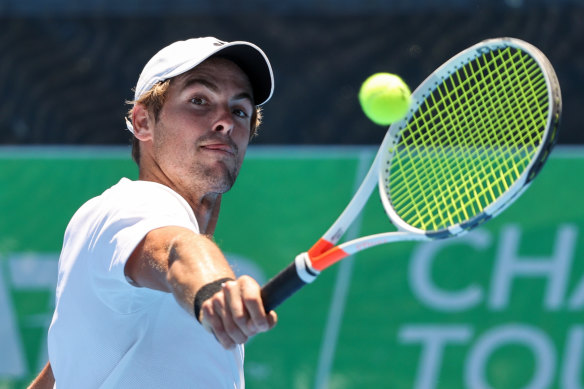
Tom Fancutt in action at a tournament in Bendigo in 2022.Credit: Getty Images
It remains Fancutt’s first and only Australian Open match. Afterwards, he was taken aside by International Tennis Integrity Agency officials and told he was the subject of an investigation into a possible anti-doping rule breach. The officials took his phone and told him they would interview him later that day, while refusing to tell him the nature of the breach.
“They said they needed to speak to me, and I was so confused. I thought it must be for someone else’s investigation, and then they made it pretty clear that it was me,” he said.
A devastated Fancutt was left to walk back to his family alone through the tunnels beneath Melbourne Park.
“I was so embarrassed walking through the locker room to go to my locker. I’m walking in the same area, walking past Alcaraz, Djokovic, Zverev, Sinner, all those guys,” he said. “It’s crazy how the Australian Open was the happiest place for me, and then it was the last place I wanted to be.”
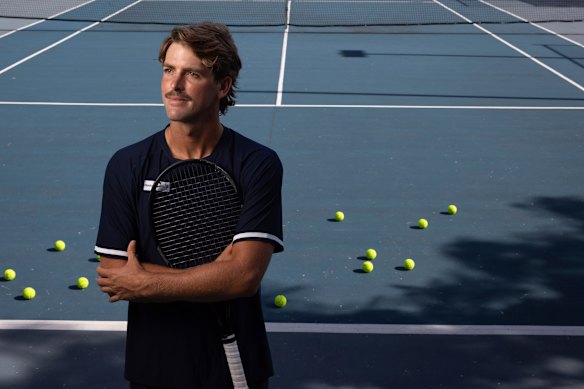
Fancutt was intercepted at the 2025 Australian Open and taken to anti-doping control. Credit: Paul Harris
When Fancutt eventually caught up with his family, he no longer felt as though he had anything to celebrate.
“We were just trying to figure out what could I have possibly done. Because I’ve always been a clean athlete,” he said. “I was trying to think about it and the only thing I could think of that wasn’t part of my normal was that I went and got an IV [intravenous therapy].”
In December 2024, Fancutt posted a photo to his Instagram account showing him receiving an intravenous infusion of vitamins B, C and magnesium. None of the ingredients in the IV, which Fancutt was told would help with fatigue, were prohibited. However, unbeknown to Fancutt at the time, players cannot receive more than 100ml of any substance by IV in any 12-hour period, except under specific permitted circumstances.
“I honestly didn’t think anything of it. I had like one good sleep from the IV,” he said.
After a wait of several hours with his family after the match, Fancutt was finally called to participate in an official interview with agency officials. By the end of it, one of them issued a warning.
Loading
“Her last words were, ‘If I was you, I’d get a lawyer, because you’re going to get suspended’.”
Fancutt did get a lawyer through the players’ association, but wasn’t suspended straight away. The investigation would drag on for months; the ban even longer. All the while, his name would be written beside a word he’d grown to hate: doping.
‘It’s an awful feeling’
Agency officials took notes during the interview to build their case against Fancutt. They recorded his immediate confirmation that he had received the IV treatment, that he’d told the clinic he was an athlete and subject to anti-doping rules, and how he’d even checked with his coach about the legality of IV treatments.
The officials found credible Fancutt’s insistence he had not known he was breaking any rules and accepted the violation was a one-off. They also accepted that Fancutt had likely received the IV for a “purpose other than the enhancement of sport performance.”
At first, the agency offered Fancutt a two-year ban, consistent with guidelines they provide for suspensions to athletes who unintentionally violate anti-doping rules. For intentional violations, athletes serve a four-year suspension.
“Obviously, I said, ‘Absolutely not’, Fancutt said. “Then the lawyers went back and forth on what’s fair, and they ended up settling on 10 months, but they didn’t count the two months of messing around, so it’s basically a full year. It was better than two years … There’s no chance I’m coming back from two years.
“I definitely kind of stewed over it and looked at that number before I agreed to it.”
Fancutt accepted the ban and a fine for the prizemoney he’d earned after receiving the IV, totalling more than $25,000.
For the first time since he could walk, Fancutt was forced to stop playing tennis. Having grown up in a family of players, there are baby photos of him holding a racquet as big as his body. At 12, he moved to live at his family’s tennis centre so he could spend more time training.
“I hate that forever I’m going to have this paint on me that I was done for doping,” he said. “It’s an awful feeling for me personally but what really hurt me was the thought that I embarrassed the family name.”
‘Is this really happening?’
News of Fancutt’s ban was made public in March 2025, but the agency’s findings – including that he had violated the rules unintentionally and for a purpose other than sports performance – wouldn’t be confirmed until August, when their decision was published.
“I had people messaging me saying that I was an embarrassment to Australia, that I was an embarrassment to tennis, and I was an embarrassment to the Fancutt family. That really cut me,” he said.
The backlash came fast and didn’t differentiate between doping – which Fancutt was not accused of – and breaking an anti-doping rule.
“It was probably the lowest, the biggest mental health struggles I’ve ever had to experience in my life. You’re just embarrassed. I’d be in and out of, ‘Is this really happening?’”
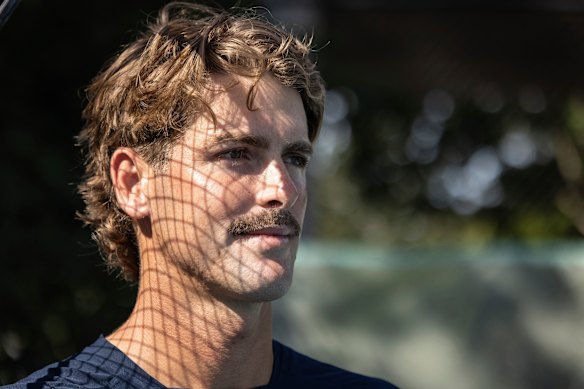
Tom Fancutt is aiming to return to the Australian Open next year.Credit: Paul Harris
Unable to play at tennis centres or any events – even a game of pickleball – Fancutt turned to coaching, which he also had to clear with the agency. All the while, he was conscripted to the World Anti-Doping Agency’s Whereabouts program, under which athletes have to provide their location details every single day so they can be randomly drug-tested. Fancutt was tested just once in the entire 10 months of his ban.
At the six-month mark, Fancutt began planning his return. He used ChatGPT to create a training schedule and began talking to coaches again. He bought a journal, committed himself to the gym and is documenting his return on social media.
“I have nothing to hide,” he said. “Maybe people will get to know me more and change their opinion on me. They might just have an opinion that I’m just that Australian tennis player who got done for doping, and maybe [I can] change a few people’s minds.
“I just started really doing the documentation of my comeback and the support has been so overwhelmingly nice.”
If there’s a silver lining, it’s the renewed motivation Fancutt has discovered for a sport he always assumed would be his to leave and not his to lose.
“There’s the biggest fire in my stomach,” he said. “It’s hard to explain. I’ve always had a drive to be good, for sure, for me and my family and everything, but right now I’ve got this real hunger to compete and really show everyone what I can do. Because I know I can be world-class.”
On January 18, Fancutt’s suspension was lifted. The same day, he entered the Tweed Heads Open on a wildcard and won the tournament without dropping a single game.
“I was like, ‘I don’t care who I play. I don’t care if the guy’s 80 years old or the kid’s 15. I just want to play tennis’.”
Fancutt is determined to get back to where he was before the ban, and to top his career high singles ranking of 382 and doubles ranking of 107. But above all, he wants to return to the Australian Open.
“I want to play the Australian Open next year,” he said. “Singles, doubles, mixed, whatever. I want to be back there, and I want to be walking there with my chest high and erase that feeling of the last time I was at Melbourne Park.”